
How Do You Choose a Reliable High Powered Flashlight Supplier?
A reliable high powered flashlight supplier should provide more than impressive lumen claims and competitive wholesale quotations. For professional B2B buyers, the real value lies in delivering consistent beam performance, controlled heat generation, dependable battery systems, documented quality standards, and repeatable production across multiple orders.
The best supplier is not necessarily the one advertising the brightest flashlight. It is the one capable of matching measurable lighting performance to your application while maintaining product consistency at a commercially viable cost.
For importers, distributors, private-label brands, outdoor equipment suppliers, security companies, and industrial procurement teams, selecting a supplier involves several critical decisions:
-
Does the flashlight provide sufficient usable beam distance?
-
Can it maintain useful brightness after thermal regulation begins?
-
Is the battery suitable for the intended operating duration?
-
Are optical, electrical, and mechanical components consistent?
-
Can the supplier support OEM branding and product customization?
-
Are sample specifications representative of mass production?
-
What testing evidence supports performance claims?
-
How are defective products and component substitutions controlled?
-
Can the factory maintain stable supply for repeat orders?
-
Does the total landed cost support your target market?
These questions matter because high-output flashlights are integrated electronic products. Their performance depends on how effectively the LED, driver, battery, optics, housing, and thermal system work together.
A powerful flashlight that performs impressively for a few seconds may be unsuitable for industrial maintenance or security patrols requiring extended illumination.
Similarly, a product that looks professional in a showroom may create substantial commercial risk if the production batch uses different batteries, drivers, or optical components.
This guide provides a practical sourcing framework for evaluating high-intensity flashlights, comparing suppliers, approving samples, controlling production quality, and preparing RFQs that lead to more accurate quotations.
What Is a High Powered Flashlight?
A high powered flashlight is a portable lighting product designed to deliver substantial light output, concentrated beam intensity, extended beam reach, or a combination of these characteristics.
However, there is no single universal lumen threshold that automatically defines a flashlight as high powered.
Suppliers may use the term to describe different product categories:
-
High-lumen flashlights designed for broad illumination
-
Long-range flashlights with concentrated beams
-
High-intensity rechargeable searchlights
-
Professional LED flashlights with regulated output
-
Zoomable flashlights offering adjustable flood and spotlight functions
-
Portable lighting products with short-duration turbo modes
This distinction is important because products marketed under the same category may perform very differently.
For example, a wide-beam flashlight may produce more total light but illuminate a smaller distance.
A focused-beam flashlight may produce fewer lumens but achieve higher beam intensity and greater standardized beam distance.
Neither design is automatically superior.
The correct choice depends on where, how long, and for what purpose the flashlight will be used.
High Lumens vs. High Beam Intensity
Lumens measure total luminous flux, while candela measures luminous intensity in a particular direction.
A high-lumen flashlight is generally useful for illuminating a broad area.
A high-candela flashlight concentrates more light into a particular direction, making it potentially more suitable for distant observation.
For buyers sourcing professional lighting products, comparing these metrics separately prevents misleading purchasing decisions.
High Power Does Not Always Mean High Continuous Output
Some flashlights include a turbo or boost mode that produces exceptionally high initial brightness.
However, electrical and thermal limitations may require output reduction after a short period.
This makes sustained brightness especially important for professional applications.
A procurement specification should therefore distinguish between:
Peak Output: Maximum output under defined conditions.
Sustained Output: Output maintained after initial thermal and electrical regulation.
Runtime: Duration measured under a stated operating mode and test method.
Peak Beam Intensity: Maximum directional luminous intensity.
Beam Distance: Distance calculated or measured according to an identified performance standard.
These values should not be combined into one vague description such as “ultra-powerful flashlight.”
Match the Flashlight to the Actual Application
Before contacting a supplier, identify the product's intended operating environment.
Different applications require different combinations of brightness, beam distribution, battery performance, portability, and mechanical protection.
| Application | Important Performance Requirements | Typical B2B Buyer |
|---|---|---|
| Security patrol | Focused beam, usable throw, runtime, quick operation | Security equipment distributor |
| Search and rescue support | Beam intensity, reliable battery, outdoor durability | Emergency equipment supplier |
| Industrial maintenance | Sustained output, practical floodlight, grip, reliability | Industrial/MRO distributor |
| Camping and outdoor recreation | Adjustable beam, rechargeability, portability | Outdoor equipment brand |
| Construction and fieldwork | Durability, water resistance, runtime | Hardware and tool supplier |
| Vehicle emergency | Compact storage, battery indication, easy operation | Automotive accessory importer |
| Agriculture and rural operations | Outdoor durability, dust protection, battery availability | Agricultural equipment supplier |
| Retail and e-commerce | Clear features, attractive packaging, consistent batches | Private-label brand |
| Long-distance observation | High candela, controlled hotspot, stable output | Professional lighting distributor |
The same flashlight may satisfy several applications, but buyers should avoid assuming that a single model can perform every task equally well.
Security and Patrol Applications
Security teams often need to inspect distant objects, entrances, fences, or large outdoor areas.
A concentrated beam may be more useful than maximum total lumens.
Important questions include:
-
How far can the beam effectively illuminate the target?
-
Can the operator identify objects without excessive glare?
-
Is the switch accessible while wearing gloves?
-
Can the flashlight maintain a useful output during a shift?
-
Is the battery indication easy to understand?
The goal is reliable visibility rather than the most aggressive advertised specification.
Industrial and Maintenance Applications
Maintenance personnel frequently work around machinery, electrical cabinets, engine compartments, and service areas.
For these users, excessively concentrated beams can create uncomfortable hotspots while leaving surrounding work areas poorly illuminated.
A balanced flood or mixed beam may be preferable.
Buyers should prioritize practical illumination, continuous operation, heat management, and ease of handling.
Outdoor and Camping Applications
Outdoor consumers may value adjustable beam patterns, rechargeable batteries, water resistance, and straightforward operating modes.
A zoomable flashlight can offer flexibility between campsite illumination and distant pathway inspection.
However, the mechanical zoom system must remain reliable after repeated adjustments.
Emergency and Vehicle Applications
Emergency-use products require dependable readiness.
Important considerations include battery storage behavior, charging access, power indication, accessories, and straightforward activation.
A flashlight with the highest peak output is not necessarily the best emergency product if it has excessive standby consumption or an overly complicated control interface.
Compare Lumens, Candela, Beam Distance, and Runtime Correctly
One of the most important sourcing tasks is determining whether the supplier's stated performance values are meaningful and comparable.
A professional quotation should identify the measurement method rather than simply list impressive numbers.
Light Output: How Many Lumens Are Actually Produced?
Lumens describe total emitted visible light.
A manufacturer's LED component specification should not automatically be treated as the finished flashlight's measured output.
The complete product can experience optical and electrical losses.
Actual output depends on:
-
LED characteristics
-
Driver efficiency
-
Operating current
-
Optical transmission
-
Battery voltage
-
Thermal conditions
-
Electrical connections
Buyers should distinguish between LED component ratings and measured complete-device output.
Beam Intensity: Why Candela Matters
Candela helps describe how concentrated a flashlight beam is.
A flashlight with a narrow hotspot may deliver strong directional intensity despite producing fewer total lumens than a broad-beam model.
This makes candela particularly relevant for long-distance observation and security applications.
When comparing products, request both lumen output and peak beam intensity whenever possible.
Beam Distance: Understand What the Number Means
Standardized beam-distance claims are based on a defined illuminance threshold.
Under the ANSI/PLATO FL 1 framework, beam distance is associated with the distance at which illumination reaches 0.25 lux.
However, reaching that threshold does not mean an operator can reliably identify every object at that distance.
Actual task visibility depends on object size, reflectivity, weather, ambient light, and the observer's needs.
Therefore, a supplier's maximum beam-distance claim should not replace practical field testing.
Runtime Must Be Linked to a Specific Output Mode
A runtime figure is incomplete unless the corresponding lighting mode and test conditions are defined.
For example, a flashlight may operate for a long time in a low-output mode while providing a much shorter period of maximum brightness.
Buyers should ask for runtime information for the modes their customers will actually use.
For professional procurement, an output-versus-time curve can be more useful than a single runtime figure.
It shows whether illumination remains stable, gradually decreases, or falls sharply after thermal regulation.
Use Standardized Testing as a Comparison Framework
The ANSI/PLATO FL 1-2025 Flashlight Basic Performance Standard establishes uniform testing and reporting methods for portable lighting performance, including output, beam intensity, beam distance, runtime, impact resistance, and environmental protection.
The revised standard also addresses short-duration elevated-brightness modes, commonly called turbo or boost.
For B2B buyers, the practical lesson is to request:
-
The testing standard and edition
-
The specific operating mode
-
Measurement conditions
-
Initial and sustained performance
-
Battery configuration
-
Test report or recorded results
-
Identification of the tested product configuration
Do not assume that a supplier follows a particular standard merely because its packaging uses familiar performance symbols.
For a deeper technical discussion, see the GHS article on high power flashlight lumens, beam performance, and thermal management.
Why Thermal Management Determines Real High-Power Performance
High-output flashlights place significant demands on the LED, driver, battery, and housing.
As electrical power increases, thermal management becomes a critical design requirement.
Poor heat transfer can cause:
-
Rapid brightness reduction
-
Excessive housing temperatures
-
Driver instability
-
Reduced electrical efficiency
-
Accelerated component aging
-
Unexpected shutdowns
A reliable high powered flashlight supplier should be able to explain the thermal design rather than relying only on a large metal housing as evidence of cooling performance.
Understand the Complete Thermal Path
Heat must move from its sources through the internal construction toward the external environment.
Important elements include:
LED Board → Thermal Interface → Internal Mounting Structure → Housing → Surrounding Air
Electrical components and batteries may also generate heat and require appropriate design consideration.
Thermal performance is affected by:
-
Material conductivity
-
Contact quality
-
Mounting pressure
-
Internal geometry
-
Housing thickness
-
Surface area
-
Ambient temperature
-
Operating current
A large flashlight can still perform poorly if internal components are not thermally integrated.
Thermal Step-Down Is Not Automatically a Defect
Many high-output flashlights reduce output to control temperature.
This can be a deliberate protection strategy.
The important purchasing question is whether the resulting output remains suitable for the application.
For example, temporary maximum brightness may be acceptable for brief search tasks.
For industrial inspection, however, stable intermediate output may deliver greater operational value.
Ask for an Output-versus-Time Test
A useful sample evaluation records output behavior at defined intervals.
A buyer-defined preliminary test might capture observations at activation, 30 seconds, 1 minute, 5 minutes, 15 minutes, 30 minutes, and later intervals appropriate to the expected runtime.
These are illustrative checkpoints, not a substitute for a standardized laboratory procedure.
The aim is to understand when thermal regulation occurs and how much usable output remains.
Request testing at representative ambient temperatures and with the battery configuration intended for production.
Optical Design: Reflector, Lens, and Adjustable Beam
The optical system determines how light is distributed.
Two flashlights with similar LEDs and batteries can produce very different beam patterns.
Reflector-Based Designs
Reflectors redirect light into a chosen beam distribution.
Their performance depends on geometry, surface finish, LED positioning, and optical alignment.
Common procurement concerns include hotspot consistency, peripheral spill, artifacts, and variation between units.
Lens-Based Designs
Optical lenses can create different distributions depending on their geometry and material.
Buyers should evaluate transmission, beam uniformity, alignment, and durability.
The best optical configuration depends on the intended lighting task.
Zoomable Flashlights
Zoom mechanisms allow users to change the beam pattern.
Potential advantages include flexibility between broader area illumination and concentrated light.
However, adjustable systems create additional mechanical considerations:
-
Smooth movement
-
Repeatable positioning
-
Mechanical wear
-
Alignment consistency
-
Dust entry points
-
Water sealing
-
Manufacturing tolerances
For wholesale or OEM orders, buyers should test the zoom mechanism repeatedly rather than judging it only from product photographs.
Avoid Choosing by Head Diameter Alone
A larger flashlight head may support certain optical designs, but physical size alone does not prove superior brightness or beam distance.
The emitter, reflector or lens, alignment, and electrical power all influence performance.
Dimensions should be evaluated together with verified optical data.
LED Driver and Battery Design Affect Supplier Reliability
A high-output flashlight is only as dependable as its electrical architecture.
The LED driver regulates electrical power supplied to the light source.
Battery characteristics determine how effectively that electrical demand can be supported.
Evaluate Driver Stability
Questions for the supplier include:
-
Is output regulated?
-
What happens as battery voltage decreases?
-
Are lighting modes consistent?
-
How does the driver respond to overheating?
-
Are low-battery protection features included?
-
Can driver components change between production batches?
Poor regulation can create inconsistent performance even when the same LED is used.
Battery Capacity Is Not the Entire Story
A battery with an attractive capacity figure may still be unsuitable for a high-current application.
Important variables include:
-
Cell chemistry
-
Nominal voltage
-
Capacity
-
Discharge capability
-
Internal resistance
-
Protection configuration
-
Supplier consistency
-
Operating temperature
For rechargeable high-intensity flashlights, buyers should ask for the exact battery configuration rather than accepting a vague statement such as “large-capacity lithium battery.”
Charging Design Matters
Where applicable, evaluate:
-
Charging connector
-
Input voltage
-
Charging current
-
Charging time
-
Charging protection
-
Indicator behavior
-
Connector durability
USB-C is a useful interface, but it does not automatically guarantee fast charging.
Any promised charging performance should be supported by the actual charging system.
Battery Safety and Traceability
For relevant portable lithium battery systems, buyers may need to assess requirements associated with IEC 62133-2 and other applicable product or market standards.
Battery transportation should also be evaluated separately from product operation.
Compliance with one requirement should not be treated as proof of compliance with every other requirement.
Mechanical Construction and Environmental Protection
Professional lighting products are frequently exposed to repeated handling, dust, moisture, vibration, and accidental impacts.
A reliable supplier should consider mechanical durability from the earliest product-selection stage.
Housing Material
Aluminum-alloy housings are common in professional flashlight categories because of their structural characteristics, machinability, and heat-transfer properties.
However, exact alloy grade and finish must be confirmed.
Important inspection areas include:
-
Body straightness
-
Thread quality
-
Surface treatment
-
Bezel attachment
-
Battery-compartment fit
-
Grip texture
-
Switch mounting
-
Lens retention
A flashlight with an attractive exterior can still develop problems if threaded connections or internal mounting structures are inconsistent.
Water Resistance
Environmental protection should be defined by a specific requirement.
IEC 60529 provides the framework for classifying degrees of protection offered by electrical enclosures.
Buyers should understand the difference between a splash-resistant design and a product tested for immersion.
A generic “waterproof” description is insufficient for demanding field applications.
If an IP rating is required, request evidence for the exact configuration being purchased.
Common Sealing Failure Points
Critical locations may include:
-
Charging-port covers
-
Lens interfaces
-
Bezel joints
-
Tailcaps
-
Switch openings
-
Battery compartments
-
O-ring grooves
OEM modifications can change sealing behavior.
For instance, relocating a charging connector or replacing the switch structure may require new validation.
Impact Resistance
A drop test should consider more than whether the flashlight remains switched on.
Inspection may also include:
-
Housing deformation
-
Lens damage
-
Battery contact interruption
-
Switch function
-
Optical alignment
-
Sealing integrity
The test method and acceptance criteria should be agreed upon before bulk production.
What Makes a High Powered Flashlight Supplier Suitable for B2B Procurement?
Product performance is only one part of supplier qualification.
Buyers should also determine whether the supplier can support their business model.
A reliable supplier should demonstrate reasonable capability in five areas.
1. Product Knowledge
The supplier should understand the relationship between the LED, driver, optics, battery, and housing.
It should be able to explain trade-offs rather than promise that every requested feature is possible without cost or performance consequences.
2. Specification Transparency
Important specifications should be documented.
A professional supplier should distinguish between:
-
Confirmed production specifications
-
Sample measurements
-
Optional configurations
-
Marketing descriptions
-
Buyer-requested targets requiring validation
This reduces the risk of misunderstandings.
3. Manufacturing Coordination
For volume orders, engineering decisions must be transferred accurately into production.
That includes component purchasing, assembly instructions, inspection procedures, and approved packaging.
4. Quality Control
A supplier should be able to describe how relevant defects are prevented, detected, documented, and corrected.
Generic promises such as “100% high quality” are not a substitute for a quality plan.
5. Repeat-Order Support
For importers and distributors, long-term supply consistency is often more commercially important than one successful sample.
The supplier should be willing to discuss component-change approval, repeat-order specifications, and corrective actions.
High-Intensity Flashlight Options From GHS
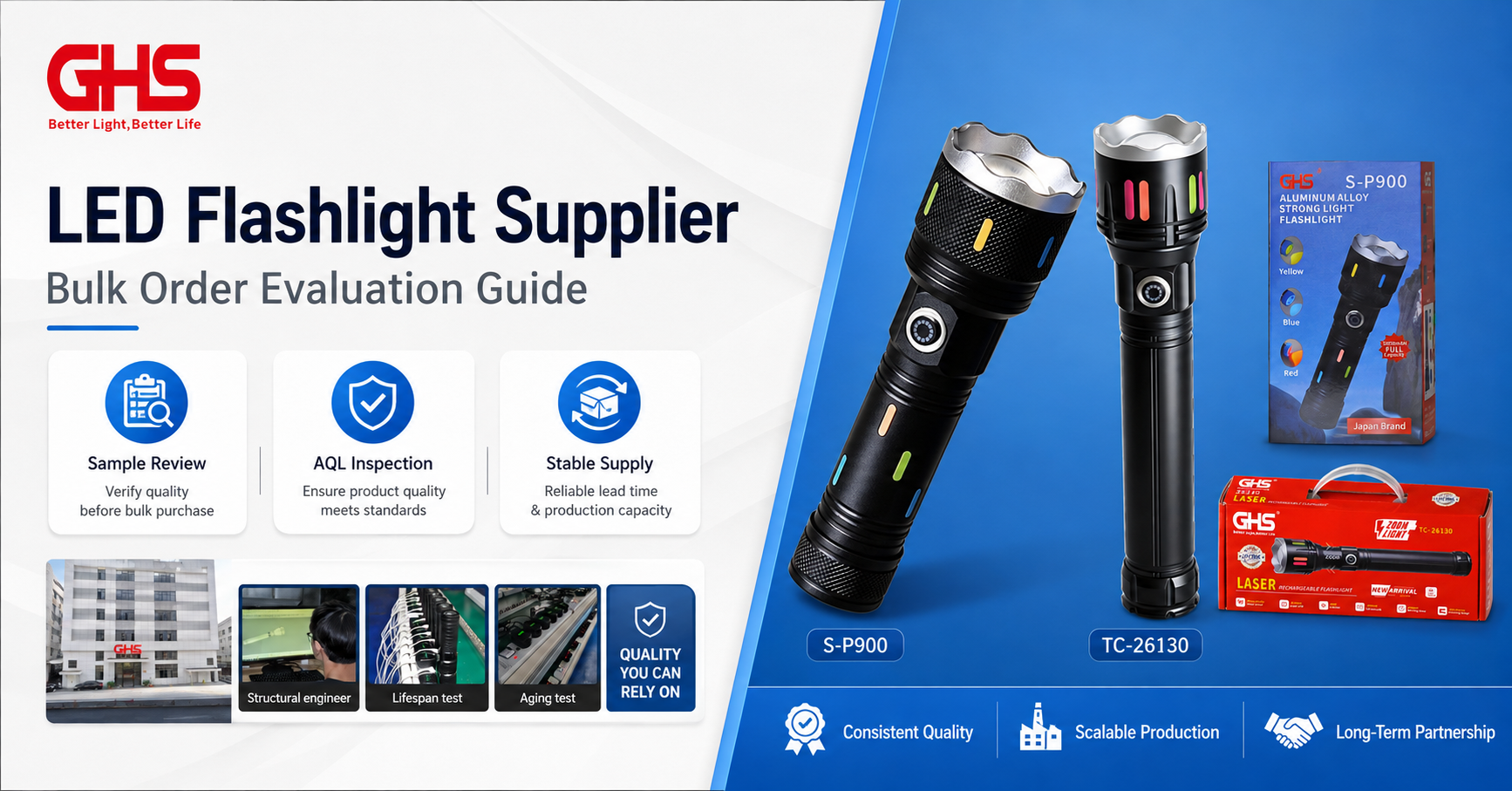
Guangdong Guanghuishi Electrical Appliances Co., Ltd. (GHS) is a China-based lighting manufacturer integrating product development, manufacturing, and sales.
Established in 2009, the company operates from Zhaoqing, Guangdong, and has a Dubai branch supporting its Middle East business relationships.
Its current portable-lighting portfolio includes basic, rechargeable, adjustable-beam, and high-intensity flashlight products.
For buyers investigating a high powered flashlight supplier, the GHS S-P Series provides useful product references for starting a sourcing discussion.
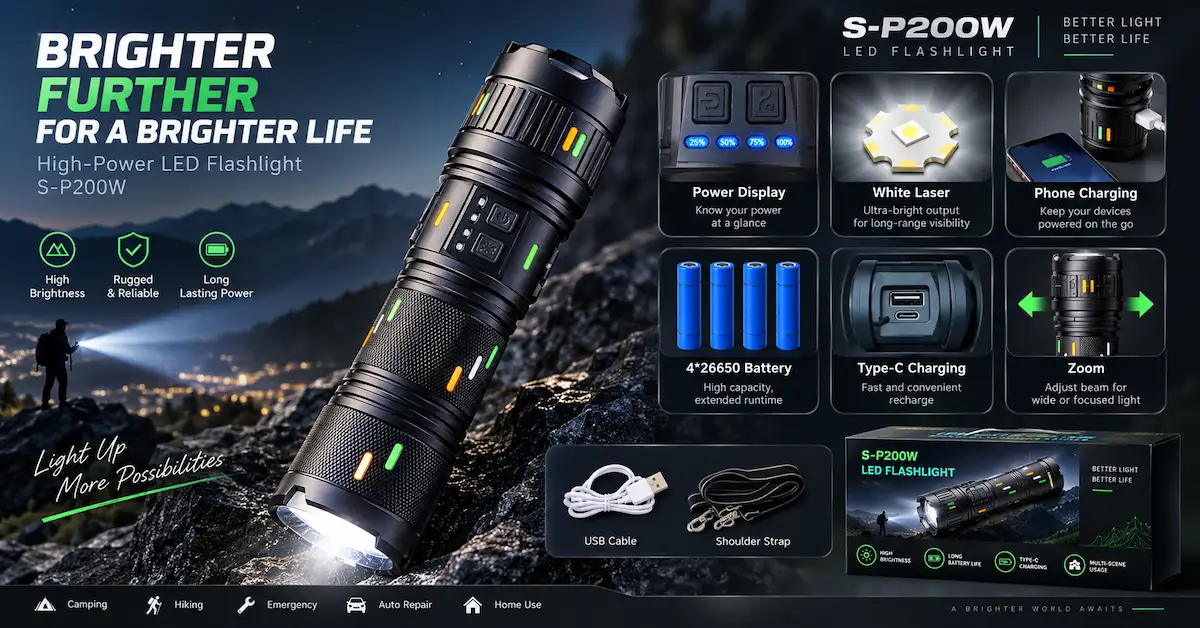
S-P200W High-Intensity Rechargeable Flashlight
The GHS S-P200W High-Intensity Flashlight is presented as a rechargeable, adjustable-beam handheld lighting product.
The product page describes a cylindrical body, textured grip, wider front head, and zoomable lighting concept.
Approximate dimensions shown on the page include:
-
Length: 285 mm
-
Head diameter: 70 mm
-
Body width: 55 mm
The product format is relevant to buyers evaluating portable lighting for security, outdoor activities, vehicle emergencies, and general field inspection.
The page also references a separate white-laser version. That designation should not be interpreted as verified laser classification or proof of a particular optical performance level.
S-P300W High-Intensity Rechargeable Flashlight
The GHS S-P300W High-Intensity Rechargeable Flashlight represents a larger handheld configuration within the high-intensity product family.
Approximate dimensions presented on the product page include:
-
Length: 300 mm
-
Head diameter: 80 mm
-
Body width: 65 mm
The product imagery and description emphasize a substantial handheld housing, directional lighting, rechargeable features, and utility-oriented controls.
This configuration may be relevant to buyers preferring a larger-format flashlight for outdoor or professional applications.
S-P200W vs. S-P300W: Product Reference Comparison
| Evaluation Item | S-P200W | S-P300W |
|---|---|---|
| Product category | High-intensity rechargeable flashlight | High-intensity rechargeable flashlight |
| Approximate length | 285 mm | 300 mm |
| Approximate head diameter | 70 mm | 80 mm |
| Approximate body width | 55 mm | 65 mm |
| Beam concept | Adjustable / zoomable | Directed / adjustable-beam features shown |
| Main purchasing consideration | Smaller physical format | Larger physical format |
| Lumen output | Confirm with supplier | Confirm with supplier |
| Beam distance | Confirm with supplier | Confirm with supplier |
| Battery configuration | Confirm with supplier | Confirm with supplier |
| IP rating | Confirm with supplier | Confirm with supplier |
| OEM availability | Discuss specific requirements | Discuss specific requirements |
Important: The model suffixes “200W” and “300W” should not be treated as independently verified electrical-power ratings. Likewise, the larger dimensions of the S-P300W do not establish higher lumen output or longer beam distance.
Both products should be assessed against the intended application and confirmed specifications before bulk ordering.
Buyers can also explore the complete GHS product collection to compare additional flashlight formats.
How to Verify a Supplier Before Placing a Bulk Order
Supplier qualification should begin before a large purchase order is issued.
A structured evaluation is more effective than relying solely on catalogs, online descriptions, or salesperson assurances.
Step 1: Confirm the Supplier's Identity
Verify:
-
Legal company name
-
Business address
-
Production location
-
Contact information
-
Relevant product categories
-
Manufacturing or sourcing responsibilities
Determine whether the organization is acting as a manufacturer, trading company, or a combination of both.
The distinction matters mainly because buyers need to understand who controls engineering decisions, production, and quality resolution.
Step 2: Review Product Capabilities
Request information about the models most relevant to the project.
Avoid evaluating unrelated products simply because they look impressive.
Ask whether the supplier can provide:
-
Specifications
-
Product images
-
Available configurations
-
Sample arrangements
-
Accessories
-
Packaging options
-
Technical documentation
Step 3: Discuss Factory and QC Processes
A factory profile should help buyers understand actual manufacturing operations.
Relevant questions include:
-
Which processes are performed internally?
-
Which components are outsourced?
-
How are incoming materials inspected?
-
How are products assembled and tested?
-
Who approves critical component substitutions?
-
How are quality problems documented?
For a view of GHS's stated manufacturing approach, buyers can review its factory videos and production introduction.
Step 4: Request Representative Samples
Samples should match the proposed quotation.
The battery, driver, optical configuration, accessories, and packaging should be identified clearly.
If an alternative sample is supplied, differences should be documented.
Step 5: Assess Commercial Reliability
Review quotation validity, payment terms, production scheduling, communication quality, and handling of potential specification changes.
A supplier's ability to communicate limitations clearly is often a valuable indicator of project maturity.
A Practical High-Power Flashlight Sample Testing Plan
Samples should be evaluated against an agreed written specification.
A professional buyer can organize testing into five groups.
Optical Performance
Evaluate:
-
Measured light output
-
Peak beam intensity
-
Beam distribution
-
Hotspot uniformity
-
Beam artifacts
-
Output regulation
-
Brightness variation between samples
Do not rely entirely on visual comparisons made in different lighting conditions.
Electrical Performance
Check:
-
Battery configuration
-
Charging function
-
Charging time
-
Driver behavior
-
Lighting modes
-
Low-battery indication
-
Unexpected shutdowns
If electrical measurements are commercially important, use appropriate instruments and documented procedures.
Thermal Performance
Operate the flashlight under conditions representative of the intended application.
Record output behavior, housing temperature, and any automatic step-down.
The aim is to establish whether the flashlight can deliver useful illumination for the required duration.
Mechanical Performance
Inspect:
-
Housing fit
-
Surface finish
-
Switch operation
-
Threads
-
Grip
-
Zoom movement
-
Charging cover
-
Accessories
Repeated-operation tests are particularly important for adjustable optical systems and frequently used switches.
Environmental Performance
Where required, commission defined water-ingress, dust-ingress, impact, or other environmental tests.
Do not interpret informal water splashing or a single drop demonstration as equivalent to a recognized testing method.
Record Sample Results
For every tested sample, document:
-
Model
-
Sample identification
-
Battery configuration
-
Test conditions
-
Measured values
-
Observed defects
-
Acceptance decision
This documentation becomes the foundation for supplier comparison and production approval.
Establish a Golden Sample Before Mass Production
A golden sample is an approved reference used to guide production acceptance.
However, a physical sample alone is insufficient for complex electronic products.
It should be supported by a written specification package.
A practical approval package includes:
-
Product identification
-
Housing dimensions
-
Approved appearance
-
LED and driver requirements
-
Battery configuration
-
Charging specification
-
Operating modes
-
Beam requirements
-
Surface finish
-
Switch functions
-
Logo artwork
-
Packaging files
-
Accessories
-
Acceptance criteria
For buyers ordering multiple configurations, each variant should be defined clearly.
A common mistake is approving one sample while allowing production to include several undocumented alternatives.
That makes later quality disputes difficult to resolve.
Why BOM Control Is Especially Important
The bill of materials identifies the approved components used in the product.
For high-output flashlights, critical items may include:
-
LED emitter
-
Driver components
-
PCB
-
Battery cells
-
Charging components
-
Optical elements
-
Switches
-
Sealing materials
Replacing a component can influence output, runtime, charging, beam appearance, or reliability.
Buyers should therefore establish a process requiring approval before significant substitutions.
This is particularly important for repeat orders, where a product may need to remain consistent with earlier inventory, retail listings, packaging claims, and customer expectations.
Quality Control Requirements for High-Intensity Flashlight Production
Quality control should cover the complete production process rather than focus solely on the finished product's appearance.
Incoming Quality Control
Incoming materials should be assessed according to their importance and risk.
Relevant components include:
-
LEDs
-
Driver electronics
-
Batteries
-
Charging components
-
Housings
-
Lenses
-
Reflectors
-
Switches
-
O-rings
-
Packaging materials
Electrical and battery components deserve careful traceability because they can affect the finished product's most important performance characteristics.
In-Process Quality Control
During assembly, the manufacturer should monitor operations such as:
-
PCB installation
-
Electrical connections
-
Optical alignment
-
Battery installation
-
Thermal-interface assembly
-
Housing closure
-
Switch installation
-
Seal placement
-
Charging-port assembly
Errors in these operations may not be visible from the outside.
Finished Product Inspection
Final inspection can include:
-
Power and mode operation
-
Charging function
-
Battery indication
-
Beam appearance
-
Mechanical fit
-
Surface quality
-
Logo accuracy
-
Accessories
-
Packaging
Testing depth should reflect product risk and the buyer's agreed requirements.
Batch-Level Performance Verification
For applications where output and runtime are important selling claims, buyers should discuss periodic performance verification using representative production samples.
A functional on/off check cannot establish luminous output or sustained thermal performance.
Likewise, a visually bright beam is not proof of a particular candela or distance rating.
Define Acceptance Criteria Before Production
Buyers may use appropriate sampling plans, including methods informed by ISO 2859-1 where applicable.
However, an AQL-based acceptance plan does not guarantee that every unit in an accepted lot is defect-free.
Critical safety or compliance requirements may need separate controls rather than routine appearance sampling.
The buyer and supplier should agree on acceptance requirements before production begins.
OEM, ODM, and Private-Label Options for High-Power Flashlights
For B2B brands, product customization can create differentiation and support stronger market positioning.
However, customization depth should match the project budget, launch schedule, and technical requirements.
Private-Label Customization
Typical requirements include:
-
Logo marking
-
Retail packaging
-
Product labels
-
Instruction manuals
-
Barcode placement
-
Accessories
-
Color options
Starting from an existing product platform may reduce development complexity.
OEM Product Modifications
More advanced customization may involve:
-
Battery configuration
-
Charging system
-
Lighting modes
-
Optical components
-
Housing finish
-
Switch arrangement
-
Indicators
-
Accessory sets
Every significant change should be reviewed for technical consequences.
ODM Product Development
Deeper projects may involve customized mechanical or electrical architecture.
Possible development areas include:
-
Industrial design
-
Housing construction
-
Optical design
-
Driver electronics
-
Battery integration
-
Thermal management
-
Prototype validation
This type of project normally requires greater engineering coordination, development time, and documentation.
Match Customization to Business Value
Not every brand needs an entirely new flashlight.
A distributor entering a market quickly may benefit more from reliable existing products with tailored packaging.
A specialized industrial supplier may require deeper functional customization.
The best decision balances differentiation, development cost, manufacturing risk, and forecast demand.
Buyers interested in reviewing GHS's product presentation and customization direction can explore the GHS product videos.
How to Compare Wholesale Flashlight Quotations
Price comparisons are meaningful only when the specifications and commercial terms are comparable.
A very low quotation may reflect a different configuration rather than greater manufacturing efficiency.
Compare the Same Product Scope
Check whether each supplier's quotation includes:
-
Flashlight body
-
Battery
-
Charging cable
-
Accessories
-
Retail packaging
-
Manual
-
Branding
-
Inspection requirements
-
Shipping cartons
A quotation excluding batteries or retail packaging should not be compared directly with a complete retail-ready product.
Review Specification Differences
Important differences may involve:
-
LED selection
-
Driver architecture
-
Battery quality
-
Housing material
-
Surface treatment
-
Optical components
-
Charging system
-
Sealing structure
These choices affect both product cost and performance.
Calculate Total Landed Cost
Unit price is only one component of the purchasing decision.
Other potential costs include:
-
Tooling
-
Sampling
-
Packaging development
-
Testing
-
Inspection
-
Freight
-
Duties and taxes
-
Local handling
-
Warehousing
-
Returns
-
Warranty administration
A supplier offering a slightly higher unit price may create better overall value if its approved configuration is more reliable and easier to replenish.
Avoid Unsubstantiated Cost-Saving Claims
A manufacturer should not claim that a design will automatically reduce cost by a specific percentage without a documented comparison.
Meaningful cost engineering requires understanding the product specification, material choices, order volume, and manufacturing process.
For procurement decisions, transparent quotation breakdowns are more useful than unsupported savings promises.
MOQ and Lead Time: What Buyers Should Clarify
Minimum order quantity depends on the exact product and customization requirements.
A supplier may offer different quantities for standard products, customized branding, special finishes, or redesigned electronics.
What Influences MOQ?
Common factors include:
-
Standard vs. customized configuration
-
Housing color
-
Printing method
-
Special packaging
-
Battery specification
-
Custom electronics
-
Tooling requirements
-
Minimum component purchase quantities
Instead of asking for one generic MOQ, request the quantity associated with the exact product configuration.
Separate Sample Lead Time From Production Lead Time
A complete order involves several stages:
-
Requirements review
-
Quotation
-
Sample preparation
-
Testing and approval
-
Artwork confirmation
-
Material purchasing
-
Production
-
Inspection
-
Packaging
-
Shipment preparation
Lead-time calculations should specify when the production clock begins.
A quoted manufacturing period may exclude sampling, artwork corrections, component procurement, or transportation.
For seasonal retail programs, these distinctions can be commercially significant.
Repeat Orders Require Forecasting
Importers and distributors should share realistic purchasing forecasts where possible.
Forecasts help suppliers discuss material planning and component availability.
However, forecast-based planning should not be interpreted as a guaranteed lead time without an agreed production schedule.
Battery Shipping and International Procurement Documentation
High-output rechargeable flashlights often contain lithium batteries.
For international buyers, transportation planning is part of the sourcing process.
The relevant requirements depend on battery chemistry, configuration, packaging, transport mode, and destination.
UN 38.3 Documentation
Lithium battery types are subject to relevant transport-testing requirements under the UN Manual of Tests and Criteria, subsection 38.3.
Buyers should request applicable battery test-summary information and ensure it matches the battery type being supplied.
A generic document belonging to an unrelated battery does not establish compliance for the purchased configuration.
Air, Sea, and Road Transport
Applicable packaging, labeling, declaration, and handling requirements can differ.
For air transport, buyers and shippers should review the current IATA Dangerous Goods Regulations and applicable carrier requirements.
A battery safety data sheet alone is not sufficient to determine all transport requirements.
Market Compliance
Depending on the destination and product characteristics, buyers may need to assess:
-
Electrical and battery safety
-
EMC requirements
-
Restricted substances
-
Product labeling
-
Applicable photobiological or laser safety requirements
-
Battery transport requirements
Where a product uses a laser-based light source, its actual technology and applicable safety classification must be established rather than inferred from a marketing name.
No compliance mark or report should be represented as covering a particular model unless its scope has been verified.
Red Flags When Evaluating Flashlight Suppliers
Several warning signs deserve closer investigation.
Extremely High Output Claims Without Test Evidence
A supplier should explain how performance was measured and which configuration was tested.
Unclear Battery Specifications
Descriptions such as “super battery” or “ultra capacity” are not substitutes for a documented battery configuration.
No Separation Between Peak and Sustained Output
This is a particular concern for high-output products with turbo modes.
Inconsistent Sample and Quotation Specifications
Differences should be clarified before approval.
Unwillingness to Define Critical Components
Without component control, repeat-order consistency may be difficult to maintain.
Generic Certification Claims
Certificates should identify their applicable scope, models, standards, and issuing bodies where relevant.
Unclear OEM Costs
Customization should be quoted according to its technical and commercial requirements.
No Written Quality Acceptance Plan
A supplier's general quality promise is not enough to define pass/fail requirements for production.
Unrealistic Lead-Time Promises
A lead time should be supported by a clear scope and confirmed material availability.
These warning signs do not automatically disqualify a supplier, but they indicate areas requiring additional evidence.
A Practical Supplier Evaluation Scorecard
Procurement teams can use a weighted scorecard to evaluate several potential suppliers.
The following weighting is an illustrative purchasing framework, not an industry accreditation.
| Evaluation Area | Suggested Weight |
|---|---|
| Optical performance and measurement evidence | 20% |
| Thermal and electrical reliability | 15% |
| QC and production consistency | 20% |
| Battery and component traceability | 15% |
| OEM/ODM capability | 10% |
| Price and commercial transparency | 10% |
| Lead time, communication, and logistics | 10% |
| Total | 100% |
Suppliers should be scored using evidence rather than subjective impressions.
For instance, a claimed performance specification supported by a relevant test report should be evaluated differently from an unsupported catalog statement.
Likewise, the ability to produce an approved sample is not identical to demonstrated control over repeat production.
The evaluation should reflect the risks most important to the buyer's target market.
What Should Be Included in a High Powered Flashlight RFQ?
A detailed request for quotation reduces uncertainty and improves supplier comparisons.
Before approaching a high powered flashlight supplier, prepare the following information.
Company and Market Information
-
Company name
-
Country or region
-
Buyer type
-
Sales channel
-
Intended application
Product Requirements
-
Preferred flashlight type
-
Desired product size
-
Housing material
-
Beam type
-
Target output
-
Beam-distance requirement
-
Runtime requirement
-
Lighting modes
-
Rechargeable battery preference
-
Charging interface
-
Environmental protection requirement
OEM and Packaging Requirements
-
Brand logo
-
Color
-
Packaging
-
Manual language
-
Barcode
-
Accessories
-
Labeling requirements
Commercial Requirements
-
Initial order quantity
-
Expected repeat-order volume
-
Target price range
-
Required sample date
-
Target shipment date
-
Shipping destination
-
Applicable documentation
Testing and Approval Requirements
-
Required performance test methods
-
Sample approval process
-
Critical component controls
-
Inspection criteria
-
Environmental testing
-
Battery documentation
If certain specifications are not yet determined, explain the intended application and ask the supplier to propose suitable alternatives.
A useful supplier response should identify the trade-offs between the proposed configurations.
Request an Application-Based Quotation
Instead of sending:
We need a powerful flashlight. Please give your best price.
A more productive inquiry is:
We are sourcing rechargeable high-intensity flashlights for outdoor and security distribution. We need a focused or adjustable beam, reliable sustained output, suitable battery runtime, OEM logo and packaging options, and documented quality requirements. Please recommend appropriate models, available technical specifications, sample arrangements, MOQ, and production lead time.
This gives the supplier enough context to recommend a relevant product rather than simply presenting the cheapest model.
For an initial project discussion, buyers can submit their specifications and sourcing requirements to GHS.
Why Work With GHS for High-Intensity Flashlight Sourcing?
GHS provides a product portfolio covering multiple portable-lighting categories, including rechargeable and high-intensity flashlight platforms.
According to the company's official introduction, its activities combine lighting research and development, manufacturing, and sales.
Its Zhaoqing operation supports manufacturing activities, while its Dubai branch provides an additional point of contact for Middle East business relationships.
For B2B buyers, these characteristics provide a basis for discussing product selection, customization requirements, and potential long-term supply.
However, buyers should still verify the specifications and commercial terms relevant to their individual projects.
Product Selection
Current high-intensity products such as the S-P200W and S-P300W provide starting points for discussing physical size, adjustable-beam operation, and rechargeable flashlight applications.
Product Development and Customization
Projects may involve existing products, private-label branding, or modifications requiring additional engineering review.
The appropriate customization scope should be agreed upon before sampling.
Manufacturing and Quality Discussion
GHS describes research, standardized production, and quality assurance as core operational areas.
Buyers should use these capabilities as a starting point for requesting project-specific QC plans and production evidence.
You can learn more about the company's background through the GHS About Us page.
Long-Term Purchasing Value
A successful supplier relationship depends on more than the first shipment.
Clear specifications, approved samples, component consistency, communication, and repeat-order planning help create a more dependable sourcing program.
For importers and distributors, these factors often determine whether a flashlight can remain commercially successful across several purchasing cycles.
Frequently Asked Questions About High Powered Flashlight Suppliers
1. How do I choose a reliable high powered flashlight supplier in China?
Evaluate product knowledge, technical specifications, testing evidence, manufacturing capability, quality control, battery traceability, OEM support, and repeat-order consistency. Request representative samples and compare suppliers using the same specification and acceptance criteria. Do not make the purchasing decision based solely on advertised brightness or unit price.
2. What is the difference between a high-powered flashlight and a regular flashlight?
High-powered models generally emphasize substantial output, directional beam intensity, extended throw, or specialized high-performance operation. However, there is no universal lumen threshold defining the category. A regular utility flashlight may deliver lower output while offering advantages in size, cost, or runtime for everyday applications.
3. Are more lumens always better for professional flashlights?
No. More lumens represent greater total light output, but they do not automatically guarantee greater beam distance or better task illumination. Security applications may benefit from higher candela, while industrial maintenance often benefits from a more balanced beam. Sustained output, runtime, thermal behavior, and usability should also be evaluated.
4. How can buyers verify a supplier's flashlight beam distance?
Ask for the measurement method, peak beam intensity, and applicable test standard. ANSI/PLATO FL 1 provides a standardized framework. Practical field testing should also be considered because standardized beam distance is not equivalent to guaranteed object recognition or identification at that range.
5. Why does a high power flashlight become dimmer after several minutes?
High-output LEDs and electronic components generate heat. A flashlight may reduce power through thermal regulation to maintain safe operating conditions. Buyers should distinguish normal controlled step-down from unstable or unexpected behavior by reviewing output-versus-time measurements and temperature-test results.
6. What is the typical MOQ for wholesale high-intensity flashlights?
MOQ depends on the product configuration, branding, packaging, component availability, and customization depth. Existing models with limited branding changes may have different minimum quantities from products requiring special housings, electronics, or tooling. Request the MOQ for the exact configuration rather than assuming one standard figure applies to every project.
7. Can I customize high-powered flashlights with my own brand?
Private-label projects may include logos, packaging, manuals, colors, and accessory sets. More advanced OEM or ODM programs may involve batteries, optical systems, controls, electronic components, or housing changes. The availability, cost, testing requirements, and development time for each modification should be confirmed with the supplier.
8. Which battery is best for a rechargeable high-power flashlight?
The best battery depends on electrical demand, desired runtime, size, weight, charging architecture, and operating environment. Battery capacity alone is not sufficient. Buyers should also evaluate discharge capability, cell quality, protection, traceability, and consistency between production batches.
9. What documents should importers request before shipping rechargeable flashlights?
Depending on the product and destination, documents may include commercial invoices, packing lists, product specifications, battery transport test summaries, and applicable compliance or testing documentation. Lithium battery shipments must follow relevant transport requirements. The required document set should be confirmed for the specific battery configuration and shipping route.
10. Is an aluminum flashlight body always better?
Not necessarily. Aluminum is often suitable for professional products requiring structural rigidity, machining flexibility, and heat transfer. Engineering plastics may offer advantages in weight, cost, and other design considerations. Material selection should be based on the complete product application and verified engineering requirements.
11. How do I prevent quality differences between flashlight production batches?
Approve a golden sample and maintain a written specification with controlled critical components. Define inspection requirements, testing methods, and a component-change approval process. Where performance claims are important, use representative batch-level verification rather than relying only on final visual inspection.
12. What information should I provide when requesting a high-power flashlight quotation?
Provide the application, destination market, estimated quantity, preferred flashlight size, beam requirements, output and runtime targets, battery preference, charging requirements, environmental protection needs, logo, packaging, accessories, and target delivery schedule. Clear RFQ information helps the supplier recommend relevant models and provide more accurate quotations.
Conclusion
Choosing a reliable high powered flashlight supplier requires balancing verified beam performance, sustained output, battery reliability, thermal design, manufacturing consistency, and total procurement cost. For B2B buyers, the most effective sourcing strategy is to define application requirements, compare measurable specifications, approve representative samples, and establish clear QC and component-control expectations before mass production.
Whether you are sourcing flashlights for security, outdoor distribution, industrial maintenance, or an OEM brand, GHS offers high-intensity product platforms worth evaluating. Explore the GHS high-intensity flashlight range or contact GHS for product specifications, sample inquiries, OEM options, and bulk quotations tailored to your target market.