
What Should Buyers Check in a High Power Flashlight Manufacturer?
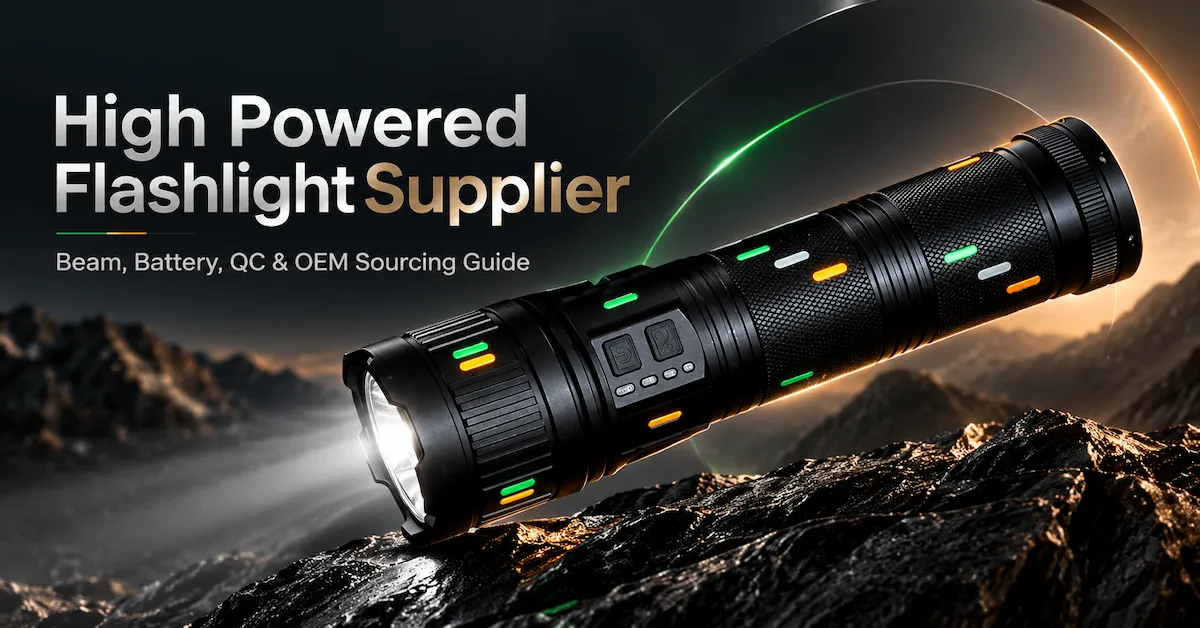
A reliable high power flashlight manufacturer should be able to explain much more than the maximum lumen figure printed on a product specification sheet.
High-output flashlight performance depends on the complete lighting system:
- LED
- Driver
- Battery
- Optics
- Housing
- Thermal path
- Electronic regulation
For professional B2B buyers, the most important question is therefore not:
“Which flashlight has the highest lumen number?”
A better question is:
“Which flashlight can deliver the beam, runtime and sustained output our application actually requires?”
A very high initial output can be useful, but it does not automatically mean a flashlight will provide better usable performance over several minutes or hours.
High Power Flashlight Buyer Checklist
Before comparing manufacturers or samples, define the major performance criteria.
| Evaluation Area | What Buyers Should Check | Why It Matters |
|---|---|---|
| Light output | Initial and sustained lumens | Shows total emitted light |
| Beam intensity | Candela / hotspot intensity | Influences long-distance performance |
| Beam distance | Effective projection distance | Important for search and outdoor use |
| Runtime | Runtime at relevant output modes | Affects real-world usability |
| Thermal design | Heat transfer and temperature control | Influences sustained output |
| Driver | Current regulation and mode control | Affects stability |
| Battery | Type, capacity and discharge capability | Supports high current demand |
| Optics | Reflector or lens configuration | Shapes beam pattern |
| Housing | Material and structural design | Influences durability and cooling |
| QC | Functional and performance inspection | Reduces batch variation |
| OEM | Branding and configuration options | Important for private-label buyers |
| Documentation | Test methods and market requirements | Supports professional procurement |
A purchasing team should compare these factors together instead of relying on one headline specification.
What Does “High Power” Actually Mean for a Flashlight?
There is no single universal lumen threshold that automatically turns a flashlight into a “high power” flashlight.
The term may refer to:
- High total light output
- Long beam distance
- High beam intensity
- High electrical power
- Large battery capacity
- Turbo or boost modes
- Professional application positioning
This creates a sourcing problem.
Two suppliers may both describe their products as high power flashlights, while the products are designed for completely different applications.
For this reason, professional RFQs should replace vague terms such as:
Super bright flashlight
or
Extremely powerful flashlight
with measurable requirements.
Lumens vs Candela vs Beam Distance
These specifications describe different aspects of flashlight performance.
Lumens
Lumens describe the total quantity of visible light produced by the flashlight.
A higher lumen figure generally means more total light output, but it does not tell buyers how concentrated the beam is.
Candela
Candela represents luminous intensity in a particular direction.
A flashlight with a concentrated hotspot may have relatively high candela even if its total lumen output is lower than another wider-beam flashlight.
Beam Distance
Beam distance represents how far the light can project according to a defined measurement method.
Therefore:
Lumens = total light
Candela = beam intensity
Beam distance = projection capability
These metrics should not be treated as interchangeable.
A Higher Lumen Number Does Not Always Mean a Longer Beam
Consider two flashlight designs.
Flashlight A
- Very wide beam
- High total output
- Strong near-field illumination
Flashlight B
- Narrower hotspot
- More concentrated beam
- Higher beam intensity
Flashlight A may have more lumens.
Flashlight B may illuminate farther away.
The better choice depends on the application.
For example:
- Search applications may prioritize distance
- Work applications may prioritize broad area illumination
- Outdoor products may need a balanced beam
- Emergency products may prioritize runtime
A good high power flashlight manufacturer should help buyers define the beam requirement rather than selling only the highest lumen figure.
Why Standardized Flashlight Testing Matters
Without consistent test methods, performance figures from different suppliers can be difficult to compare.
The current ANSI/PLATO FL 1-2025 standard establishes uniform methods for reporting portable-light performance attributes including light output, beam distance, peak beam intensity, runtime, impact resistance, and protection against water and dust.
The revised standard also introduced standardized treatment of Short-Duration Elevated Brightness, commonly marketed as turbo or boost output.
This is especially relevant to high-output flashlights because an extremely high initial brightness level may not represent the flashlight's continuously sustainable output.
For sourcing purposes, buyers should ask:
- How is lumen output measured?
- Is the specification initial output or sustained output?
- Is a turbo mode involved?
- How long does turbo mode operate?
- What happens after thermal regulation starts?
- Which operating mode is used for runtime testing?
These questions make supplier comparisons more meaningful.
Maximum Output vs Sustained Output
One of the most important concepts in high-performance flashlights is the difference between peak output and sustained output.
When an LED operates at high current, it generates heat.
The battery and driver also generate heat.
As internal temperature increases, the flashlight may need to reduce electrical power.
This is commonly called:
- Thermal step-down
- Thermal regulation
- Output regulation
The flashlight may initially produce a very high brightness level and later settle at a lower sustainable level.
For B2B buyers, both figures can matter.
Maximum Output
Useful for:
- Short bursts
- Search situations
- Marketing comparisons
- Temporary maximum visibility
Sustained Output
Important for:
- Professional work
- Inspection
- Outdoor activities
- Security
- Longer-duration use
If the target customer needs continuous lighting, sustained output may be more valuable than an impressive five-second peak.
Why Thermal Management Is Critical
High-output LEDs convert electrical energy into both light and heat.
The generated heat must move through the product structure.
A simplified thermal path is:
LED junction → PCB → thermal interface → flashlight housing → surrounding air
If this path is inefficient, internal temperatures can increase rapidly.
LED manufacturers themselves treat junction temperature and thermal resistance as important design parameters. Cree LED's thermal-management guidance notes that LED reliability is directly related to junction temperature and that higher junction temperature reduces LED lifetime.
For flashlight buyers, this means the housing is not merely cosmetic.
It can be part of the thermal-management system.
What Should Buyers Check in Flashlight Thermal Design?
Important considerations can include:
- LED mounting
- PCB construction
- Contact between PCB and housing
- Thermal interface
- Aluminum body structure
- Head mass
- Surface area
- Driver regulation
- Temperature monitoring
A flashlight that looks physically large does not automatically have good thermal performance.
The heat path must be properly designed.
Aluminum Housing and High Output
Aluminum alloy is widely used in performance flashlights because it can provide:
- Mechanical strength
- Heat transfer
- Machining flexibility
- Durable surface finishes
- Premium appearance
However, simply specifying “aluminum body” is not enough.
Buyers should also consider:
- Housing thickness
- Internal contact surfaces
- Machining consistency
- Surface treatment
- Mechanical fit
Thermal design depends on the complete structure.
Why the LED Driver Matters
The driver controls electrical power delivered to the LED.
It can influence:
- Output level
- Mode sequence
- Efficiency
- Battery utilization
- Output stability
- Temperature regulation
A high-performance LED combined with a poorly designed driver may not deliver stable flashlight performance.
For B2B projects, buyers can ask:
- Is output electronically regulated?
- Does brightness decline gradually with battery voltage?
- Is thermal step-down included?
- Are output modes current-controlled?
- Can mode sequences be customized?
These questions are particularly important for an OEM high power flashlight project.
Battery Performance Becomes More Important at High Output
High-output flashlights can place greater electrical demand on their batteries.
Therefore, battery evaluation should go beyond capacity alone.
Important factors can include:
- Cell chemistry
- Cell format
- Rated capacity
- Discharge capability
- Protection design
- Battery quality
- Internal resistance
A very large capacity figure does not automatically mean that a battery is ideal for a high-output flashlight.
The battery must also support the electrical current required by the driver.
Runtime Should Be Compared by Output Mode
A common specification mistake is comparing:
10-hour runtime
with
4-hour runtime
without checking the test mode.
The 10-hour flashlight may have been tested on low mode.
The 4-hour product may have been tested at a much higher brightness level.
For professional procurement, request runtime information by mode.
For example:
| Mode | Output | Runtime |
| Turbo | Confirm | Confirm |
| High | Confirm | Confirm |
| Medium | Confirm | Confirm |
| Low | Confirm | Confirm |
The manufacturer should provide the actual model-specific data.
Do not assume that one runtime figure describes every operating mode.
Beam Pattern Matters as Much as Output
A flashlight beam typically includes:
- Hotspot
- Spill
- Transition area
Different optical systems can produce very different beam shapes.
Wide Flood Beam
Suitable for:
- Close-range work
- Inspection
- Camping
- General illumination
Concentrated Spot Beam
Suitable for:
- Long-distance search
- Security
- Outdoor spotting
- Large-area patrol
Adjustable / Zoom Beam
Provides flexibility between different beam distributions depending on the product design.
The correct beam pattern should reflect how the end customer will use the flashlight.
How to Build a High Power Flashlight RFQ
A strong RFQ should contain measurable requirements.
Application
Tell the supplier whether the flashlight is intended for:
- Outdoor use
- Search
- Security
- Industrial inspection
- Hardware distribution
- Emergency use
- Professional work
Optical Requirements
Specify:
- Target lumen range
- Beam distance
- Beam type
- Operating modes
Power Requirements
Specify:
- Battery preference
- Required runtime
- Rechargeable or replaceable battery
- Charging interface
Mechanical Requirements
Specify:
- Housing material
- Product dimensions if important
- Waterproof requirement
- Impact requirement
Commercial Requirements
Include:
- Quantity
- Logo
- Packaging
- Target market
- Target delivery date
The more complete the RFQ, the easier it is for a high power flashlight manufacturer to recommend an appropriate product.
How to Evaluate High Power Flashlight Samples
A sample evaluation should simulate realistic use.
Check Initial Output
Confirm that the product begins in the expected operating mode.
Run the Flashlight Continuously
Observe:
- Heat buildup
- Output reduction
- Unexpected shutdown
- Switch operation
Check Beam Quality
Evaluate:
- Hotspot
- Spill
- Artifacts
- Beam consistency
Test Runtime
Test the modes most relevant to your customer.
Check Charging
For rechargeable models, verify:
- Charging interface
- Indicator behavior
- Connector fit
Inspect the Housing
Check:
- Threads
- Finish
- Lens
- Bezel
- Switch
- Product fit
Samples should be evaluated against a written specification rather than memory.
How Should High Power Flashlight QC Be Managed?
Higher-output products can require careful control of both components and assembly.
Incoming Components
Potentially important parts include:
- LEDs
- Drivers
- Batteries
- PCBs
- Switches
- Optics
- Housings
Assembly
Production inspection may verify:
- LED mounting
- PCB installation
- Wiring
- Driver connection
- Housing fit
- Lens installation
Functional Testing
Testing may include:
- Lighting modes
- Switch operation
- Charging
- Output sampling
- Current
- Runtime sampling
Thermal Performance Sampling
For performance-focused projects, representative samples may also be operated at high output to confirm that thermal behavior remains consistent with the approved model.
The exact test plan should be agreed before production.
Why Component Consistency Matters
Changing one component can alter flashlight performance.
For example, changing the:
- LED
- Driver
- Battery
- Reflector
- Lens
can affect:
- Lumens
- Beam distance
- Runtime
- Heat
- Color
- Electrical performance
Therefore, buyers should identify critical components and define how substitutions will be controlled.
For repeat orders, this can be more important than the appearance of the product alone.
How to Compare High Power Flashlight Manufacturers
Use a structured comparison rather than choosing by maximum lumen number.
| Factor | Supplier A | Supplier B | Importance |
| Peak output | Compare | Compare | Medium |
| Sustained output | Compare | Compare | High |
| Beam distance | Compare | Compare | High |
| Runtime | Compare | Compare | High |
| Battery | Compare | Compare | High |
| Thermal management | Compare | Compare | High |
| Driver design | Compare | Compare | High |
| QC process | Compare | Compare | High |
| OEM options | Compare | Compare | Medium |
| MOQ | Compare | Compare | Medium |
| Lead time | Compare | Compare | Medium |
| Price | Compare | Compare | High |
The weighting should change according to the application.
What Determines High Power Flashlight Cost?
Cost can be influenced by:
- LED
- Driver
- Battery
- PCB
- Optics
- Housing material
- Machining
- Thermal structure
- Charging electronics
- Waterproof construction
- Accessories
- Packaging
- Testing
- Order quantity
Two similar-looking flashlights may therefore have different costs because the internal configuration is different.
Professional buyers should compare equivalent specifications before comparing prices.
Common High Power Flashlight Sourcing Mistakes
Choosing the Highest Lumen Claim
Peak output does not describe sustained performance.
Ignoring Beam Intensity
High lumens do not automatically mean long beam distance.
Ignoring Heat
High electrical power creates thermal challenges.
Comparing Runtime Without Checking the Mode
Runtime values are meaningless without the corresponding output level.
Choosing Battery Capacity Alone
Battery quality and discharge capability also matter.
Approving Samples Only by Appearance
High-output products should be functionally tested.
Allowing Uncontrolled Component Changes
Different LEDs, drivers or batteries can change performance.
Buying Only by Unit Price
Low cost may reflect different specifications or quality controls.
GHS High-Intensity Flashlight Product Context
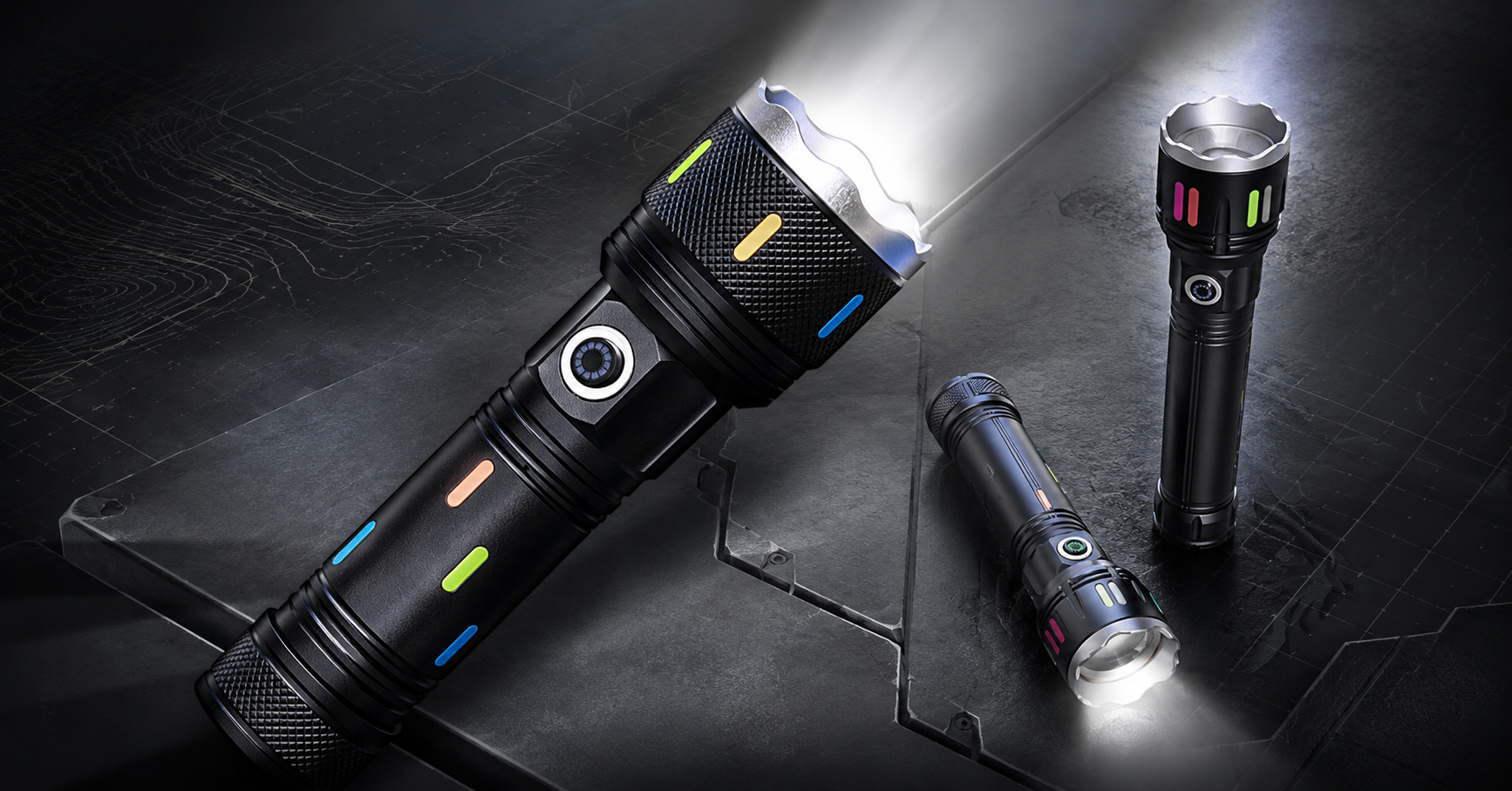
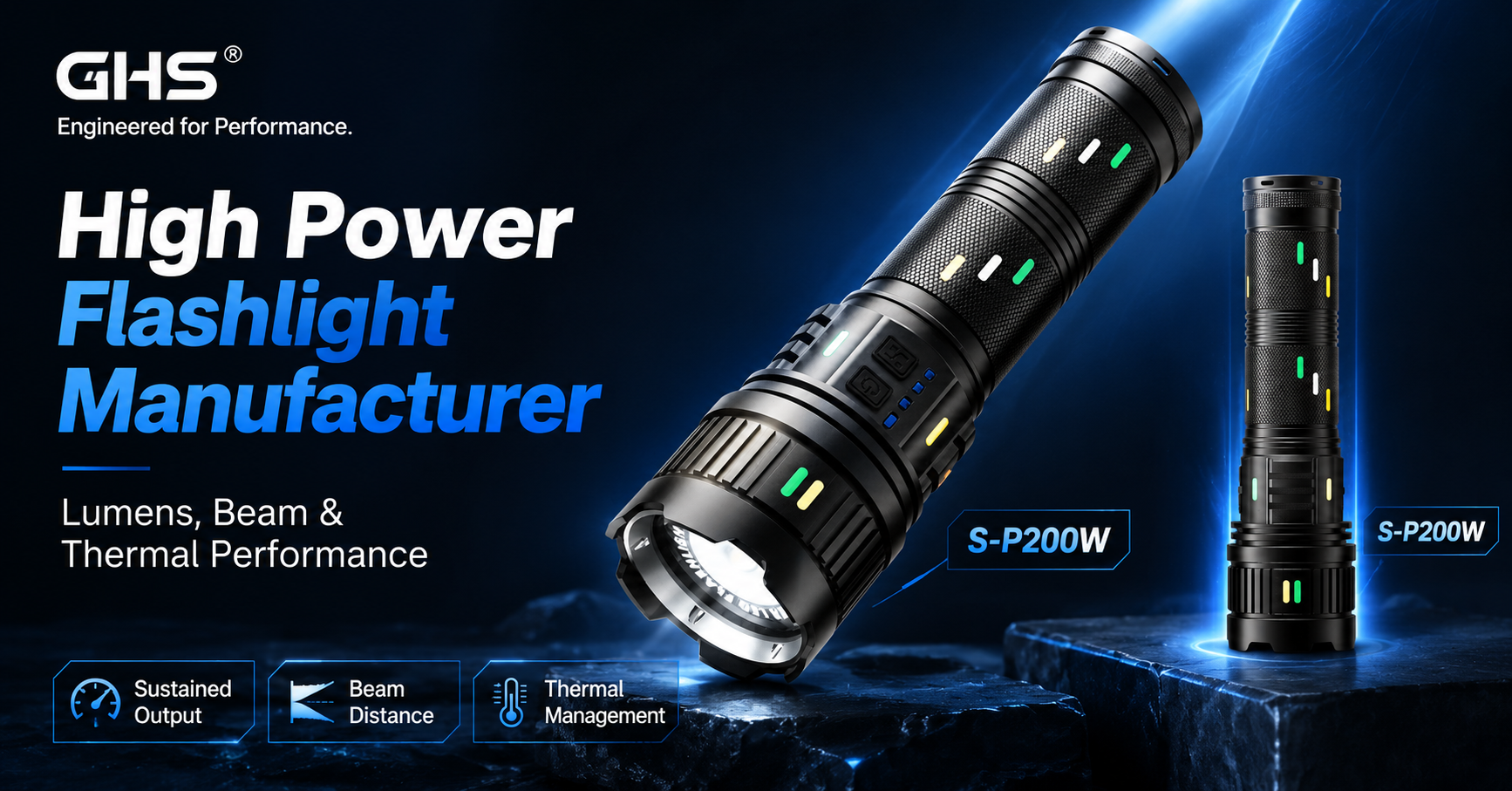
GHS currently has a dedicated High-intensity flashlight category containing the S-P300W High-Intensity Rechargeable Flashlight and S-P200W High-Intensity Rechargeable Flashlight.
These products provide relevant starting points for buyers evaluating high-intensity portable-lighting projects.
However, model names should not be treated as verified technical output specifications by themselves.
Before sourcing a specific model, buyers should confirm directly:
- Actual lumen output
- Beam distance
- Peak beam intensity
- Runtime by mode
- Battery configuration
- Charging system
- Thermal behavior
- Waterproof requirement
- OEM options
- MOQ
- Lead time
This ensures the purchasing decision is based on confirmed product data.
Questions to Ask a High Power Flashlight Manufacturer
Before placing an order, ask:
- What is the measured light output?
- Is the stated output peak or sustained?
- Does the flashlight use a turbo mode?
- How long can turbo output operate?
- What is the sustained output after step-down?
- What is the peak beam intensity?
- What is the measured beam distance?
- How is runtime tested?
- What is the runtime at each main mode?
- Which LED is used?
- Which driver is used?
- What battery configuration is included?
- How is heat transferred from the LED?
- Does the flashlight use thermal regulation?
- What happens if internal temperature becomes too high?
- How are LEDs, batteries and drivers inspected?
- Can we approve a production sample?
- How are critical-component substitutions controlled?
- Which OEM options are available?
- What determines MOQ and production lead time?
FAQ About High Power Flashlight Manufacturers
What is a high power flashlight?
A high power flashlight generally refers to a portable light designed for high output, long-distance illumination or other demanding performance requirements. There is no single universal lumen threshold defining every high power flashlight.
Is the highest lumen flashlight always the best?
No. Buyers should also compare sustained output, beam intensity, beam distance, runtime, thermal management and battery performance.
What is sustained flashlight output?
Sustained output is the brightness a flashlight can continue to deliver after temporary maximum or turbo output has ended and thermal or electrical regulation has stabilized.
Why do powerful flashlights become hot?
High-output LEDs and electronics generate heat. The flashlight housing and internal thermal path must transfer that heat away from critical components.
Why does flashlight brightness decrease after several minutes?
Some high-output flashlights intentionally reduce power when temperature rises. This thermal regulation helps manage heat and protect components.
Do more lumens mean longer beam distance?
Not necessarily. Beam distance is strongly affected by optical design and beam intensity as well as total light output.
What battery is best for a high power flashlight?
There is no universal best battery. The appropriate battery depends on required output, runtime, physical size, discharge capability and flashlight design.
What should B2B buyers test in a high power flashlight sample?
Test light output behavior, beam pattern, runtime, heat, charging, operating modes, housing quality and the product's consistency with the written specification.
Can high power flashlights be customized?
Depending on the product platform, customization may include branding, packaging, batteries, operating modes, colors or more advanced product changes. The exact options should be confirmed with the manufacturer.
How do I choose a reliable high power flashlight manufacturer?
Compare measurable performance, sustained output, thermal design, batteries, driver control, QC, component consistency, documentation, OEM capability and commercial terms rather than relying on maximum lumens alone.