
How Should B2B Buyers Evaluate an LED Flashlight Supplier?
A reliable LED flashlight supplier should be evaluated by its ability to supply the required product consistently, communicate specifications clearly, support quality verification and meet the commercial requirements of a bulk purchasing program.
For importers, distributors, wholesalers and retail purchasing teams, supplier selection is different from buying an individual flashlight.
A bulk buyer needs to know:
- What exactly is included in the quotation?
- Are two supplier quotations based on the same specification?
- Can the approved sample be reproduced in mass production?
- How will quality be inspected?
- What drives MOQ and lead time?
- Who is responsible for freight, export handling and risk?
- What happens when a component becomes unavailable?
- Can repeat orders maintain the same product?
The lowest unit price does not answer these questions.
For professional procurement, the goal should be:
Specification consistency + acceptable quality + predictable delivery + commercially competitive cost.
LED Flashlight Supplier Evaluation Checklist
Before comparing suppliers, create a consistent purchasing checklist.
| Evaluation Area | What Buyers Should Verify | Priority |
|---|---|---|
| Product specification | LED, battery, housing, modes and charging | High |
| Sample quality | Function, finish and performance | High |
| Quotation scope | Product, accessories, packaging and terms | High |
| MOQ | Quantity by product and customization | Medium–High |
| Quality control | Incoming, production and final inspection | High |
| Inspection criteria | Defect standards and sample plan | High |
| Production consistency | Approved sample and component control | High |
| Lead time | Sample, material and production schedule | Medium–High |
| Packaging | Retail box, manual, barcode and cartons | Medium |
| Trade terms | EXW, FCA, FOB or other agreed terms | High |
| Documentation | Product and shipment requirements | High |
| Communication | Response quality and technical clarity | Medium–High |
| Repeat orders | Specification-change control | High |
| After-sales | Defect and corrective-action process | Medium–High |
Using the same checklist across multiple suppliers makes sourcing decisions more objective.
Supplier, Manufacturer or Trading Company: Know Who You Are Buying From
The term LED flashlight supplier can describe several types of companies.
Direct Manufacturer
A manufacturer participates directly in product manufacturing or assembly and may have greater control over:
- Production
- Engineering
- Components
- QC
- Customization
- Production scheduling
This can be advantageous for buyers requiring stable volume or product changes.
Trading Company
A trading company sources products from one or more factories.
Potential advantages may include:
- Wider product selection
- Multiple product categories
- Consolidated purchasing
- Flexible sourcing
The key question is not whether a supplier is a factory or trading company.
The more important question is:
Who controls the product specifications, production process and quality decisions for your order?
If your project requires long-term repeat production, buyers should understand how deeply the supplier controls these factors.
Define the Product Before Requesting a Price
A common sourcing mistake is sending:
Please quote your best price for LED flashlights.
This is not enough information for an accurate comparison.
A supplier may quote:
- A different LED
- A different battery
- A different housing
- Different accessories
- Different packaging
- A different charging cable
- Different inspection standards
The prices may look comparable while the products are not.
A better RFQ should define the required configuration first.
What Should Be Included in an LED Flashlight RFQ?
A useful RFQ should contain enough information to let each supplier quote an equivalent product.
Basic Product Requirements
Include:
- Flashlight type
- Application
- Estimated order quantity
- Target market
- Size range if important
- Housing material
- Required functions
Lighting Requirements
Specify:
- Target lumen range
- Beam style
- Required operating modes
- Runtime expectations
- Beam distance if important
Battery and Charging
For rechargeable products, clarify:
- Battery type
- Capacity requirement
- Built-in or replaceable battery
- Charging interface
- Required cable or accessories
Branding
If required:
- Logo
- Color
- Packaging
- User manual
- Labels
- Barcode
Commercial Requirements
Include:
- Estimated quantity
- Destination
- Required quotation term
- Target delivery schedule
- Sample requirement
The clearer the RFQ, the easier it becomes to compare suppliers fairly.
How to Compare LED Flashlight Quotations Correctly
A unit price should never be compared in isolation.
Create a comparison sheet.
| Quotation Item | Supplier A | Supplier B | Supplier C |
| Product model | Confirm | Confirm | Confirm |
| LED configuration | Confirm | Confirm | Confirm |
| Battery | Confirm | Confirm | Confirm |
| Housing | Confirm | Confirm | Confirm |
| Charging cable | Confirm | Confirm | Confirm |
| Accessories | Confirm | Confirm | Confirm |
| Logo | Confirm | Confirm | Confirm |
| Packaging | Confirm | Confirm | Confirm |
| Inspection | Confirm | Confirm | Confirm |
| MOQ | Confirm | Confirm | Confirm |
| Lead time | Confirm | Confirm | Confirm |
| Trade term | Confirm | Confirm | Confirm |
| Unit price | Compare | Compare | Compare |
Only after the specification is aligned should the purchasing team compare price.
A small price difference may be reasonable if one quotation includes:
- Better battery specification
- Stronger packaging
- More extensive inspection
- Additional accessories
- Different shipment responsibilities
Why Samples Matter Before Bulk Orders
Product photos cannot verify flashlight performance.
Before selecting an LED flashlight supplier for a substantial order, buyers should evaluate physical samples whenever practical.
A sample provides information about:
- Housing quality
- Assembly
- Surface finish
- Switch feel
- Beam
- Light modes
- Charging
- Accessories
- Packaging
- User experience
However, sample evaluation should also be systematic.
What Should Buyers Test on Flashlight Samples?
Product Appearance
Check:
- Surface finish
- Scratches
- Color
- Housing joints
- Lens
- Threads
- Logo
Functional Performance
Verify:
- Power on/off
- Mode sequence
- Switch response
- Charging
- Indicator function
- Zoom function if applicable
Packaging
Check:
- Product fit
- Accessories
- Manual
- Barcode
- Labels
- Carton information
Product Specification
Compare the sample to the quotation and specification sheet.
A sample should not be approved simply because it “looks good.”
It should match the requirements you intend to purchase.
Approved Samples Should Become Production References
Once the sample is accepted, both buyer and supplier should confirm which features are approved.
For example:
- Housing appearance
- Product color
- Logo
- Operating modes
- Accessories
- Packaging
- Labels
For important internal components, written specifications may also be necessary.
These can include:
- LED
- Battery
- Driver
- PCB
- Charging system
Using both an approved physical sample and a written specification provides better control than relying on either one alone.
How Should Flashlight Quality Inspection Be Managed?
Bulk purchasing requires an agreed inspection method.
For professional orders, buyers should decide:
- What will be inspected?
- When will inspection occur?
- How many products will be checked?
- Which defects are acceptable?
- Which defects require rejection or corrective action?
The current ISO 2859-1:2026 standard defines acceptance sampling schemes indexed by Acceptance Quality Limit, or AQL, for lot-by-lot inspection by attributes. It can provide a structured statistical framework for sample-based inspection, although the buyer and supplier still need to agree on the specific inspection criteria appropriate to the flashlight order.
This does not mean that every flashlight order must automatically use the same AQL values.
The inspection plan should reflect the product and the buyer's risk tolerance.
Critical, Major and Minor Defects
Before inspection, defects can be classified according to their impact.
Critical Defects
Potential examples may involve issues that create serious safety or regulatory concerns.
Major Defects
Examples may include:
- Flashlight does not turn on
- Charging does not work
- Important mode is missing
- Incorrect battery
- Wrong product configuration
- Major packaging error
Minor Defects
Examples may include:
- Small cosmetic imperfections
- Minor printing variation
- Non-critical appearance issues
The exact classification should be agreed between buyer, supplier and inspection provider.
Do not wait until an inspection fails to decide what constitutes a defect.
Quality Control Should Start Before Final Inspection
Final inspection cannot compensate for uncontrolled production.
A strong LED flashlight supplier should also consider quality during:
Incoming Materials
Potential checks include:
- LEDs
- Batteries
- PCBs
- Switches
- Housing parts
- Charging components
- Packaging materials
Production
Checks may include:
- Assembly
- Wiring
- Soldering
- Housing fit
- Switch function
- Charging
Functional Testing
Depending on the product:
- Operating modes
- Charging
- Light function
- Current
- Runtime sampling
Final Packing
Checks may include:
- Quantity
- Accessories
- Logo
- Manual
- Barcode
- Box
- Shipping carton
This helps reduce the probability of discovering systematic problems only after production is finished.
What Determines Wholesale Flashlight MOQ?
MOQ is often influenced by the production requirements behind the product.
Factors can include:
- Standard product vs customized product
- Product color
- Battery
- Packaging
- Logo
- Accessories
- Component purchasing quantities
- Production setup
A standard model may have different MOQ requirements from an OEM version.
Therefore, when discussing MOQ with a wholesale flashlight supplier, ask:
Which part of the order is creating the minimum quantity?
For example, the flashlight itself may support one quantity while custom printed packaging requires another.
Understanding the MOQ driver can help buyers adjust the project.
How Should Buyers Evaluate Flashlight Lead Time?
Do not treat lead time as one single number.
A bulk order can involve several stages.
Sample Stage
Includes:
- Product selection
- Sample preparation
- Branding
- Buyer approval
Material Preparation
May include:
- Component purchasing
- Battery purchasing
- Packaging production
- Custom materials
Production
Includes:
- Assembly
- Testing
- Inspection
- Packing
Shipment Preparation
May include:
- Final inspection
- Documentation
- Export preparation
- Freight booking
Ask the supplier which stage controls the schedule.
A supplier promising “fast delivery” without discussing materials or customization may be giving an incomplete estimate.
Incoterms Matter When Comparing Supplier Prices
International quotations should clearly identify the agreed trade term.
Incoterms® 2020, published by the International Chamber of Commerce, defines widely used trade rules that allocate certain delivery responsibilities, costs and risk between seller and buyer. For example, EXW and FCA create different delivery obligations and risk-transfer points.
For procurement teams, this means:
EXW USD 5.00
and
FCA USD 5.20
are not automatically directly comparable.
The supplier's responsibilities differ.
Always compare:
- Product price
- Export handling
- Inland transport
- Freight responsibility
- Insurance where relevant
- Risk-transfer point
on the same commercial basis.
Why the Cheapest Supplier Can Become the Most Expensive
The purchase price is only one part of total sourcing cost.
Additional costs may arise from:
- Defects
- Customer complaints
- Returns
- Rework
- Delayed production
- Incorrect packaging
- Air freight caused by delays
- Replacement shipments
- Failed inspections
- Lost sales
This is why a professional sourcing decision should compare:
Unit Price + Quality Risk + Delivery Risk + Service Cost + Repeat-Order Reliability
A slightly higher quotation can sometimes represent lower overall procurement risk.
Check Packaging Before Bulk Production
Packaging problems are common in private-label and wholesale projects because several parties may be involved:
- Flashlight factory
- Packaging printer
- Buyer
- Designer
- Barcode provider
Before approving bulk packaging, verify:
- Box dimensions
- Product model
- Logo
- Product image
- Color
- Barcode
- Accessories
- Warnings
- Manual
- Carton marks
A packaging mistake can delay shipment even when the flashlight itself is ready.
How to Evaluate Supplier Communication
Communication quality is a practical sourcing indicator.
A strong supplier should be able to answer questions such as:
- Which battery is used?
- What exactly is included in the price?
- Which specifications are fixed?
- Which parts can change?
- How is runtime tested?
- What inspection is performed?
- What is the actual production lead time?
Be cautious if answers repeatedly remain vague.
Examples include:
“Very high quality.”
“Best battery.”
“No problem.”
“Everything can be customized.”
Professional sourcing requires measurable answers.
How Should Component Changes Be Controlled?
Component availability can change over time.
For flashlights, important components may include:
- LED
- Battery
- Driver
- PCB
- Switch
- Charging components
A good supplier-management system should define what happens when a component needs to change.
The supplier should not silently substitute a critical component if that substitution can affect:
- Output
- Runtime
- Charging
- Reliability
- Compliance
- Appearance
Buyers should identify critical components and require notification before substitutions.
Why Repeat-Order Consistency Matters
A supplier may deliver a successful first order but still perform poorly over time.
For distributors and wholesalers, repeatability is often more valuable than a one-time successful shipment.
Repeat-order risks can include:
- Different battery
- Different LED
- Changed driver
- Different color
- Packaging changes
- Accessory changes
Therefore, purchasing teams should keep:
- Approved specifications
- Approved samples
- Packaging artwork
- QC criteria
- Order history
These records make it easier to compare future production with the original approved order.
Wholesale Supplier vs Custom Supplier
Not every supplier serves the same purchasing model.
Standard Wholesale Supplier
May be suitable when buyers need:
- Existing models
- Standard colors
- Standard packaging
- Faster sourcing
- Straightforward bulk orders
OEM / Custom Supplier
May be more suitable when buyers need:
- Custom logo
- Private-label packaging
- Product color
- Battery changes
- Lighting-mode changes
- Structural modifications
Buyers should match the supplier to the project instead of asking every supplier to support every sourcing model.
Common LED Flashlight Supplier Sourcing Mistakes
Comparing Prices Before Specifications
Different products cannot produce a meaningful price comparison.
Requesting “Best Price” Without Quantity
Order volume affects purchasing and production planning.
Approving Only Product Photos
Photos cannot verify function, battery or assembly quality.
Ignoring Inspection Requirements
Quality expectations should be defined before shipment.
Comparing Different Incoterms as the Same Price
Commercial responsibilities may differ substantially.
Failing to Control Repeat Orders
A successful first shipment does not automatically guarantee product consistency later.
Selecting a Supplier Only by Response Speed
Fast communication is useful, but product and quality capability still need verification.
Focusing Only on MOQ
MOQ matters, but the buyer should also evaluate quality, price, delivery and repeat-order stability.
GHS Product Options for B2B Supplier Evaluation
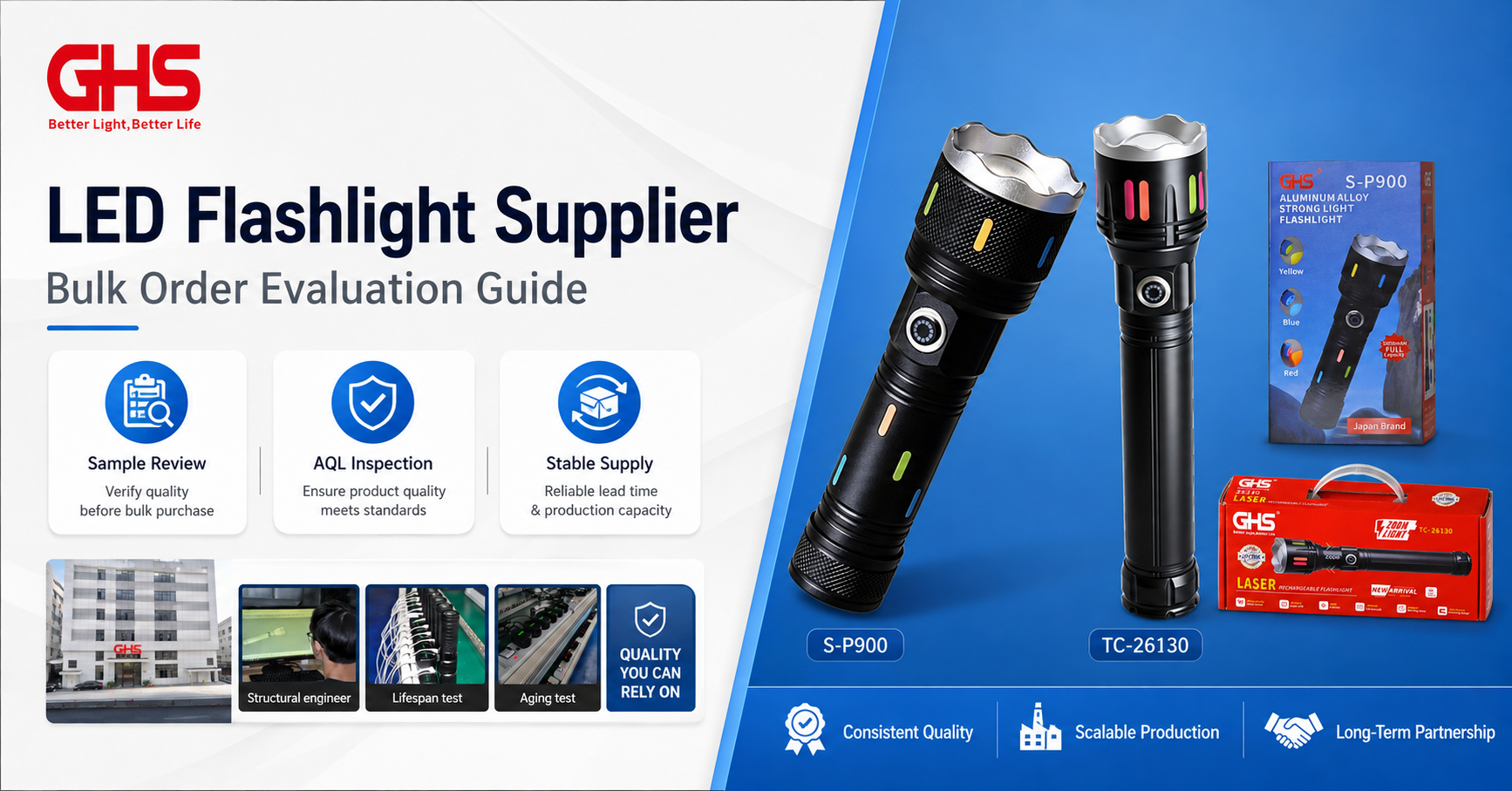
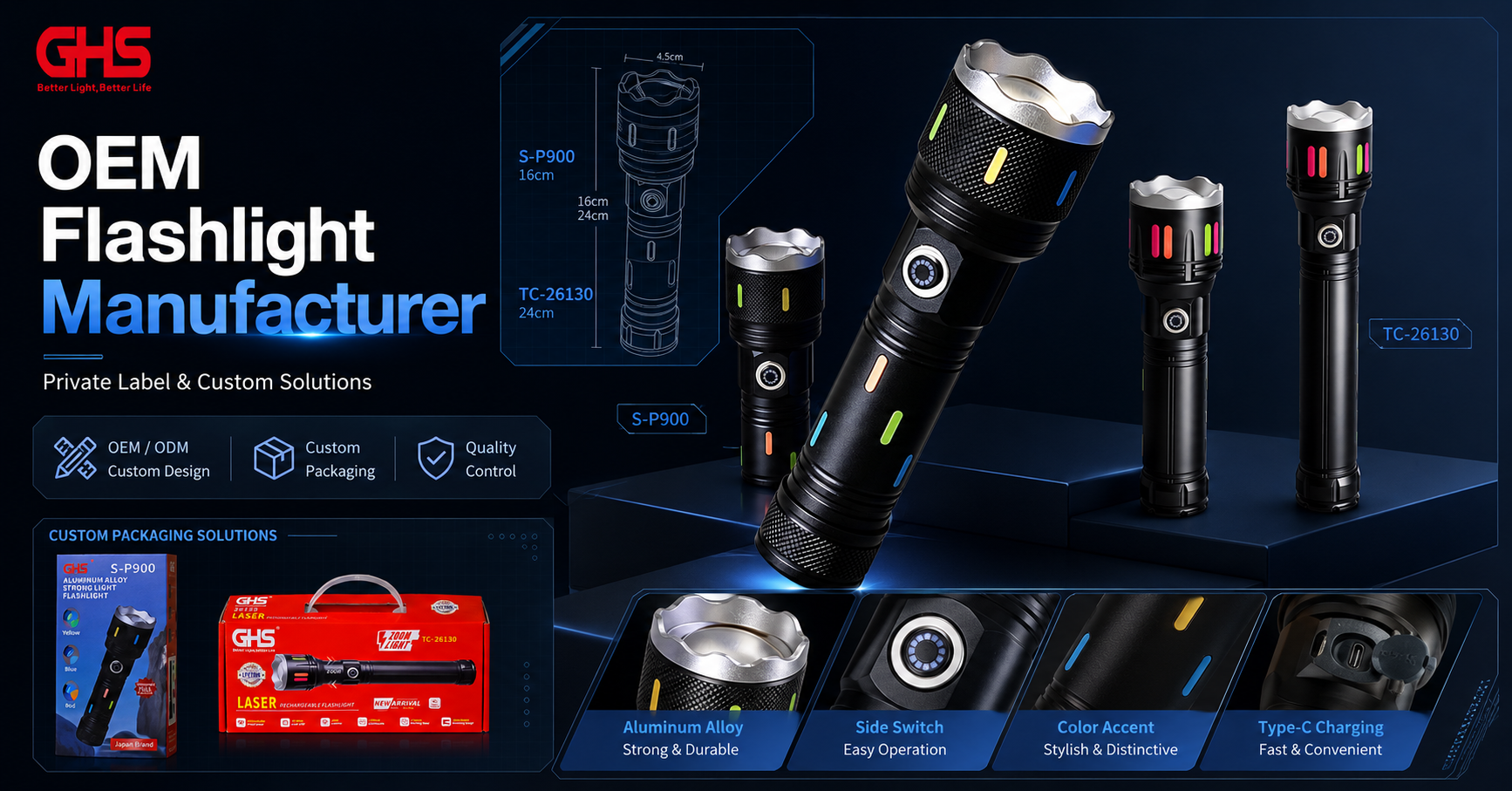
GHS currently offers multiple flashlight products that can serve as reference products for B2B buyers evaluating potential portable-lighting sourcing projects.
The existing range includes rechargeable models such as TC-26130, TC-18130, TC-12130, and S-P900, which provide buyers with different product platforms to review during the supplier-selection and sample-evaluation process.
For a specific order, buyers should confirm the exact model requirements directly before quotation, including:
- Product configuration
- Battery
- Lighting modes
- Charging
- Quantity
- Packaging
- Logo requirements
- Available customization
- MOQ
- Lead time
- Inspection requirements
Do not assume that all models use identical specifications or support the same customization.
Questions to Ask an LED Flashlight Supplier Before Ordering
Use these questions during supplier evaluation:
- Are you the manufacturer or sourcing supplier for this model?
- What exactly is included in the quotation?
- What LED does the model use?
- What battery configuration is included?
- What accessories are included?
- What packaging is included?
- What is the MOQ?
- What determines the MOQ?
- What is the sample lead time?
- What is the production lead time?
- Can we approve a final sample before production?
- Which product specifications will be fixed?
- How are component substitutions managed?
- What quality inspections are performed?
- Can third-party pre-shipment inspection be arranged?
- Which Incoterm is the quotation based on?
- Which documents are available for the selected product?
- What happens if the inspection identifies defects?
- How are quality claims handled after shipment?
- Can repeat orders maintain the approved specification?
FAQ About LED Flashlight Suppliers
How do I choose a reliable LED flashlight supplier?
Compare product specifications, samples, QC, component control, MOQ, lead time, commercial terms, documentation and repeat-order consistency rather than selecting a supplier by price alone.
What should I send an LED flashlight supplier for a quotation?
Provide the product type, application, quantity, battery, lighting requirements, housing, charging, accessories, packaging, branding, destination and required trade term.
How can I compare flashlight supplier quotations?
First confirm that each supplier has quoted the same product specification, accessories, packaging, quantity, quality requirements and Incoterm. Then compare pricing.
Should I request samples before ordering flashlights in bulk?
For significant B2B orders, samples can help buyers evaluate appearance, assembly, function, charging, accessories and packaging before committing to mass production.
What is AQL inspection for flashlights?
AQL-based inspection uses a statistical sampling plan to evaluate a production lot. The actual defect categories and acceptance criteria should be agreed before inspection.
What is the difference between a flashlight supplier and manufacturer?
A manufacturer participates directly in production, while a supplier may be a manufacturer, trading company, wholesaler or sourcing company. Buyers should understand who controls the product and quality process.
What affects wholesale flashlight MOQ?
MOQ can be affected by product configuration, color, battery, logo, packaging, accessories, component purchasing quantities and production setup.
Which Incoterm should I use when buying flashlights?
There is no single best term for every purchase. The appropriate Incoterm depends on logistics arrangements and the responsibilities buyer and seller intend to assume.
Why do two similar LED flashlights have different prices?
Differences may come from the LED, battery, driver, housing, accessories, packaging, testing, customization or commercial terms.
How can I reduce supplier risk on repeat orders?
Keep the approved sample, written specification, critical-component requirements, packaging artwork and QC criteria, and require approval before important product changes.