
How to Choose a Professional Flashlight Factory in China
A buyer searching for a professional flashlight factory China is usually looking for more than an inexpensive source of portable lighting. The real objective is to identify a manufacturer capable of producing reliable flashlights for demanding applications while maintaining consistent specifications, quality, and supply performance across repeated orders.
For importers, OEM brands, security equipment distributors, industrial suppliers, and outdoor equipment companies, the most important factor is not simply whether a factory can produce a working flashlight.
It is whether the factory can repeatedly manufacture the approved product without uncontrolled changes to its critical components or performance.
Professional flashlight manufacturing involves several closely connected systems:
-
Optical engineering and LED selection
-
Electronic driver and PCB integration
-
Battery and charging architecture
-
Housing design and mechanical assembly
-
Thermal management
-
Switches and user interfaces
-
Waterproof sealing
-
Quality control and testing
-
OEM/ODM product development
-
Packaging and export coordination
A weakness in one area can compromise the performance of the entire product.
For example, a flashlight may deliver excellent initial brightness during sampling but produce inconsistent runtime after a battery supplier changes. Another may demonstrate good water resistance in its original configuration but fail after an OEM modification introduces a different charging-port cover.
These problems are difficult to identify through product photographs or price comparisons alone.
A dependable manufacturing partner should therefore be evaluated through verifiable processes, representative production evidence, documented specifications, and clear responsibility for quality.
This guide explains how to assess a Chinese professional flashlight factory, what manufacturing evidence to request, how to evaluate OEM readiness, and how to minimize sourcing risks before committing to commercial production.
What Makes a Flashlight Factory Suitable for Professional Applications?
Not every flashlight factory serves the same market.
Some manufacturers primarily produce inexpensive household torches and promotional lighting products. Others focus on rechargeable flashlights, high-intensity models, outdoor equipment, industrial inspection lights, or customized portable lighting.
A factory suitable for professional applications should understand how product requirements change according to the operating environment.
Professional use does not automatically mean that a flashlight must have the highest possible lumen output or the heaviest housing.
Instead, it means the product must satisfy requirements appropriate to its intended task.
Professional Flashlight vs. General-Purpose Flashlight
| Evaluation Area | General-Purpose Flashlight | Professional-Application Flashlight |
|---|---|---|
| Primary objective | Convenient everyday lighting | Reliable illumination for defined tasks |
| Output | Basic usable brightness | Application-specific output and beam control |
| Runtime | General household requirements | Defined operating duration |
| Construction | Cost and convenience | Durability appropriate to the environment |
| Battery | Standard battery configuration | Defined battery performance and reliability |
| Quality control | Basic functional inspection | Risk-based inspection and performance verification |
| Documentation | Basic product information | More detailed specifications and test evidence |
| Customization | Logo and packaging | Potential functional and engineering changes |
| Repeat production | Commercial consistency | Controlled specifications and critical components |
These differences are general purchasing considerations, not proof that every product marketed as professional has undergone more demanding testing.
The buyer must establish the actual performance and quality requirements.
Define the Intended Operating Environment
Professional flashlight applications may include:
Industrial maintenance: Equipment inspection, mechanical repair, electrical cabinet inspection, and facility maintenance.
Security and patrol: Property inspection, perimeter observation, entrance checks, and nighttime patrol activities.
Outdoor operations: Camping, fieldwork, agricultural operations, and general outdoor equipment use.
Emergency preparedness: Vehicle emergency kits, backup lighting, and general emergency response support.
Commercial distribution: Hardware retailers, industrial suppliers, outdoor brands, and regional flashlight distributors.
Each market presents different priorities.
For example, industrial maintenance personnel may prefer stable illumination and straightforward operation, while security equipment buyers may emphasize beam concentration and rapid switching.
A professional flashlight factory should be able to discuss these differences before recommending a product platform.
How to Verify That a Chinese Flashlight Supplier Has Real Manufacturing Capabilities
One of the most important steps when evaluating a professional flashlight factory China supplier is distinguishing marketing claims from actual manufacturing responsibilities.
A company website may display factory images, equipment photographs, product videos, and quality certificates.
These materials are useful starting points, but they do not automatically establish which operations the company performs.
Understand the Factory's Business Model
A flashlight supplier may operate as:
-
A manufacturer handling product assembly and quality control
-
An integrated manufacturer with internal product development
-
A factory using external specialist component suppliers
-
A trading company coordinating production across factories
-
A supplier combining manufacturing and outsourced operations
None of these business models is automatically unsuitable.
The critical purchasing question is:
Who controls the product specification, critical components, production process, quality approval, and corrective actions?
A manufacturer with outsourced components may deliver excellent products if its supplier qualification and production controls are effective.
Conversely, a factory with impressive machinery may still struggle with quality if its engineering specifications and inspection processes are weak.
Request Evidence for Specific Operations
Instead of asking, “Are you a real factory?”, use more precise questions.
Ask the supplier to explain:
-
Where are the flashlight products assembled?
-
Which components are purchased from external suppliers?
-
Who develops or approves the electronic design?
-
Who approves the battery configuration?
-
Where are housing components manufactured?
-
How are incoming materials inspected?
-
Where is finished-product testing conducted?
-
Who controls approved specifications?
-
What happens when a critical component becomes unavailable?
-
Who investigates and resolves production defects?
These questions establish manufacturing responsibility more effectively than a general factory-direct claim.
Review Factory Photos and Videos Critically
Factory videos can provide useful visual evidence of:
-
Production environment
-
Assembly activities
-
Inspection stations
-
Equipment
-
Material handling
-
Product testing
-
Packaging operations
However, a video demonstrates only what it actually shows.
It does not automatically verify annual production capacity, certification status, or performance across all product models.
Buyers researching Guangdong Guanghuishi Electrical Appliances Co., Ltd. can begin with the company's GHS factory videos and manufacturing introduction.
The next step should be to request project-specific production information relevant to the chosen flashlight model.
The Manufacturing Process a Professional Flashlight Factory Should Control
Professional flashlight production is a sequence of engineering, purchasing, assembly, inspection, and release activities.
Understanding the process helps buyers identify where defects can enter production.
1. Product Requirements and Engineering Review
The process should begin with a written description of the intended product.
Important requirements include:
-
Application
-
Output and beam expectations
-
Operating modes
-
Battery configuration
-
Charging interface
-
Product dimensions
-
Housing material
-
Environmental protection
-
Packaging
-
Target order quantity
For custom projects, the supplier should evaluate technical feasibility before committing to final pricing or production schedules.
2. Component Sourcing and Supplier Control
Critical components may include:
-
LED emitters
-
Electronic drivers
-
PCBs
-
Lithium batteries
-
Charging components
-
Optical lenses or reflectors
-
Switches
-
Housing parts
-
Sealing materials
A good factory should maintain appropriate purchasing specifications for important components.
This reduces the possibility of unapproved substitutions.
3. Incoming Material Inspection
Incoming inspections help identify unsuitable or incorrect components before production begins.
For professional flashlights, this may include checking:
-
Component identification
-
Visual condition
-
Mechanical dimensions
-
Battery specifications
-
PCB consistency
-
Switch operation
-
Housing surface quality
-
Packaging materials
The inspection depth should reflect the component's risk.
4. Electronics and Optical Assembly
Electronics assembly may involve driver boards, electrical connections, charging circuitry, indicators, and switches.
Optical assembly may involve mounting LED modules, reflectors, and lenses.
Alignment is important because manufacturing variation can change beam appearance or concentration.
5. Mechanical Housing Assembly
Housing assembly includes components such as:
-
Battery compartment
-
Head and bezel
-
Switch mounting
-
Threaded connections
-
Lens retention
-
Sealing rings
-
Charging-port covers
The factory must ensure that dimensional tolerances allow consistent assembly.
6. Functional Verification
Completed flashlights should undergo relevant functional checks.
These may include:
-
Power on/off
-
Lighting modes
-
Switch operation
-
Battery indication
-
Charging
-
Adjustable beam
-
USB output, where applicable
7. Performance and Reliability Evaluation
Testing should be matched to the product specification.
For professional applications, relevant tests may include luminous output, beam intensity, runtime, charging behavior, thermal regulation, ingress protection, or mechanical durability.
Not every test must be performed on every unit, but buyers should understand the factory's verification strategy.
8. Packaging and Shipment Release
Final preparation involves confirming product identity, accessories, labeling, packaging, cartons, and quantities.
The factory should also confirm that the shipped product matches the approved configuration.
| Production Stage | Key Control | Evidence Buyers Can Request |
|---|---|---|
| Engineering | Requirements and feasibility | Approved specification |
| Purchasing | Critical component approval | BOM and component records |
| Incoming inspection | Material conformity | Incoming inspection results |
| Electronics assembly | Electrical consistency | Process instructions and functional checks |
| Mechanical assembly | Fit and sealing | Assembly criteria |
| Functional testing | Operating performance | Inspection records |
| Quality verification | Defined performance requirements | Applicable test results |
| Packaging | Correct commercial configuration | Approved packaging specification |
| Shipment release | Final order conformity | Inspection and shipment records |
A professional flashlight factory does not necessarily need to perform every component-manufacturing process internally.
It does need effective control over the processes and suppliers that determine the finished product's quality.
Evaluate Engineering Capability, Not Just Assembly Capacity
A factory may be capable of assembling thousands of flashlights but still have limited ability to modify product electronics, optics, or mechanical structures.
This distinction becomes important for OEM and ODM projects.
LED and Optical Engineering
A professional lighting product requires the LED and optical system to operate together.
Key considerations include:
-
LED selection
-
Output requirements
-
Reflector geometry
-
Lens design
-
Beam uniformity
-
Optical alignment
-
Driver compatibility
High lumens do not automatically guarantee effective long-distance illumination.
Beam intensity and distribution must match the application.
For a detailed explanation of these relationships, buyers can review the GHS guide to high-power flashlight output, beam performance, and thermal management.
Driver and PCB Engineering
The driver regulates electrical power delivered to the LED.
Its design affects:
-
Output stability
-
Electrical efficiency
-
Lighting modes
-
Battery consumption
-
Thermal response
-
Low-voltage behavior
A manufacturer proposing modifications to brightness levels or lighting modes should be able to explain whether changes to electronics, components, or testing are necessary.
Battery Integration
Rechargeable professional flashlights depend on battery quality and the complete electrical system.
Important factors include:
-
Cell format
-
Battery capacity
-
Discharge capability
-
Protection design
-
Charging current
-
Charging time
-
Battery traceability
Buyers should not evaluate battery systems solely by the mAh number printed on a package.
Thermal Design
High-output flashlights generate heat during operation.
The physical design must support appropriate heat transfer.
Manufacturers should be able to explain how the LED mounting structure, internal heat path, and housing contribute to thermal performance.
A large metal housing is not sufficient evidence of effective heat management.
Mechanical Engineering
Professional users may operate flashlights repeatedly under challenging conditions.
Engineering considerations include:
-
Structural strength
-
Grip
-
Switch positioning
-
Mechanical tolerances
-
Thread quality
-
Surface treatment
-
Impact protection
-
Sealing
For OEM projects, mechanical changes should be reviewed alongside optical and electrical requirements.
Identify Critical-to-Quality Characteristics Before Sampling
A useful way to improve supplier evaluation is to define Critical-to-Quality (CTQ) characteristics.
CTQs are product attributes that strongly influence customer satisfaction, safety, or commercial acceptance.
Instead of creating an inspection checklist based only on appearance, buyers should identify the product features that matter most.
For a professional flashlight, CTQs may include:
| CTQ Characteristic | Why It Matters | Suggested Verification |
|---|---|---|
| Light output | Determines usable illumination | Defined output measurement |
| Beam distribution | Supports the intended task | Beam evaluation |
| Runtime | Affects operational availability | Mode-specific runtime testing |
| Battery configuration | Influences performance and transport | Approved component specification |
| Charging function | Affects daily usability | Functional and electrical checks |
| Switch reliability | Determines operating consistency | Defined switch-cycle evaluation |
| Housing fit | Influences durability and assembly | Dimensional and visual inspection |
| Ingress protection | Matters in wet or dusty environments | Applicable test procedure |
| Component consistency | Protects repeat-order performance | BOM and change-control review |
| Packaging accuracy | Prevents commercial and customer-service issues | Packing inspection |
The CTQ list should be agreed upon before prototype approval.
For example, a security equipment distributor may prioritize beam intensity, switch responsiveness, and battery performance.
An industrial maintenance supplier may prioritize sustained output, durability, and comfortable close-range illumination.
A retail brand may prioritize charging convenience, packaging, product appearance, and return-rate reduction.
This application-specific approach produces more useful requirements than applying the same generic checklist to every product.
How to Evaluate Prototype and Sample Quality
Sample evaluation is one of the most important steps when qualifying a professional flashlight factory in China.
However, a sample should not be approved solely because it looks attractive or functions correctly during a short demonstration.
Stage 1: Concept or Product Selection Sample
The initial sample helps buyers evaluate:
-
Product size
-
General design
-
Grip
-
Beam concept
-
Charging format
-
User controls
-
Appearance
At this stage, the product may not yet represent the final commercial configuration.
Stage 2: Engineering Validation Sample
A more advanced sample should use the intended component architecture.
Important areas include:
-
LED and driver
-
Battery configuration
-
Charging circuit
-
Optical structure
-
Housing
-
Switch
-
Accessories
Relevant performance tests should be completed before proceeding.
Stage 3: Production Approval Sample
The final approval sample should represent the configuration intended for mass production.
It should be supported by written documentation, including the applicable specification and approved components.
This sample can become the golden sample.
Why a Golden Sample Alone Is Not Enough
A physical sample communicates appearance and function, but it does not necessarily identify critical internal components.
Two flashlights may look identical while using different batteries, drivers, or charging circuits.
Therefore, professional purchasing should combine:
Golden Sample + Written Specification + Controlled BOM + Defined Inspection Criteria
This creates a more reliable reference for production and repeat orders.
Quality Control: How to Verify Factory Consistency
When evaluating a professional flashlight factory China buyers should prioritize, quality control should be assessed as a complete operating system.
A factory should not depend entirely on final shipment inspection.
Incoming Quality Control
Incoming inspection focuses on the materials and components entering production.
Typical inspection areas include electronic components, batteries, switches, housing parts, optical components, and packaging.
Buyers should ask how the factory handles nonconforming materials.
In-Process Quality Control
In-process inspection helps identify production problems before large quantities are completed.
Depending on the product, this may include:
-
Electrical connections
-
PCB installation
-
Switch assembly
-
LED positioning
-
Housing fit
-
Sealing components
-
Charging-port installation
Finished Product Quality Control
Finished-product inspection verifies whether completed units meet defined acceptance requirements.
This may involve appearance, function, accessories, labeling, and packaging.
Performance Verification
Professional products may also require periodic testing of measurable characteristics.
For example, an on/off test cannot confirm luminous output, sustained brightness, or runtime.
A risk-based quality plan should distinguish basic functional checks from more specialized performance testing.
Inspection Sampling
The current ISO 2859-1:2026 standard provides acceptance sampling schemes indexed by Acceptance Quality Limit (AQL) for lot-by-lot inspection by attributes.
This can support structured sampling decisions.
However, AQL inspection does not guarantee that every unit in an accepted lot is defect-free.
Critical defects, safety concerns, and essential performance characteristics may require additional controls.
Buyers should define defect classifications, sample plans, acceptance limits, and responsibilities before production.
Corrective and Preventive Action
When defects occur, a supplier should have a process for investigating the cause.
Useful questions include:
-
Was the problem caused by a component?
-
Was an assembly step incorrect?
-
Were inspection instructions inadequate?
-
Did an approved specification change?
-
Could the same problem affect other batches?
-
What action will prevent recurrence?
A documented corrective and preventive action process is more valuable than simply replacing defective units.
Battery Traceability and Component Change Control
Component consistency becomes particularly important when a flashlight is sold through professional distribution channels.
Once an importer has established product listings, distributor catalogs, and customer expectations, unexpected changes can create significant commercial problems.
Components That Deserve Special Attention
Critical components may include:
-
LED emitter
-
Driver IC
-
PCB
-
Battery cell
-
Battery protection system
-
Charging components
-
Optical lens
-
Switch
-
O-ring
-
Waterproof charging cover
Not every component requires the same level of control.
The priority should reflect its impact on performance, reliability, or compliance.
Ask About Component Substitution Rules
Suppose a battery supplier cannot provide the originally approved cell.
What happens next?
A dependable factory should not automatically substitute a different battery without assessing the consequences.
The replacement may affect capacity, discharge performance, dimensions, charging behavior, runtime, or applicable documentation.
For important changes, the buyer should receive the proposed revised specification and confirm whether retesting or reapproval is necessary.
Establish a Production Change Notice
A practical OEM agreement can require notification before changing critical components.
The notification should identify:
-
Original component
-
Proposed replacement
-
Reason for change
-
Expected performance impact
-
Required testing
-
Approval responsibility
This process can significantly reduce repeat-order variation.
How to Assess Professional Flashlight Testing and Compliance
Professional buyers should distinguish between three different types of evidence:
Performance testing: Demonstrates how the flashlight operates.
Environmental testing: Evaluates resistance to defined external conditions.
Regulatory or standards compliance: Addresses requirements applicable to the product and destination market.
These areas are related but not interchangeable.
Portable Lighting Performance
The ANSI/PLATO FL 1-2025 standard provides standardized methods for measuring and reporting portable lighting performance.
Its revised framework includes provisions addressing short-duration elevated-brightness modes.
Buyers should request information about the applicable test conditions, measurement methods, and exact product configuration.
A high peak output should not be presented as sustained performance without supporting data.
Ingress Protection
IEC 60529 provides a framework for classifying enclosure protection against ingress.
If a flashlight is marketed with an IP rating, buyers should confirm the tested product configuration and relevant documentation.
For example, a charging-port modification can influence water resistance.
A supplier should not automatically apply a previous test result to a structurally modified product.
Battery Transportation
Rechargeable flashlights containing lithium batteries may be subject to relevant transport requirements.
The UN Manual of Tests and Criteria, subsection 38.3, addresses testing of lithium cells and batteries for transport purposes.
Applicable requirements depend on the battery type, packaging, shipping arrangement, and transport mode.
Buyers should request appropriate documentation before shipment planning is finalized.
Other Market-Specific Requirements
Depending on the intended destination and product design, buyers may need to assess:
-
Electrical safety
-
Electromagnetic compatibility
-
Restricted substances
-
Battery requirements
-
Labeling
-
Photobiological or laser safety
-
Environmental protection
Certification and compliance claims should always be associated with the relevant model and configuration.
A factory-level quality certificate does not automatically certify every flashlight produced by that factory.
Similarly, a product marketed as a “tactical flashlight” should not automatically be assumed suitable for hazardous environments.
Applications requiring explosion-protected equipment need appropriately certified models.
OEM, ODM, and Private Label: Which Manufacturing Model Fits Your Project?
A professional flashlight factory should clearly explain its available customization options.
The appropriate manufacturing model depends on the buyer's development objectives.
Private Label: Faster Market Entry
Private-label sourcing usually starts with an existing flashlight platform.
Typical customization may include:
-
Brand logo
-
Retail packaging
-
Product color
-
Instruction manual
-
Barcode
-
Accessories
This approach may be appropriate for importers and brands seeking faster commercialization with limited engineering changes.
OEM: Customization Based on Existing Product Architecture
OEM projects may involve modifications to an existing product.
Examples include:
-
Charging interface
-
Battery configuration
-
Lighting modes
-
Optical components
-
Housing finish
-
Switch arrangement
-
Indicators
Changes should be assessed for technical feasibility and validation requirements.
ODM: Deeper Product Development
ODM projects can involve more extensive engineering work.
Potential development areas include:
-
Industrial design
-
New housing construction
-
Optical engineering
-
Driver and PCB design
-
Battery integration
-
Thermal management
-
Prototype validation
These projects may require additional engineering resources, tooling, and testing.
Match Customization to Your Business Model
| Buyer Profile | Likely Starting Approach | Main Priority |
|---|---|---|
| New private-label brand | Existing model with branding | Faster launch and lower development complexity |
| Regional distributor | Standard or lightly customized models | Product selection and replenishment |
| Security equipment brand | OEM feature customization | Application-specific usability |
| Industrial equipment supplier | Validated existing model or functional OEM | Reliability and performance |
| Established lighting brand | OEM or ODM | Product differentiation |
| Specialized professional buyer | Engineering-driven ODM where needed | Defined technical requirements |
The best option is not necessarily the most customized product.
A standard platform that already meets the application may be commercially preferable to a complex redesign.
For additional guidance, explore the GHS article on OEM flashlight manufacturing and private-label project selection.
Evaluating GHS as a Professional Flashlight Manufacturing Partner
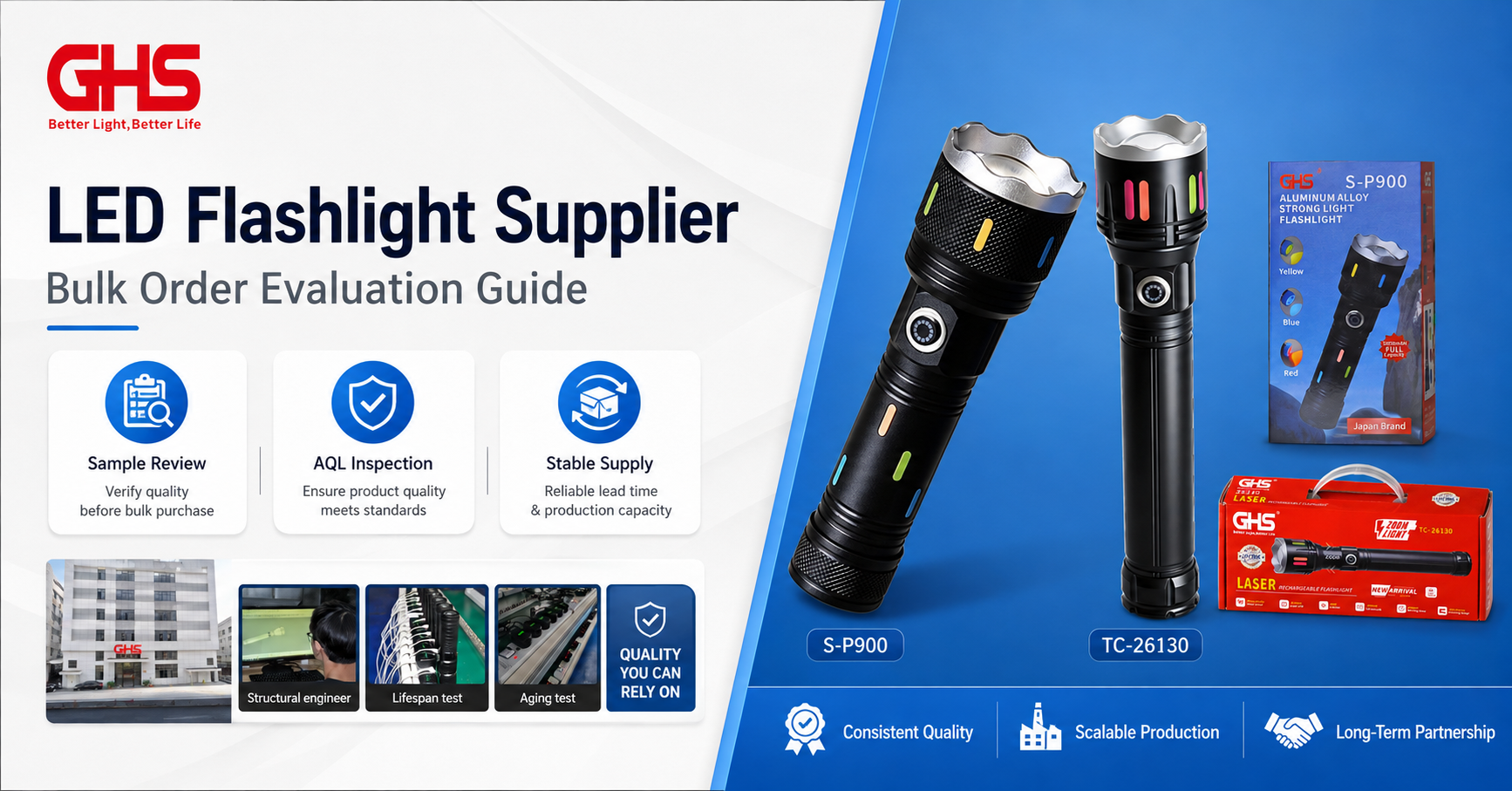
Guangdong Guanghuishi Electrical Appliances Co., Ltd. (GHS) is a China-based lighting manufacturer founded in 2009.
According to its official company profile, GHS integrates lighting research and development, manufacturing, and sales.
The company is headquartered in Zhaoqing, Guangdong, within the Zhaoqing High-Tech Industrial Development Zone.
Its About Us page identifies an approximately 1,300-square-meter factory and describes product development, standardized manufacturing processes, quality management, and international customer support as key operating areas.
GHS also established a Dubai branch in 2017 to support its Middle East business relationships.
Buyers can review these details on the GHS company profile and manufacturing overview.
Product Platforms Available for Evaluation
The company's current website presents multiple flashlight categories, including basic, rechargeable, new-product, and high-intensity platforms.
Three relevant examples are:
| Model | Product Positioning | Visible or Described Features | Purchasing Consideration |
|---|---|---|---|
| S-P200W | High-intensity rechargeable flashlight | Zoomable handheld design, larger head, textured grip | Security, outdoor, and general inspection distribution |
| S-P300W | Larger high-intensity flashlight | Larger physical format, rechargeable design, directional lighting concept | Buyers evaluating larger handheld configurations |
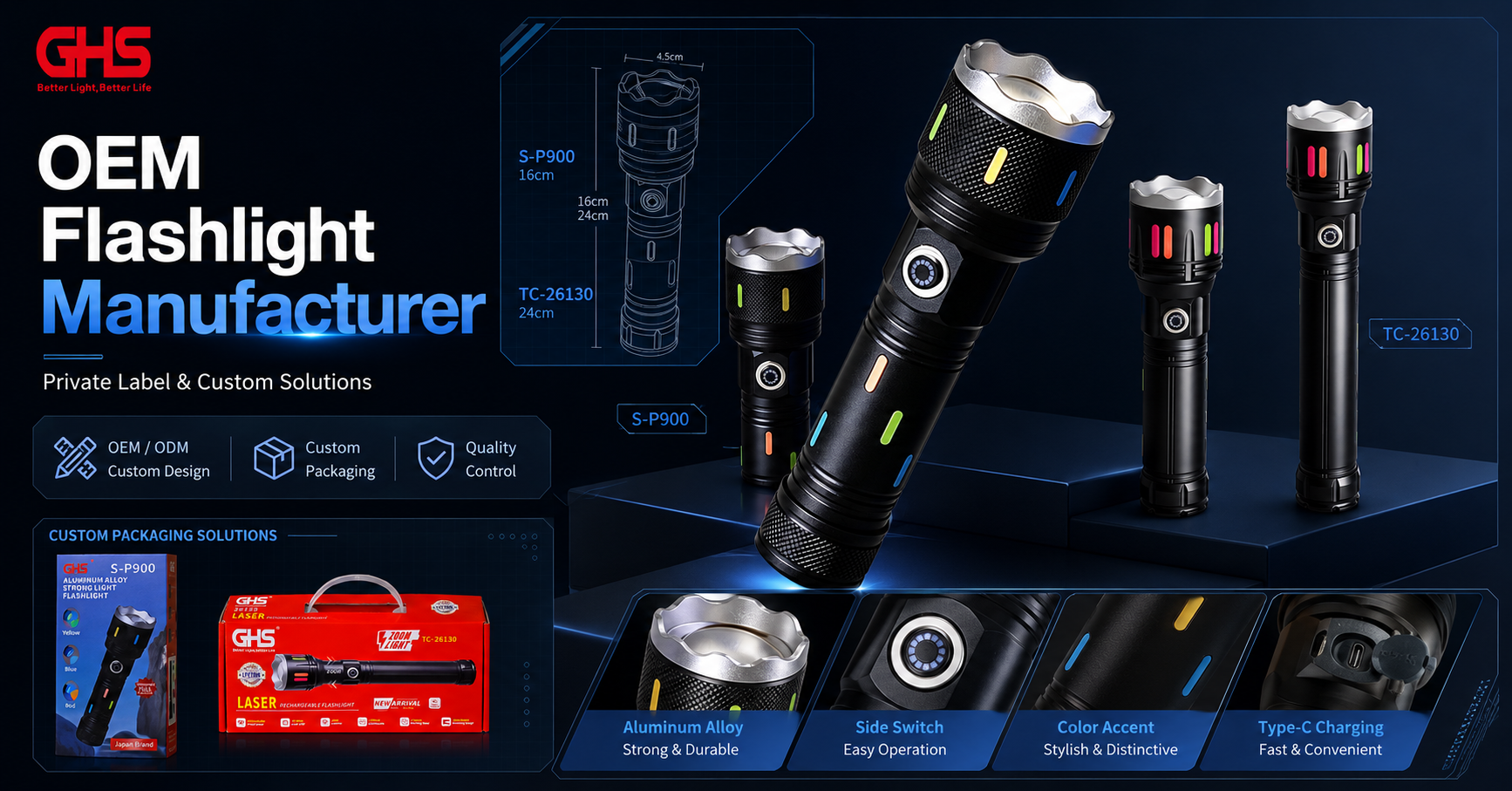
| TC-26130 | Rechargeable utility flashlight | Type-C charging, adjustable beam, side control, battery indication | Retail, emergency, outdoor, and utility programs |
These are product-selection references rather than fully validated performance comparisons.
Exact lumen output, runtime, battery capacity, beam distance, ingress protection, and other application-critical parameters should be confirmed for the chosen configuration.
High-Intensity Product Reference: S-P200W
The GHS S-P200W High-Intensity Rechargeable Flashlight provides an example of the company's larger handheld flashlight designs.
Its product page describes a zoomable, rechargeable format with a textured housing and practical beam adjustment.
The published approximate dimensions include a length of 285 mm and a head diameter of 70 mm.
Buyers should request model-specific performance data before selecting it for professional distribution.
Larger-Format Product Reference: S-P300W
The GHS S-P300W High-Intensity Flashlight provides another product reference.
Its listed physical dimensions are larger than those of the S-P200W.
However, larger dimensions do not independently establish superior light output, runtime, or beam distance.
A suitable comparison requires technical specifications and testing.
Rechargeable Product Reference: TC-26130
For buyers interested in rechargeable utility lighting, the GHS TC-26130 Rechargeable LED Flashlight provides a different product format.
Its product information highlights Type-C charging, adjustable beam operation, and user-oriented controls.
This platform may be useful when exploring retail, emergency, outdoor, or private-label applications.
Manufacturing and Customization Discussion
The GHS website also presents product demonstration materials and identifies OEM/ODM capability within its portable-lighting business.
Prospective buyers can examine GHS product videos and request clarification about available configurations, customization scope, sampling, and production terms.
As with any supplier, actual project suitability should be determined through specifications, commercial discussions, and representative samples.
How to Audit Production Capacity and Lead-Time Reliability
Production capacity should be evaluated in relation to the specific product being purchased.
A factory's building size or total annual production statement does not automatically establish how quickly it can deliver a particular customized flashlight.
Ask for Model-Specific Capacity
Important questions include:
-
What production processes are required for this model?
-
Which components have the longest purchasing lead time?
-
Are custom housings or electronics involved?
-
How many assembly and inspection steps are required?
-
Can the proposed quantity be completed within the requested schedule?
-
Is the timeline based on confirmed material availability?
Understand the Complete Manufacturing Schedule
A typical project may involve:
-
Requirement confirmation
-
Engineering review
-
Sample preparation
-
Sample validation
-
Artwork approval
-
Component procurement
-
Production scheduling
-
Assembly
-
Quality inspection
-
Packaging and shipment preparation
Buyers should avoid assuming that a quoted production lead time includes every stage.
Evaluate Replenishment Capability
For distributors, repeat-order performance is especially important.
A successful first shipment may lead to demand across several sales channels.
The supplier should be able to discuss forecast planning, approved component availability, and reordering procedures.
This helps buyers avoid inventory interruptions and uncontrolled product changes.
Total Sourcing Cost: Look Beyond the Factory Unit Price
The lowest factory quotation is not always the lowest commercial cost.
A professional flashlight sourcing program may involve additional expenses related to product development, inspection, transportation, and market requirements.
Important cost categories include:
-
Unit manufacturing cost
-
Battery configuration
-
Packaging
-
Accessories
-
Tooling
-
Testing
-
Sampling
-
Third-party inspection
-
Freight
-
Duties and taxes
-
Warehousing
-
Returns and warranty administration
Compare Quotations Using the Same Specifications
If two suppliers quote different battery configurations, optical components, or packaging arrangements, the quotations are not directly comparable.
Before making a decision, confirm:
-
Included battery
-
Product specifications
-
Accessories
-
Packaging
-
Inspection requirements
-
Delivery terms
-
Payment terms
Consider Cost of Quality
A lower-priced flashlight may generate higher downstream costs if it experiences inconsistent charging, functional failures, packaging omissions, or frequent returns.
A useful evaluation considers both purchasing price and the likely cost of managing product problems.
For professional buyers, stable quality can be a significant competitive advantage.
A Practical Supplier Qualification Scorecard
Procurement teams can use a weighted assessment to compare manufacturers.
The following framework is an illustrative evaluation tool rather than an external certification system.
| Assessment Area | Suggested Weight |
|---|---|
| Manufacturing process control | 20% |
| Quality management and inspection | 20% |
| Engineering and product knowledge | 15% |
| Component traceability and BOM control | 15% |
| Sample validation and testing evidence | 10% |
| OEM/ODM capability | 10% |
| Commercial communication and delivery planning | 10% |
| Total | 100% |
Each area should be scored using evidence.
For example, a supplier that provides documented component-change procedures and relevant inspection records should be assessed differently from one offering only general assurances.
The scorecard can also reveal the relative importance of weaknesses.
A factory may offer competitive pricing and good communication but require additional verification of technical performance.
Another may demonstrate strong engineering capabilities but lack flexibility for smaller private-label orders.
The appropriate choice depends on the purchasing project's priorities.
Common Mistakes When Sourcing Professional Flashlights From China
Choosing a Factory Based Only on Website Appearance
Factory photographs and product presentations cannot establish complete manufacturing capability.
Request relevant production evidence.
Focusing Exclusively on Unit Price
Compare the same specifications and include quality, logistics, and repeat-order risks.
Confusing Product Categories With Performance Verification
Terms such as “professional,” “tactical,” “industrial,” and “high power” do not automatically establish test results or certifications.
Approving Samples Without Written Specifications
A sample should be supported by controlled technical and commercial documentation.
Ignoring Critical Component Substitutions
Unapproved changes to batteries, drivers, LEDs, and sealing materials can affect performance.
Assuming Every OEM Request Is Simple
A logo modification differs significantly from changing the electronics, charging architecture, or housing structure.
Waiting Until Shipment to Check Battery Documentation
Battery transport requirements should be considered during product planning.
Using One Quality Standard for Every Application
Inspection priorities should reflect the intended product and risk.
Failing to Establish Repeat-Order Controls
A successful initial order does not automatically guarantee future production consistency.
Avoiding these mistakes makes supplier qualification more systematic and reduces preventable commercial problems.
What Should You Include in a Professional Flashlight Factory RFQ?
A detailed request for quotation helps the factory understand both technical and commercial requirements.
Company and Market Information
Provide:
-
Company name
-
Destination country
-
Buyer type
-
Sales channel
-
Intended application
-
Expected order volume
Product Requirements
Specify:
-
Flashlight category
-
Beam type
-
Output expectations
-
Runtime requirements
-
Battery preferences
-
Charging interface
-
Housing requirements
-
Operating modes
-
Environmental protection requirements
OEM Requirements
Where applicable, include:
-
Logo artwork
-
Color
-
Packaging design
-
Accessories
-
User manual
-
Barcode
-
Labeling
-
Required functional changes
Quality and Documentation Requirements
Identify any essential:
-
Performance tests
-
Inspection requirements
-
Critical component controls
-
Market-specific compliance documents
-
Battery transport documentation
Commercial Requirements
Confirm:
-
Initial order quantity
-
Potential repeat-order quantity
-
Target price range
-
Sample schedule
-
Production deadline
-
Destination
-
Required trade terms
A well-defined RFQ enables more accurate quotation comparisons.
If you are still selecting the product platform, it is reasonable to begin with the intended application and request technical recommendations.
Example RFQ for a Professional Flashlight Project
We are sourcing professional rechargeable flashlights for security and industrial distribution. Our requirements include dependable battery performance, practical beam control, durable construction, and consistent production quality. We are also considering private-label branding and customized retail packaging. Please recommend suitable models and provide available specifications, sample arrangements, MOQ, lead time, inspection information, and OEM options.
This type of inquiry is more useful than requesting the lowest price for an unspecified high-power flashlight.
For project discussions, sample requests, and quotation preparation, buyers can contact the GHS sales team with their product requirements.
Frequently Asked Questions About Professional Flashlight Factories in China
1. How can I verify a professional flashlight factory in China?
Begin by confirming the company's identity, manufacturing location, product categories, and actual responsibilities. Review factory information, request relevant production evidence, evaluate representative samples, and ask about component traceability, quality control, and corrective actions. For larger projects, consider a targeted factory audit.
2. What is the difference between a professional flashlight factory and a regular flashlight supplier?
A factory is primarily associated with manufacturing operations, while a supplier may be a manufacturer, distributor, trading company, or sourcing organization. The more important distinction is which organization controls product engineering, specifications, components, production quality, and repeat orders.
3. Can Chinese flashlight factories provide OEM and ODM services?
Many manufacturers offer different customization levels, but the actual capability varies. Private-label services may include logos and packaging, while OEM and ODM projects may involve electrical, optical, mechanical, or product-development changes. Buyers should confirm each requested modification individually.
4. What tests are important for professional LED flashlights?
Testing depends on the application. Relevant areas may include light output, beam intensity, runtime, thermal behavior, charging, battery protection, switch durability, impact resistance, and ingress protection. Test methods and acceptance criteria should be defined before production.
5. How do I verify that a flashlight meets its advertised brightness?
Request measurement information for the complete flashlight rather than relying only on the LED component rating. ANSI/PLATO FL 1 provides a standardized portable-lighting performance framework. The test should identify the operating mode, conditions, battery configuration, and measured output.
6. What certifications should a professional flashlight factory provide?
Applicable requirements depend on the product, intended market, and application. Buyers should request evidence relevant to the exact model and configuration. A company's general management-system certification does not automatically establish product-level compliance.
7. What is the typical MOQ for OEM professional flashlights?
MOQ depends on the product platform, customization depth, components, tooling, and packaging requirements. Existing models with branding changes may have different minimum quantities from fully customized products. Ask for the MOQ of the exact proposed configuration.
8. How can I reduce defects in bulk flashlight orders?
Define critical product characteristics, approve representative samples, control the BOM, agree on inspection criteria, and establish procedures for handling nonconforming products. Quality verification should include relevant incoming, in-process, and finished-product controls.
9. Can professional flashlights be customized for security and industrial applications?
Potential customization may include beam configuration, battery system, charging, operating modes, housing finish, switches, indicators, accessories, and packaging. However, any changes affecting performance, safety, or sealing should undergo appropriate engineering review and validation.
10. How long does professional flashlight manufacturing take in China?
Lead time varies according to the product, components, order quantity, customization, and production schedule. A complete timeline should separate sampling, approval, material purchasing, manufacturing, quality inspection, and shipment preparation. Buyers should request a project-specific schedule rather than relying on a generic estimate.
11. What is the most important factor when choosing a professional flashlight factory China supplier?
The strongest indicator is the manufacturer's ability to repeatedly deliver the approved specification. Product knowledge, component control, sample validation, quality management, and corrective-action procedures are essential because they directly influence long-term reliability.
12. How should importers prepare for repeat orders?
Maintain approved specifications, component records, packaging files, sample references, and inspection requirements. Agree on a process for reviewing critical component changes. Repeat orders should reference the previously approved configuration rather than rely on informal descriptions.
Conclusion
Choosing a professional flashlight factory China buyers can trust requires verified manufacturing capabilities, consistent component control, application-specific testing, and dependable OEM/ODM processes. A strong factory partnership is built around repeatable product quality, transparent specifications, and reliable production rather than price alone.
For importers, distributors, security equipment brands, and industrial buyers, GHS offers a range of rechargeable and high-intensity flashlight platforms for evaluation. Explore the GHS flashlight product range or contact GHS to discuss OEM requirements, sample evaluation, manufacturing capabilities, and bulk quotations.