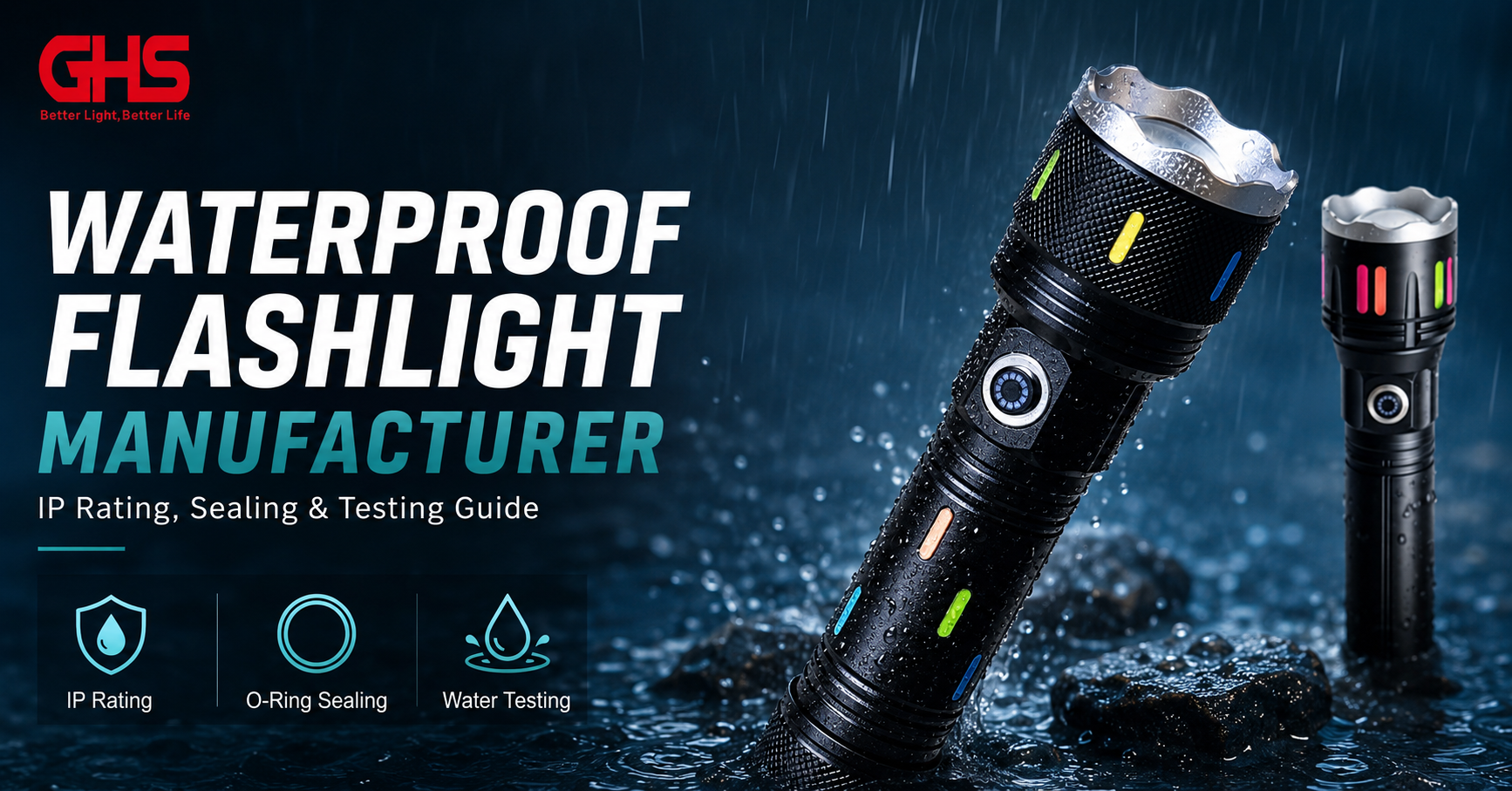

What Should Buyers Check in a Waterproof Flashlight Manufacturer?
A reliable waterproof flashlight manufacturer should be able to explain exactly what level of water protection a product is designed to achieve, how that protection is created and how it is verified during production.
For professional B2B buyers, the word “waterproof” alone is not an adequate specification.
A product listing may say:
- Waterproof
- Water-resistant
- Rainproof
- Weatherproof
- Outdoor waterproof
But these descriptions do not automatically tell a buyer what conditions the flashlight can withstand.
A better sourcing question is:
What ingress-protection requirement does this flashlight meet, under what test conditions, and how is production consistency controlled?
That question turns a vague marketing claim into a measurable purchasing requirement.
Waterproof Flashlight Buyer Checklist
Before comparing products or quotations, buyers should establish the required protection level and test criteria.
| Evaluation Area | What Buyers Should Check | Why It Matters |
|---|---|---|
| IP requirement | Defined target protection level | Replaces vague “waterproof” claims |
| Housing joints | Fit and structural sealing | Common water-ingress location |
| O-rings | Material, placement and compression | Important for removable joints |
| Lens sealing | Lens, bezel and gasket construction | Protects optical cavity |
| Switch | Mechanical or electronic sealing design | Common failure point |
| Charging port | Port structure and protective cover | Important for rechargeable models |
| Tailcap | Threads, O-rings and battery access | Frequently opened by users |
| Test method | Water exposure conditions and duration | Makes results comparable |
| Sample testing | Pre-production verification | Confirms design before bulk orders |
| Production QC | Inspection and water-test sampling | Controls batch consistency |
| Assembly | Torque, seals and component fit | Affects actual protection |
| OEM changes | Impact of modifications on enclosure | Customization may alter sealing |
A professional buyer should define these items before approving mass production.
What Does an IP Rating Mean?
The IP Code is defined by IEC 60529, Degrees of Protection Provided by Enclosures.
An IP designation normally uses two characteristic numerals.
The first relates to protection against solid objects and access to hazardous parts.
The second relates to protection against water ingress.
When only water protection is being discussed and solid-particle protection has not been specified, the first numeral may be replaced by an X, producing descriptions such as:
- IPX4
- IPX5
- IPX6
- IPX7
- IPX8
For B2B procurement, this distinction matters because IPX7 and IP67 are not identical claims.
IP67 includes a defined solid-particle protection classification as well as water protection, while IPX7 only communicates the water-related classification.
Buyers should therefore copy the exact rating stated in the valid test documentation rather than simplifying it in product packaging or marketing material.
IPX4 vs IPX5 vs IPX6 vs IPX7 vs IPX8
Different IP levels address different water-exposure conditions.
A simplified buyer-oriented comparison is:
| Rating | General Water-Protection Context | Typical Buyer Consideration |
| IPX4 | Splashing water | Rain and general outdoor exposure |
| IPX5 | Water jets | More demanding wet environments |
| IPX6 | Stronger water jets | Higher exposure to driven water |
| IPX7 | Temporary immersion under defined conditions | Accidental immersion scenarios |
| IPX8 | Immersion under manufacturer-agreed conditions beyond IPX7 | More demanding immersion requirements |
These descriptions should be used as procurement guidance rather than as substitutes for the detailed IEC test requirements.
A buyer requiring a specific IP rating should confirm the exact test conditions with the manufacturer or testing laboratory.
Higher IP Numbers Are Not Automatically Better for Every Product
It is tempting to request the highest possible waterproof rating.
That can be unnecessary.
A flashlight intended for:
- Household emergency kits
- Hardware retail
- Routine outdoor use
may have different requirements from a flashlight intended for:
- Marine environments
- Search-and-rescue use
- Professional field work
- Frequent exposure to heavy rain
- Temporary immersion
Higher protection requirements can influence:
- Product structure
- Port design
- Manufacturing tolerances
- Assembly process
- Testing
- Cost
The correct specification should therefore start with the actual application, not the highest available IP number.
“Waterproof” Is Not the Same as “Works Underwater”
This is an important distinction for buyers.
A flashlight may be designed to prevent water ingress under a particular standardized test without being intended for continuous operation as an underwater diving light.
The IP rating addresses enclosure protection under defined conditions.
It does not automatically establish suitability for every underwater application.
Buyers sourcing products for prolonged underwater operation should define additional requirements such as:
- Operating depth
- Duration
- Pressure
- Temperature
- Repeated immersion
- Switch operation underwater
These requirements may go beyond a typical outdoor flashlight specification.
Where Does Water Usually Enter a Flashlight?
Water does not pass through a solid aluminum wall.
It normally enters through interfaces between components.
Common risk areas include:
- Lens and bezel
- Flashlight head joints
- Switches
- Charging ports
- Tailcaps
- Battery-compartment joints
- Accessory or structural openings
A professional waterproof flashlight manufacturer should consider all of these interfaces as part of the enclosure system.
Why O-Rings Matter
O-rings are commonly used to seal threaded or removable flashlight joints.
Their effectiveness depends on more than simply placing a rubber ring inside the product.
Important factors include:
- O-ring dimensions
- Material
- Groove geometry
- Compression
- Surface finish
- Lubrication where appropriate
- Assembly consistency
If an O-ring is too loose, it may not seal effectively.
If it is excessively compressed or damaged during assembly, its sealing performance may also deteriorate.
For repeat production, buyers should therefore treat critical sealing components as controlled parts.
Thread Design Can Affect Water Resistance
Threaded joints are common in flashlight bodies and tailcaps.
These areas must allow users to open the product while still maintaining enclosure protection after reassembly.
Factors can include:
- Thread tolerance
- O-ring position
- O-ring compression
- Machining consistency
- Surface finish
- Assembly torque
A sample that passes a water test once is useful, but long-term product design should also consider repeated opening and closing.
For products with replaceable batteries, this becomes particularly important.
Lens and Bezel Sealing
The front optical assembly is another critical area.
A typical flashlight may include:
- Bezel
- Lens
- Gasket
- Reflector or optic
- Housing
Water entering around the lens can affect:
- Optical clarity
- Reflector surfaces
- LED electronics
- Internal corrosion
Buyers should inspect samples for visible gasket placement, assembly consistency and evidence of moisture after testing.
Switch Design Is a Common Waterproofing Challenge
The flashlight switch must allow user input while maintaining enclosure integrity.
Depending on the design, waterproofing may involve:
- Rubber switch boots
- Internal membranes
- Sealed electronic switches
- Structural gaskets
- Mechanical barriers
Buyers should check both:
Does the switch function normally after water exposure?
and
Does water enter through the switch assembly?
A product should not be evaluated only by whether the light remains on during a short test.
Rechargeable Flashlights Add Charging-Port Risk
Rechargeable flashlights introduce an additional enclosure opening.
The charging interface may use:
- USB-C
- Micro-USB
- Proprietary connectors
- Other charging systems
If a physical charging port is exposed through the housing, its design becomes part of the waterproofing strategy.
Important factors can include:
- Rubber cover
- Cover fit
- Cover thickness
- Retaining structure
- Port position
- Internal protection
A loose charging-port cover can become a common failure point.
Is a Rubber USB-C Cover Enough?
Not necessarily.
A rubber cover can help protect a charging interface, but actual water resistance depends on the entire port structure.
Buyers should consider:
- How tightly the cover seats
- Whether it remains attached after repeated use
- Whether users can accidentally leave it partially open
- Whether the internal connector has additional protection
- Whether testing is performed with the cover installed correctly
For professional projects, the instruction manual may also need to explain that the charging-port cover must be fully closed before exposure to water.
Waterproofing and Heat Management Can Conflict
One engineering challenge in high-performance flashlights is that strong sealing limits direct airflow into the enclosure.
At the same time, high-output LEDs and drivers generate heat.
The manufacturer therefore needs to manage both:
Ingress protection
and
thermal performance
without creating unnecessary failure risks.
Metal housings can help transfer heat through the flashlight body while the enclosure remains sealed.
This is one reason waterproofing should be evaluated as part of the complete flashlight design rather than as an isolated rubber-seal feature.
How Should Waterproof Flashlights Be Tested?
The test method should match the claimed protection requirement.
Depending on the IP level, evaluation may involve controlled:
- Splash exposure
- Water jets
- Immersion
- Duration
- Distance
- Water flow or pressure
The exact test conditions should follow the applicable standard or agreed specification.
For B2B sourcing, buyers should avoid informal tests such as:
We poured water on it and it still worked.
That may be useful as a demonstration, but it is not equivalent to a defined standardized test.
Design Verification vs Production Testing
Buyers should distinguish between two types of testing.
Design Verification
This asks:
Can this flashlight design meet the intended waterproof requirement?
Testing may be performed on engineering or production-representative samples.
Production Quality Control
This asks:
Is mass production consistently assembled to the approved waterproof design?
A model passing a laboratory test once does not guarantee that every production batch will automatically maintain identical sealing.
Production controls are still necessary.
Should Every Flashlight Be Immersion Tested?
Not necessarily.
The correct production inspection plan depends on:
- Product design
- Required IP rating
- Order quantity
- Test duration
- Cost
- Manufacturing risk
- Buyer requirements
Some projects may use:
- 100% functional inspection
- Visual seal inspection
- Leak-test methods
- Sampling-based water tests
- Final inspection sampling
A buyer should discuss the appropriate QC plan with the manufacturer before production.
Waterproof Flashlight Production QC Checklist
Important production-control points can include:
Incoming Components
Inspect:
- O-rings
- Gaskets
- Switch boots
- Port covers
- Lens parts
- Housing components
Assembly
Verify:
- O-ring presence
- O-ring positioning
- Seal damage
- Housing fit
- Lens assembly
- Switch installation
- Port-cover installation
Functional Testing
Confirm:
- Lighting modes
- Switch function
- Charging
- Battery connection
Water-Protection Sampling
According to the agreed plan:
- Select production samples
- Apply the defined water test
- Inspect for internal moisture
- Verify operation after testing
How Do You Check for Internal Water Ingress?
After water testing, a product may continue to operate even though a small amount of moisture has entered.
Inspection should therefore look beyond basic operation.
Potential indicators include:
- Condensation behind the lens
- Water droplets
- Moisture around the battery compartment
- Wet internal components
- Corrosion risk
If moisture is found, the manufacturer should identify the ingress path rather than simply drying the flashlight and repeating the test.
Why Manufacturing Tolerance Matters
A waterproof design can fail if production dimensions vary excessively.
Potential problems include:
- O-ring groove variation
- Housing diameter variation
- Uneven mating surfaces
- Thread differences
- Lens-seat variation
- Inconsistent port-cover fit
This means machining, molding and assembly consistency are part of waterproof performance.
For B2B buyers, a supplier's process control can therefore be just as important as the original enclosure concept.
Can Impact Damage Reduce Waterproof Performance?
Yes.
A waterproof flashlight is a physical enclosure.
If it is dropped hard enough to:
- Deform the bezel
- Crack a lens
- Damage a switch
- Distort a housing joint
- Tear a seal
its original water resistance may no longer remain intact.
The revised ANSI/PLATO FL 1-2025 framework also strengthened the relationship between portable-light durability testing and water/dust ingress protection.
For outdoor products, buyers should therefore evaluate durability and water protection together rather than as completely separate product characteristics.
What About Dust Protection?
Outdoor users encounter more than water.
They may also encounter:
- Sand
- Dust
- Dirt
- Fine particles
When both water and solid-particle protection matter, buyers should consider the full IP designation rather than only an IPX water rating.
For example, a product specification may need both dust and water protection depending on its market.
Again, the exact required rating should be based on actual use conditions.
Waterproof vs Weather-Resistant Flashlights
These terms should not be treated as technical equivalents.
Weather-Resistant
Usually describes general ability to tolerate outdoor environmental exposure, but the term itself does not communicate a standardized IP level.
Water-Resistant
Suggests some resistance to water exposure but still requires clarification.
Waterproof
Commonly used in marketing, but without a rating or defined test it remains ambiguous.
IP-Rated
Provides a clearer technical basis when supported by appropriate testing and documentation.
For B2B procurement, measurable specifications are preferable to marketing adjectives.
How to Write a Waterproof Flashlight RFQ
A professional RFQ should include the actual environment.
Application
For example:
- Camping
- Hardware retail
- Outdoor work
- Security
- Emergency kits
- Agricultural use
- Marine environments
Water Requirement
Specify:
- Required IP rating
- Expected rain exposure
- Immersion requirement if applicable
- Test documentation requirement
Product Requirements
Include:
- Battery
- Charging
- Output
- Runtime
- Housing material
- Size
- Beam type
Commercial Requirements
Include:
- Quantity
- Logo
- Packaging
- Market
- Target schedule
This allows the manufacturer to evaluate whether an existing product is suitable.
What Happens When a Waterproof Flashlight Is Customized?
OEM changes can affect enclosure protection.
Changes that deserve additional review can include:
- New switch
- Different charging port
- Modified housing
- New tailcap
- Different lens
- Structural machining
- New accessory opening
Even changes that appear small may alter sealing surfaces.
Therefore, buyers should not automatically assume:
Standard model is IP-rated, so customized model has the same rating.
The customized configuration should be reviewed and, where necessary, revalidated.
Logo Customization Usually Has Lower Sealing Risk
Surface branding such as:
- Laser engraving
- Printing
generally does not require creating an opening through the flashlight housing.
As a result, it may have less effect on enclosure protection than structural customization.
However, the actual production process should still be evaluated by the manufacturer.
What Determines Waterproof Flashlight Cost?
Waterproof performance can affect cost through:
- Additional seals
- Higher machining precision
- Port covers
- Switch structures
- Housing design
- Assembly control
- Testing
- QC
- Materials
A lower-priced flashlight that uses a weaker sealing structure may not be commercially equivalent to a properly validated IP-rated product.
Buyers should therefore compare:
Specification + Test Requirement + Quality Control + Price
not price alone.
How to Compare Waterproof Flashlight Manufacturers
Use a structured comparison.
| Factor | Supplier A | Supplier B | Importance |
| Claimed IP rating | Confirm | Confirm | High |
| Test method | Confirm | Confirm | High |
| Supporting documentation | Confirm | Confirm | High |
| O-ring design | Evaluate | Evaluate | High |
| Switch sealing | Evaluate | Evaluate | High |
| Charging-port protection | Evaluate | Evaluate | High |
| Housing tolerance | Evaluate | Evaluate | High |
| Production QC | Evaluate | Evaluate | High |
| Water-test sampling | Evaluate | Evaluate | High |
| Battery / charging | Compare | Compare | Medium |
| OEM options | Compare | Compare | Medium |
| MOQ | Compare | Compare | Medium |
| Lead time | Compare | Compare | Medium |
| Price | Compare | Compare | High |
The manufacturer should be evaluated on both design capability and production repeatability.
Common Waterproof Flashlight Sourcing Mistakes
Accepting the Word “Waterproof”
Always request a measurable requirement.
Confusing IPX7 With IP67
The first numeral and second numeral communicate different protection characteristics.
Assuming Higher IP Is Always Necessary
Select protection according to application.
Ignoring the Charging Port
Rechargeable interfaces can become critical ingress points.
Testing Only One Perfect Sample
Production consistency also matters.
Ignoring Seal Wear
Tailcaps and port covers may be opened repeatedly by users.
Modifying the Housing Without Revalidation
OEM structural changes can affect the original protection level.
Inspecting Only Whether the Light Still Works
Internal moisture may exist even when the flashlight remains operational.
GHS Waterproof Flashlight Project Evaluation
GHS manufactures portable flashlight products for outdoor and rechargeable lighting applications.
For a waterproof flashlight project, the appropriate model should be selected according to the buyer's actual application rather than assuming that every GHS flashlight has the same ingress-protection rating.
Before ordering, buyers should confirm model-specific information such as:
- Target IP rating
- Water-test method
- Housing and sealing structure
- Battery configuration
- Charging interface
- Output
- Runtime
- OEM options
- MOQ
- Lead time
- Required documentation
This is particularly important because waterproof performance should be tied to the exact model and configuration being purchased.
Questions to Ask a Waterproof Flashlight Manufacturer
Before placing a bulk order, ask:
- What IP rating does this exact model support?
- Which test method is used?
- Is a test report available for the selected configuration?
- Where are the main O-rings located?
- What material are critical seals made from?
- How is the lens sealed?
- How is the switch protected?
- How is the charging port protected?
- Must the charging-port cover be closed during water exposure?
- How is the tailcap sealed?
- Is waterproof testing performed during production?
- What sampling plan is used?
- How are defective seals detected?
- Does the flashlight undergo testing after assembly?
- Can we evaluate water resistance during sample approval?
- Can structural customization affect the IP rating?
- How are critical sealing components controlled between orders?
- What happens if an O-ring or gasket supplier changes?
- What is the MOQ for the required waterproof configuration?
- What is the production and testing lead time?
FAQ About Waterproof Flashlight Manufacturers
What is a waterproof flashlight manufacturer?
A waterproof flashlight manufacturer produces portable lighting products designed to resist defined levels of water ingress through enclosure design, seals, switches, joints and other protected interfaces.
What IP rating should an outdoor flashlight have?
There is no single rating suitable for every outdoor application. Buyers should select the required protection level according to expected rain, jets, immersion, dust and operating conditions.
What is the difference between IPX7 and IP67?
Both include the same water-protection numeral, but IP67 also specifies solid-particle protection. IPX7 leaves the solid-particle classification unspecified.
Is IPX8 always better than IPX7?
IPX8 represents different immersion conditions, but the appropriate requirement depends on the application. Buyers should not automatically specify a higher rating without considering product use and test conditions.
Can a USB rechargeable flashlight be waterproof?
Yes, a rechargeable flashlight can be designed for water resistance, but the charging-port structure, seals and cover design become important parts of the enclosure system.
Can OEM customization affect waterproofing?
Yes. Structural changes to the housing, switch, charging port, lens or tailcap can affect sealing and may require additional validation.
Why are O-rings important in flashlights?
O-rings help seal removable or threaded housing joints. Their dimensions, material, groove design and assembly directly affect sealing performance.
Should every flashlight be tested underwater before shipment?
Not necessarily. The correct production test plan depends on the product design, IP requirement, quantity and buyer specification. Sampling or other leak-testing methods may be appropriate.
Can a waterproof flashlight lose water resistance after being dropped?
Yes. Impact can damage seals, lenses, switches or housing joints and may reduce the enclosure's original protection.
How do I choose a reliable waterproof flashlight manufacturer?
Compare the defined IP requirement, test method, enclosure design, sealing components, production tolerances, QC, sample verification, documentation and repeat-order control rather than relying on the word “waterproof.”