
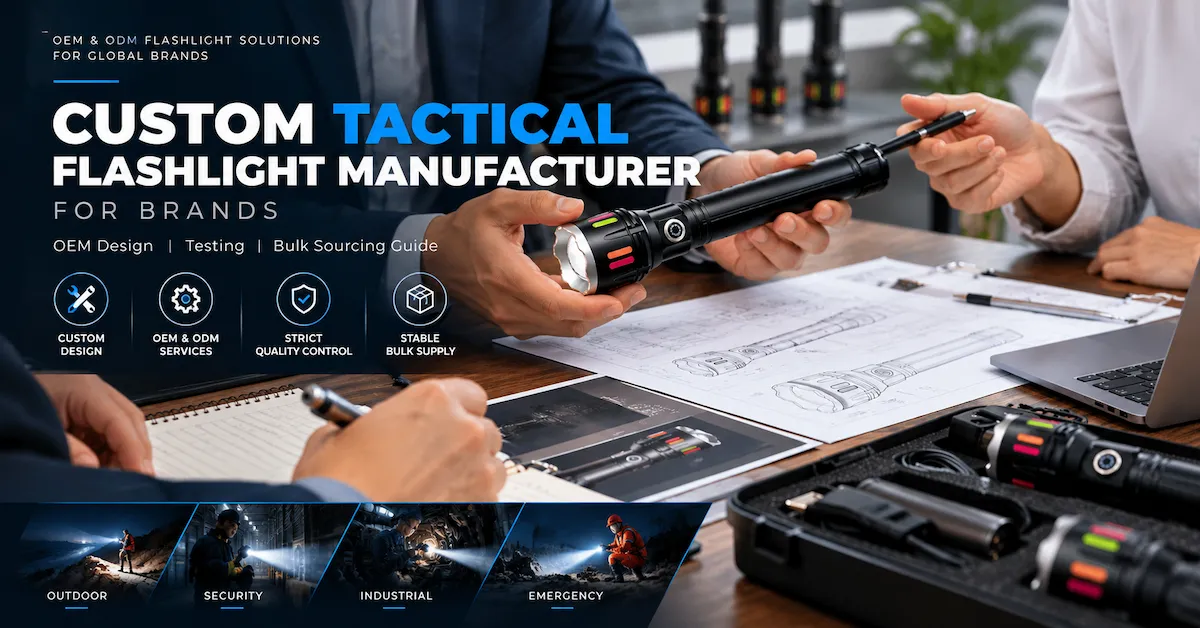
Choosing a custom tactical flashlight manufacturer for brands requires more than finding a factory that can engrave a logo on a black flashlight. Brand owners need a product platform that matches their customers' expectations, supports meaningful differentiation, and maintains consistent quality across repeat orders.
For outdoor equipment brands, security product distributors, hardware retailers, and private-label sellers, the real challenge is balancing product design, practical lighting performance, manufacturing costs, and reliable delivery.
The best approach is to define your target users, select a suitable flashlight platform, establish measurable specifications, approve functional samples, and document production requirements before placing a bulk order.
This guide explains how to develop a branded handheld flashlight collection, evaluate OEM options, control manufacturing risks, and prepare a detailed request for quotation.
1. What Does a Custom Tactical Flashlight Manufacturer Do for Brands?
A custom tactical flashlight manufacturer develops or produces handheld lighting products according to a buyer's branding, functional, or design requirements.
Depending on the manufacturer's capabilities and the complexity of the project, customization may involve:
-
Brand logo and product identification
-
Housing color, appearance, and surface finish
-
Retail packaging and multilingual instructions
-
Battery and charging configuration
-
Lighting modes and switch operation
-
Optical components and beam characteristics
-
Carrying accessories and packaging sets
-
Product structure and industrial design
These changes are not equally complex.
Adding branding to an existing flashlight requires a different development process from changing its electronics, optical system, or mechanical construction.
A supplier capable of applying a logo should not automatically be considered capable of developing a new flashlight platform.
For brand owners, choosing the appropriate manufacturing relationship is therefore essential.
Which Buyers Benefit Most from Custom Tactical Flashlights?
| Buyer Type | Commercial Objective | Important Customization Needs |
|---|---|---|
| Outdoor Equipment Brands | Launch distinctive handheld lighting collections | Housing design, beam modes, portability, packaging |
| Security Equipment Distributors | Supply practical inspection and patrol lighting | Controls, sustained output, durability evaluation |
| Private-Label E-commerce Brands | Differentiate products across online channels | Branding, accessory bundles, accurate specifications |
| Hardware and Tool Brands | Expand into professional-looking lighting products | Product consistency, packaging, cost control |
| Importers and Wholesalers | Build repeatable product assortments | Stable models, quantity planning, quality inspection |
| Emergency Equipment Brands | Develop rechargeable backup-lighting products | Battery storage, charging, operating simplicity |
Not every flashlight described as tactical is designed for specialized operational use.
A tactical-style handheld flashlight may be suitable for everyday carry, outdoor work, or general security inspection. Products intended for hazardous locations or regulated professional applications require additional evaluation.
For private-label brands, the first task is to define what “tactical” means for the intended customer rather than relying on the product's appearance.
2. Build a Product Strategy Before Starting OEM Customization
Successful flashlight brands typically begin with a defined market position.
A brand selling compact everyday-carry lighting has different priorities from one supplying large handheld lights for outdoor inspection.
Trying to combine every feature in one product may create unnecessary cost and complicated operation.
Three Product Positions to Consider
| Product Position | Key Design Priorities | Target Market |
|---|---|---|
| Compact Tactical-Style EDC | Portable body, convenient charging, simple controls | Everyday carry, hardware retail, outdoor accessories |
| Rechargeable Inspection Flashlight | Adjustable beam, accessible switch, practical runtime | Maintenance, security inspection, vehicle applications |
| High-Intensity Handheld Flashlight | Beam performance, thermal management, handling comfort | Outdoor equipment distributors, high-output lighting buyers |
These are proposed product strategies, not a claim that every configuration is already available from GHS.
Define a Minimum Viable Product
Before creating custom artwork, determine the product characteristics essential to your target market.
For example, an outdoor brand may prioritize one-hand operation, controlled beam adjustment, charging convenience, and comfortable carrying.
A security equipment distributor may place greater emphasis on dependable activation, consistent light output, and repeatable operation.
Document these requirements before evaluating a supplier's catalog.
This prevents a common sourcing problem: selecting an attractive flashlight design and discovering later that its internal components or operating system cannot satisfy the intended application.
3. OEM vs ODM vs Private Label: Which Model Fits Your Brand?
The customization model determines development costs, project responsibilities, and the level of product differentiation.
Private-Label Flashlight Manufacturing
Private-label projects generally use an existing flashlight platform and introduce buyer-specific branding.
Typical requests include logo placement, printed boxes, product labels, and instruction manuals.
This approach may reduce the amount of product development required, making it a logical starting point for brands testing new lighting categories.
However, the supplier must confirm which branding methods and packaging configurations are available for the chosen model.
OEM Tactical Flashlight Customization
OEM projects may involve additional product or configuration requirements.
A buyer might want a specific accessory kit, operating-mode arrangement, housing appearance, or battery configuration.
The manufacturer should review whether each change is compatible with the existing design and whether additional validation is required.
ODM Flashlight Development
ODM projects may involve substantial changes to product structure, electronics, optical systems, controls, or industrial design.
These projects generally require greater engineering coordination.
Brand owners should establish design responsibilities, tooling ownership, testing requirements, and approval milestones before beginning development.
Customization Comparison
| Project Type | Main Activities | Key Commercial Consideration |
|---|---|---|
| Private Label | Logo, labeling, packaging | Minimum order and branding cost |
| OEM | Approved configuration changes | Engineering feasibility and validation |
| ODM | New or substantially modified product design | Development expenses, tooling, IP ownership |
For further sourcing considerations, see the GHS guide to choosing an OEM flashlight manufacturer for private-label projects.
4. Which Technical Specifications Matter for Custom Tactical Flashlights?
A tactical-style flashlight should be evaluated as a complete lighting system.
Housing appearance alone does not establish output, reliability, weather resistance, or suitability for professional use.
LED Output, Beam Intensity, and Distance
Luminous flux, measured in lumens, describes the total visible light emitted.
Candela describes luminous intensity in a particular direction.
Beam distance relates to how far the projected beam reaches a defined illumination threshold under a specified method.
For buyers, the difference matters because a flashlight with high total output may not produce the most concentrated long-distance beam.
Outdoor brands should determine whether customers primarily need broad-area illumination, focused lighting, or an adjustable beam.
Request relevant performance measurements rather than relying on promotional terms such as ultra bright or long range.
Battery and Charging Design
Rechargeable flashlight performance depends on battery configuration, driver efficiency, operating modes, and charging electronics.
A higher battery-capacity number does not automatically establish longer practical runtime.
Brands should request information about battery chemistry, nominal capacity, charging input, protection functions, and runtime under defined conditions.
If USB-C charging is proposed, confirm the actual charging behavior. A Type-C connector does not automatically guarantee compatibility with every charging protocol or power source.
Housing and Mechanical Structure
The housing influences handling, heat dissipation, component protection, and appearance.
Important mechanical details include grip texture, switch placement, body dimensions, threaded joints, lens alignment, and charging-port protection.
Where relevant, buyers should inspect how the flashlight operates while wearing gloves or using one hand.
The exact housing material and finish should be confirmed in the approved specification.
Switches and User Interface
A well-designed flashlight should make essential functions easy to access.
Complicated lighting-mode sequences may create difficulties for users who need straightforward operation.
When preparing an OEM brief, identify the desired activation method, mode sequence, brightness adjustment, and switch location.
Any requested control changes must be evaluated for compatibility with the product platform.
Technical Specification Checklist
| Specification | Why Brands Should Evaluate It | Evidence to Request |
|---|---|---|
| LED output | Supports accurate product positioning | Measured luminous flux |
| Peak beam intensity | Helps assess focused illumination | Candela measurement |
| Runtime | Indicates operating performance | Brightness-versus-time results |
| Battery configuration | Affects energy capacity and supply consistency | Approved battery specification |
| Charging input | Determines charging compatibility | Electrical and functional test data |
| Housing material | Affects structure and finish | Confirmed material specification |
| Switch operation | Influences usability | Functional and cycle-testing criteria |
| Water resistance | Determines environmental suitability | Applicable ingress-protection test evidence |
| Drop resistance | Indicates defined impact tolerance | Test method and results |
| Product dimensions | Affects handling and packaging | Approved dimensions and weight |
The ANSI/PLATO FL 1-2025 standard provides recognized methods for evaluating important portable-lighting performance claims.
For outdoor or professional-looking products, buyers should distinguish short-duration maximum output from sustained illumination.
A branded tactical flashlight should be marketed according to verified performance, not assumptions based on appearance or product names.
5. How to Evaluate GHS Flashlight Platforms for Brand Development
Guangdong Guanghuishi Electrical Appliances Co., Ltd. (GHS) is a China-based lighting company whose website describes activities in product development, manufacturing, and sales.
Its published LED flashlight product catalog includes rechargeable handheld flashlights and high-intensity lighting models.
For brand owners, existing products can provide a useful starting point for evaluating form factors, charging arrangements, controls, and possible customization requirements.
GHS Product Platforms Worth Reviewing
| Product | Officially Described Characteristics | Potential Brand Positioning |
|---|---|---|
| TC-26130 Rechargeable Flashlight | Handheld rechargeable design, Type-C charging, side controls, zoom-related features | Utility, inspection, tactical-style retail |
| S-P900 Rechargeable Flashlight | Portable handheld body, side switch, adjustable-beam concept | Outdoor accessories and rechargeable lighting |
| S-P161 Rechargeable Flashlight | Rechargeable flashlight platform with beam-adjustment features described | Outdoor, everyday-carry and inspection-oriented assortments |
Product selection note: These are existing flashlight references, not independently verified professional tactical models. The available versions, customization scope, dimensions, battery configuration, optical performance, and compliance documentation must be confirmed before purchasing.
For example, the TC-26130 product information references a related TC-26230 configuration, making version confirmation particularly important.
How Brands Can Use Existing Models
A brand can begin by comparing the physical design, controls, charging arrangement, packaging, and intended customer segment of available products.
The next step is to ask which modifications the manufacturer can actually support.
The goal is not necessarily to develop an entirely new flashlight.
For some brands, a well-selected existing platform with coherent branding, reliable quality control, and a suitable accessory package can be more commercially practical than a complex development project.
For others, stronger differentiation may justify additional design work.
Both approaches require realistic feasibility and cost assessment.
6. Sample Approval and Quality Control for Branded Flashlights
A manufacturer's sample should represent an agreed product configuration rather than merely demonstrate that a flashlight can turn on.
Brand owners need to understand what will be reproduced during mass production.
Establish a Golden Sample
A golden sample is the approved product reference used during production and inspection.
It should be supported by documentation covering critical components, external appearance, functionality, branding, packaging, and relevant performance requirements.
If the supplier proposes changing a battery, LED driver, optical component, or other critical part, the buyer should assess the implications before approving the change.
Recommended Sample Testing Matrix
| Inspection Area | Suggested Evaluation | Common Concern |
|---|---|---|
| Appearance | Finish, markings, body assembly | Scratches, incorrect branding |
| Controls | Switch and lighting-mode operation | Intermittent activation |
| Optics | Beam consistency and alignment | Uneven beam or incorrect output |
| Runtime | Output over a defined operating period | Unexpected brightness reduction |
| Charging | Input behavior and charging completion | Charging instability |
| Mechanical Structure | Thread fit, buttons, lens assembly | Loose or inconsistent components |
| Packaging | Artwork, labels, manuals and accessories | Incorrect or missing components |
| Environmental Protection | Required application-specific tests | Unsupported durability claims |
Testing should be selected according to the product's actual use and commercial risks.
A flashlight intended for general outdoor retail may require a different qualification plan from one marketed for demanding professional applications.
Control Quality Across Production
The buyer should ask how incoming components, assembly, functional testing, and finished goods are inspected.
Document the acceptance criteria for critical, major, and minor defects.
Where sampling inspection is used, agree on the inspection method before production.
Do not accept an undefined promise of strict quality control as a substitute for agreed inspection procedures.
Maintain Repeat-Order Consistency
Successful branded product lines often depend on repeat orders.
Maintaining the approved bill of materials, packaging artwork, and product version can help reduce unexpected changes.
For private-label buyers, this is particularly important because inconsistent products can create returns, complaints, and problems with established product listings.
7. What Compliance Documents Should Tactical Flashlight Brands Request?
Compliance requirements depend on the destination market, battery system, product features, and intended application.
No single set of documents applies universally to every handheld flashlight.
For rechargeable products containing lithium batteries, relevant transportation documentation may include the applicable UN 38.3 lithium battery test summary.
Where water or dust resistance is advertised, buyers should request evidence corresponding to the applicable IEC 60529 protection classification.
Product-specific electrical safety, electromagnetic compatibility, materials restrictions, and labeling requirements should also be assessed for the target market.
For European consumer markets, relevant requirements may include applicable EU product legislation and the General Product Safety Regulation.
A generic tactical appearance does not establish suitability for explosive atmospheres, hazardous industrial locations, or specialized operational equipment.
Brand owners should avoid making those claims without applicable model-specific evidence.
The correct sourcing question is not simply whether the factory has certifications. It is whether the actual product version has the documentation necessary for its intended market.
8. MOQ, Pricing, and Development Costs for Custom Tactical Flashlights
A custom tactical flashlight manufacturing quote depends on more than the number of finished units.
The required development work, component configuration, packaging, and production quantity all influence the commercial structure.
What Changes the Price?
| Cost Factor | Potential Commercial Impact |
|---|---|
| Existing vs new product platform | Engineering and development requirements |
| Housing design and finish | Material, processing and setup costs |
| LED and optical system | Component cost and validation effort |
| Battery and electronics | Component quality, safety and testing requirements |
| Logo and packaging | Artwork, production setup and materials |
| Accessories | Additional parts and packing operations |
| Testing and documentation | Qualification, inspection and compliance costs |
| Order volume | Purchasing efficiency and production planning |
A quotation for an existing product with standard packaging should not be directly compared with a newly developed product requiring additional tooling or testing.
How to Evaluate MOQ
MOQ may differ between a standard product, a branded package, a custom housing color, or a new product development project.
Before requesting a minimum quantity, specify exactly what will be customized.
Ask whether the MOQ is calculated per model, color, logo, or packaging design.
How to Evaluate Lead Time
Lead time should be broken into meaningful stages: requirement confirmation, sample preparation, approval, component procurement, manufacturing, inspection, and shipping preparation.
The applicable schedule should be confirmed directly with the supplier.
GHS buyers should request project-specific MOQ, customization costs, and production timing rather than relying on generalized figures.
9. How to Build a Successful Private-Label Tactical Flashlight Collection
A coherent product collection is more valuable than several unrelated models carrying the same logo.
For brands introducing handheld lighting, consider developing a small assortment around distinct customer needs.
For example, a collection might contain a compact everyday-carry model, a rechargeable inspection flashlight, and a larger outdoor lighting option.
Each product should have a clear reason to exist within the assortment.
Use Consistent Branding
Align product markings, packaging, user instructions, color themes, and product naming.
A consistent presentation makes a collection easier to recognize and maintain across distribution channels.
Differentiate Through Verifiable Features
Avoid relying entirely on dramatic brightness claims.
Brands can create value through practical design choices, straightforward operation, appropriate accessories, clear product information, and quality consistency.
Performance claims should remain tied to the approved product configuration.
Define Ownership and Reordering Terms
For customized projects, document responsibility for artwork, product drawings, tooling, packaging files, and engineering revisions.
Before placing repeat orders, confirm that the intended product version remains available.
These commercial details can be just as important as the initial product design.
10. Request for Quotation: What Should Brands Send to a Flashlight Manufacturer?
A detailed RFQ helps the manufacturer determine what can be supplied and which elements require further development.
| RFQ Item | Information to Provide |
|---|---|
| Buyer profile | Company, brand, target market |
| Product positioning | Outdoor, EDC, inspection, hardware retail |
| Reference product | Existing GHS model or design reference |
| Quantity | Estimated trial and recurring order volumes |
| Product requirements | Beam, runtime, dimensions, controls |
| Battery and charging | Preferred configuration and input requirements |
| Customization | Logo, housing, finish, accessories |
| Packaging | Retail box, labels, manual, language |
| Compliance | Destination-market documentation |
| Quality | Sampling, testing and acceptance criteria |
| Schedule | Sample deadline and target shipment window |
| Commercial terms | Preferred Incoterm and quotation basis |
For a more complex project, include drawings, technical targets, packaging examples, and expected development responsibilities.
Discuss Your Custom Flashlight Requirements with GHS
If you are developing a rechargeable flashlight collection for an outdoor, utility, or private-label market, begin by reviewing the GHS flashlight product range.
Identify the models closest to your intended design and describe the changes required.
Then contact GHS for a product and customization quotation, including your target quantity, application, branding requirements, and destination market.
The supplier can then confirm which product configurations and customization options are available for discussion.
11. Frequently Asked Questions
Can I put my brand logo on an existing tactical-style flashlight?
Logo customization may be possible on suitable flashlight platforms, depending on the manufacturer's available marking methods, product structure, and minimum order requirements.
Confirm the logo position, finish, artwork format, and approval process before ordering.
What is the difference between a custom tactical flashlight and a standard flashlight?
A custom tactical-style flashlight is developed or configured around particular branding, operating, or application requirements.
However, the word tactical does not independently establish higher durability, greater output, professional suitability, or specialized certification.
Those characteristics must be verified individually.
Can brands customize the battery and lighting modes?
Such modifications may be possible depending on the original design and manufacturer capability.
Changing batteries, driver circuits, or operating functions can require additional engineering and testing.
Request a technical feasibility review before approving the project.
What is the minimum order quantity for private-label tactical flashlights?
MOQ varies according to the model, customization level, components, packaging, and production arrangements.
There is no universal minimum applicable to all projects. Request a model-specific quotation.
What should I verify before placing a bulk order?
Check the approved sample, product specification, critical components, charging behavior, required performance evidence, branding, packaging, compliance documents, and quality acceptance criteria.
Make sure changes are controlled between sample approval and mass production.
How do I select a custom tactical flashlight manufacturer for brands?
Evaluate manufacturing responsibilities, product development capability, technical communication, component control, sample testing, quality management, and repeat-order reliability.
Choose a supplier able to demonstrate that the proposed product meets your requirements rather than selecting solely on advertised brightness or unit price.
Conclusion
Choosing a custom tactical flashlight manufacturer for brands is ultimately about balancing product differentiation with dependable manufacturing.
A successful branded flashlight should offer a clear customer benefit, appropriate lighting performance, consistent component quality, and packaging that matches the target market.
Before committing to production, define your product requirements, confirm what can be customized, evaluate samples, and agree on quality standards and commercial conditions.
GHS provides existing rechargeable flashlight platforms that brands can review as potential starting points for private-label or custom lighting projects.
Explore the GHS LED flashlight collection or contact GHS to discuss your preferred models, branding requirements, sample evaluation, and bulk purchasing needs.