
When a buyer searches for a wholesale tactical flashlight supplier China, the real need is rarely a single low-cost flashlight. The buyer usually needs a repeatable product program: a reliable supplier, a product range that fits several retail or professional applications, consistent performance from one batch to the next, practical packaging, clear commercial terms, and a process that reduces the risk of returns or customer complaints.
The word “tactical” also creates a sourcing problem. It may describe a rugged appearance, a focused beam, a compact EDC format, a high-output rechargeable product, or a flashlight intended for security and inspection work. These are not the same requirement. A product with an aggressive design is not automatically suitable for professional use, and a high peak brightness claim does not prove useful runtime, beam quality, thermal stability, or charging safety.
This guide gives importers, wholesalers, distributors, hardware retailers, outdoor brands, security-equipment buyers, and e-commerce operators a practical way to evaluate a Chinese supplier before buying in bulk. It covers product selection, performance verification, factory and quality-control questions, batteries, packaging, MOQ, lead time, OEM and private-label options, and the information a buyer should include in an RFQ.
For an overview of GHS lighting capabilities and company background, visit the GHS About Us page. To review the current product range, use the GHS products page.
What Does a Wholesale Tactical Flashlight Supplier Actually Need to Provide?
A wholesale supplier should provide more than a product photograph and a price list. A professional B2B supply program normally includes five connected layers:
- A defined product platform. The buyer should understand which models are basic rechargeable products, which are Type-C rechargeable, which include multicolor or emergency functions, and which are intended for higher-output applications.
- A performance specification. The specification should explain the LED, output method, beam pattern, battery type, charging input, runtime test condition, operating modes, dimensions, weight, and environmental protection. If a value is not verified, it should be marked as pending rather than presented as a guarantee.
- A quality-control process. The supplier should explain incoming inspection, assembly checks, charging and function tests, aging or burn-in, sampling, packaging inspection, and shipment release.
- A commercial and customization process. The buyer needs clear answers about MOQ, sample cost, logo method, packaging, accessories, lead time, tooling, engineering changes, and approval of the golden sample.
- A communication and documentation system. Product versions, artwork, bills of materials, test records, labels, and shipment documents should be controlled so that a repeat order does not silently change.
The best wholesale tactical flashlight supplier China buyers can work with is therefore not always the supplier with the shortest quotation. It is the supplier that can connect product design, manufacturing, inspection, packaging, and after-sales responsibility into one understandable process.
Why the Lowest Unit Price Is Not the Best Wholesale Decision
Unit price is important, but the purchase price is only one part of the total cost. A flashlight that is one dollar cheaper can become more expensive if it creates a high return rate, inconsistent battery capacity, broken charging ports, inaccurate packaging claims, or a second inspection before arrival.
Wholesale buyers should consider at least six cost factors.
Product Cost
This includes the flashlight body, LED, driver, reflector or lens, switch, battery, charging board, accessories, packaging, and assembly. Ask whether the quotation includes the same battery, charger or cable, lanyard, protective sleeve, carton, and printed materials that will be used in the sample.
Development Cost
Private-label work may require logo setup, artwork, color matching, packaging design, tooling, samples, or engineering changes. A supplier should separate one-time development costs from recurring unit costs.
Quality Cost
Quality cost includes sample testing, aging, inspection, rework, replacement, and the internal time needed to resolve customer complaints. A clear inspection plan can cost a little more before production while reducing much larger costs after arrival.
Logistics Cost
Battery products may require specific packing, labels, documents, and transport arrangements. Carton size, gross weight, accessory count, and battery configuration can change the freight calculation even when the flashlight unit price stays the same.
Inventory Cost
The wrong product mix can leave a distributor with slow-moving stock. A buyer should decide whether the channel needs a low-price basic SKU, a mid-range rechargeable SKU, a high-output product, a multi-function product, or a set that combines several units.
Reputation Cost
An inaccurate claim about lumen output, waterproof performance, charging time, or runtime can damage a retailer’s reputation. The supplier selection process should therefore protect the buyer’s brand as well as the purchase budget.
How to Define the Right Tactical Flashlight for Your Channel
Before comparing suppliers, define how the product will be sold and used. A wholesaler serving hardware stores may need a different product mix from an outdoor brand or a security-equipment distributor.
Hardware and Tool Channels
Hardware buyers generally need simple selling points, stable replenishment, a clear price ladder, and packaging that explains the main functions quickly. A compact rechargeable flashlight, a Type-C model, and a higher-output option can create a practical three-level assortment. The buyer should not overload the line with products that have similar appearance but unclear differences.
Outdoor and Camping Brands
Outdoor buyers usually care about portability, grip, beam choice, runtime, charging convenience, weather exposure, and packaging. The product should be matched to the activity. A small EDC flashlight for a pocket or daypack has a different design brief from a larger product used for a campsite, vehicle, or emergency kit.
Security and Inspection Distribution
Security and inspection customers may value a predictable focused beam, one-hand operation, switch reliability, battery readiness, and consistent output. The buyer should define whether the flashlight is for short inspection tasks, continuous patrols, outdoor search, equipment rooms, or backup use. “Tactical” should describe a use case and validation plan, not only a visual style.
Automotive and Emergency Products
Vehicle and emergency-kit buyers often need charging, storage, easy operation, and a combination of flood and focused illumination. A product that can also provide emergency charging or multiple light modes may be suitable for a kit, but those functions must be tested as part of the complete product rather than assumed from the packaging.
E-commerce and Private-Label Brands
E-commerce brands need clear photographs, accurate bullet points, dependable packaging, and a product that can survive customer reviews. Private-label buyers should confirm every claim that will appear on the product page: output, runtime, battery capacity, charging method, water resistance, included accessories, and warranty or service policy.
Ten Criteria for Choosing a Wholesale Tactical Flashlight Supplier China Buyers Can Verify
1. Supplier Identity and Manufacturing Scope
Start with the basic identity of the company. Confirm the legal company name, brand name, factory location, main website, business contact, product category, and the relationship between the factory and any trading or sales office.
Ask the supplier:
- Is the company a manufacturer, a trading company, or a combination of manufacturing and sourcing?
- Which processes are handled internally?
- Which components or processes are outsourced?
- Who is responsible for product engineering and quality decisions?
- Can the supplier support repeat orders with the same model and packaging version?
GHS presents Guangdong Guanghuishi Electrical Appliances Co., Ltd. as a lighting company integrating research and development, manufacturing, and sales. Its website identifies a headquarters and factory in Zhaoqing, China, a 1,300-square-metre production area, and a Dubai branch established to support Middle East customers. These facts help a buyer understand the supplier’s stated operating structure, but the buyer should still match the proposed product and process to the actual project requirements.
The supplier’s company profile should be read together with the product list and the commercial quotation. A company may have a capable factory but still be the wrong fit for a buyer whose order requires a specific battery, packaging language, testing protocol, or delivery schedule.
2. Product Architecture and SKU Logic
A wholesale buyer should be able to explain why each SKU exists. The supplier should help organize products by use and commercial position, not only by model number.
A useful tactical flashlight portfolio may include:
- Basic rechargeable models for household, vehicle, warehouse, hardware, and promotional channels.
- Type-C rechargeable models for buyers who want a current charging interface, a power display, or a more convenient retail message.
- Multi-function or color-light models for outdoor, emergency, gift, and e-commerce bundles.
- High-intensity or larger-format models for search, vehicle, industrial, outdoor, and emergency applications.
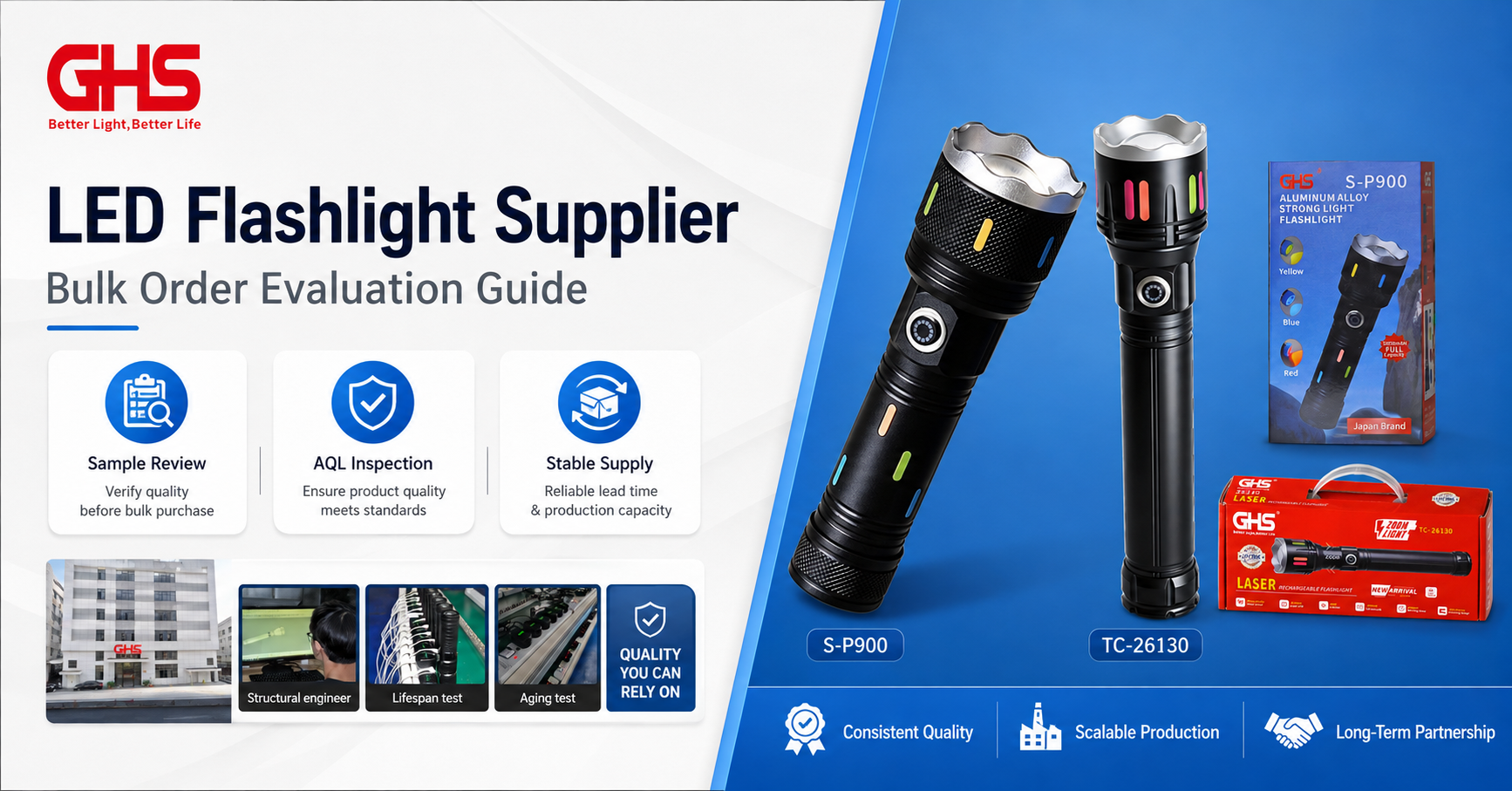
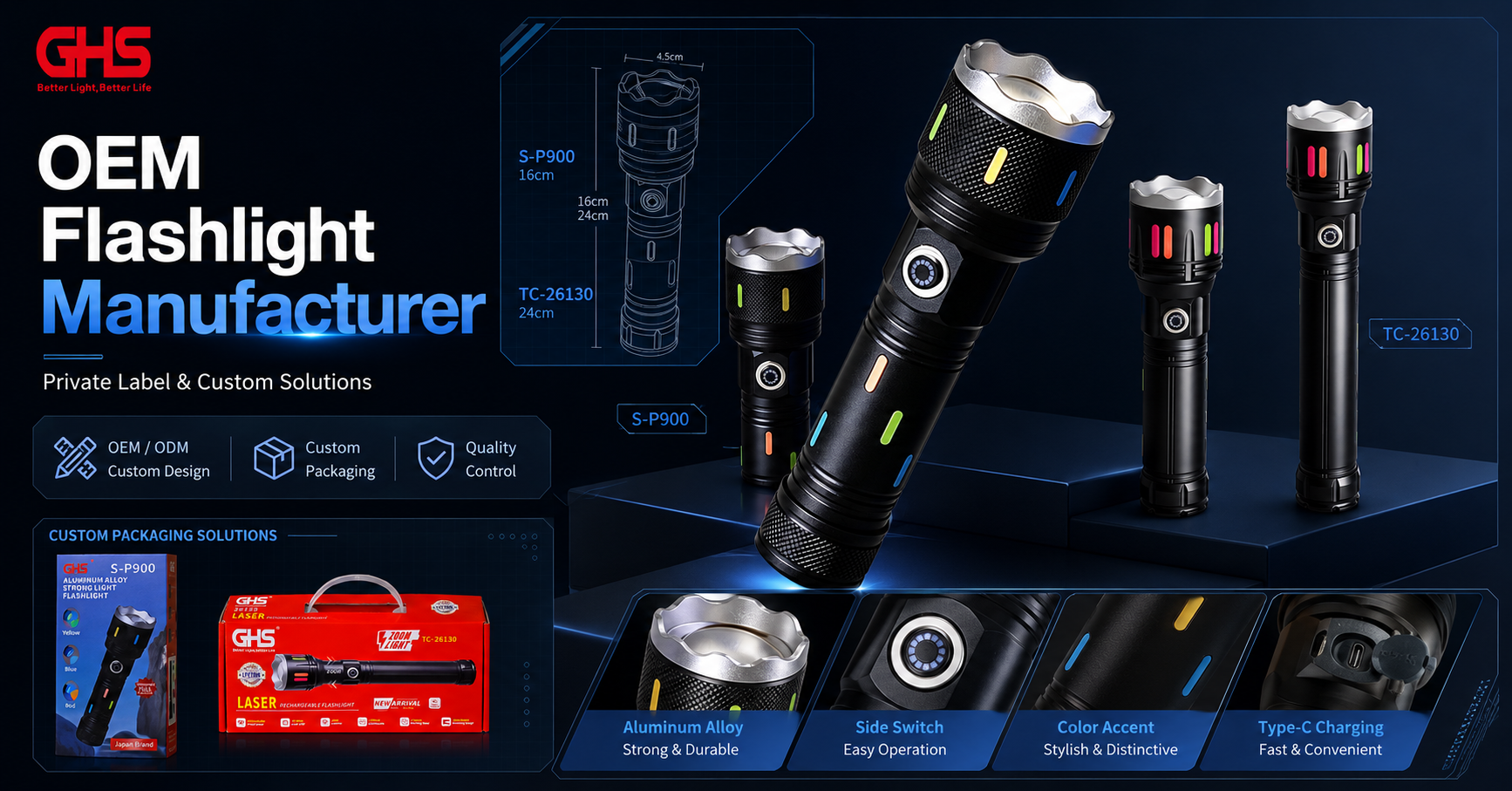
GHS’s visible product range includes models such as DC-70, TC-80, TC-10120, TC-11030, TC-18130, TC-26130, TC-12130, S-9031, S-P161, S-P900, S-P200W, and S-P300W. A buyer should request the current model matrix before selecting products for a wholesale program because model names, packaging versions, and specifications need to be aligned before publication.
| Product position | Typical wholesale application | What the buyer should verify | GHS examples to review |
|---|---|---|---|
| Basic rechargeable | Hardware, household, vehicle, warehouse, value retail | Size, battery, charging method, basic modes, packaging, replenishment cost | DC-70, TC-80, and the current DC-280/DC-80 version |
| Type-C rechargeable | Outdoor, inspection, e-commerce, general distribution | Battery capacity, charging time, runtime method, display, cable, port durability | TC-10120, TC-11030, TC-18130, TC-26130, TC-12130 |
| Multi-function or color-light | Emergency kits, camping, gifts, promotional bundles | Actual light modes, phone-charging output, accessories, package contents | S-9031, S-P161, and relevant TC configurations |
| High-intensity or larger format | Search, vehicle, industrial, outdoor, emergency | Sustained output, thermal performance, weight, battery combination, transport documents | S-P900, S-P200W, S-P300W |
This table is a starting framework, not a final specification sheet. The model name, image, package, battery, and confirmed test data must be matched before a buyer publishes a catalogue or commits to a large purchase.
Do not build an assortment only from products that look different. Build it around a buying reason. For example, one model may be selected for low-cost replenishment, one for Type-C convenience, one for a multi-function gift set, and one for higher-output applications. The buyer should be able to describe the difference in one sentence on a shelf, catalogue, or product page.
3. Beam Performance and Useful Light
Tactical flashlight buyers often compare lumen numbers, but lumen alone is not enough. A useful evaluation should consider:
- Lumens or light output: how much visible light the product produces under a defined test condition.
- Candela or peak intensity: how concentrated the beam is in a direction.
- Beam distance: the distance used by the supplier’s test method, not an unqualified marketing number.
- Spot and spill: whether the beam provides a focused center with useful peripheral light.
- Flood and spotlight balance: whether the product is better for close work, path lighting, or distant identification.
- Mode stability: whether the output drops rapidly after activation because of heat, battery state, or driver control.
- Optical consistency: whether samples show similar beam shape, color, and alignment.
If a model has a zoom mechanism, check whether the adjustment is smooth, whether the beam remains usable at different positions, and whether the mechanism can withstand normal handling. A zoom feature should solve a real application need rather than exist only as a catalogue bullet.
Ask the supplier for a test description: instrument, distance, battery condition, mode, ambient conditions, and whether the value is peak or sustained. If the supplier cannot provide a comparable test method, use the figure as a marketing reference only and do not compare it directly with a competitor’s tested value.
4. Battery, Charging, and Runtime Evidence
Battery performance is one of the most important wholesale risks because a flashlight can appear functional while still failing the customer after several cycles.
Confirm:
- Battery chemistry and cell format.
- Rated capacity and the test condition used for that capacity.
- Charging input and connector type.
- Charging time from the specified starting state.
- Protection against overcharge, over-discharge, short circuit, and abnormal temperature where applicable.
- Runtime by mode rather than one unspecified runtime number.
- Whether the flashlight can operate while charging, if that function is advertised.
- Whether a power-display reading represents battery state accurately enough for the intended use.
- Which shipping and battery documents are available for the target market.
For Type-C products, verify the complete charging path: port strength, cable fit, charging indicator, charging board, battery protection, and final assembled product. A Type-C port is an interface, not proof of a particular charging speed or protocol.
Runtime should be tested with a defined battery, mode, starting voltage, and end-of-test condition. A buyer should ask whether the published value means time until the light turns off, time until it reaches a lower output, or time at a specified usable brightness. These definitions can produce very different numbers.
Never allow a supplier to replace a confirmed battery with a lower-cost alternative without written approval. A battery change can affect weight, runtime, charging time, thermal behavior, packaging, and shipping documentation.
5. Materials, Structure, and Thermal Management
Aluminum alloy is common in tactical-style flashlights because it can provide a rigid body and a useful heat path. It is not, by itself, proof of durability. The buyer should review the alloy or material specification, surface treatment, threads, lens, reflector, switch, tail cap, grip, and protective parts.
For higher-output products, ask how heat moves from the LED and driver into the body. Check whether the output is regulated, whether the body becomes uncomfortable during sustained use, and whether the product steps down in a controlled way. A high peak output with poor thermal control may create a disappointing real-world experience.
For wholesale applications, structural questions include:
- Does the battery compartment close securely?
- Is the lens protected during normal packing and transport?
- Can the switch be operated with gloves where required?
- Does the tail cap maintain contact after repeated opening and closing?
- Are threads clean and consistent across samples?
- Does the grip remain secure when wet or dusty?
- Are accessories such as lanyards, clips, sleeves, or charging cables packed consistently?
When the buyer needs a drop or impact requirement, define the height, surface, number of drops, product state, and pass criteria. “Rugged” should be connected to a test plan, not used as a substitute for one.
6. Environmental Protection and Application Limits
Water resistance is frequently misunderstood. An IP rating is meaningful only when the product has been tested according to a defined method and the claim applies to the exact production configuration. A product image, rubber ring, or sealed-looking charging port does not establish an IP rating.
If the product is intended for outdoor or emergency use, ask:
- What IP level is confirmed for the final model?
- Was the charging port covered or open during the test?
- Was the battery compartment assembled exactly as in production?
- What water, dust, immersion, or exposure conditions were used?
- Is the rating valid after the product is opened for battery replacement or service?
- Does the packaging explain the limitations of the rating?
The same principle applies to temperature, humidity, salt exposure, and impact. A wholesale tactical flashlight supplier should help the buyer choose a realistic requirement for the application instead of adding an unsupported “waterproof” label.
7. Quality-Control Checkpoints from Component to Shipment
A strong quality system is visible in the checkpoints, not only in a statement that the factory has “strict QC.” Ask for the actual control plan for the project.
Incoming Inspection
The supplier should check incoming LED components, housings, batteries, switches, charging boards, lenses, reflectors, cables, packaging, and printed materials. The inspection should identify the approved specification and the response to nonconforming parts.
In-Process Checks
During assembly, check polarity, soldering, driver connection, switch function, charging behavior, sealing parts, threads, lens alignment, and cosmetic standards. In-process control prevents a whole batch from reaching final inspection with the same defect.
Functional and Aging Tests
The supplier should define which products receive charging tests, mode tests, burn-in or aging, output checks, and battery verification. For a wholesale program, the test record should connect to the product model and production batch.
Final Inspection
Final inspection should cover appearance, dimensions where relevant, functions, accessories, labels, packaging, carton quantity, and sampling level. If the buyer has a special requirement, it should be written into the acceptance standard before production.
Golden Sample and Change Control
The golden sample is the physical reference approved by the buyer. It should include the product, logo, color, packaging, accessories, instruction leaflet, label, and any agreed cosmetic or functional details. A supplier should not change the LED, battery, switch, charging board, lens, housing, or packaging without approval when those changes affect the approved product.
GHS describes integrated product development, manufacturing, quality management, and global service capabilities on its company page. A buyer should turn those general capabilities into a project-specific inspection plan before placing a bulk order. The GHS Contact Us page can be used to send the application, quantity, packaging, and quality requirements for a more precise discussion.
8. MOQ, Lead Time, and Repeat-Order Control
MOQ is not only a number. It can apply separately to a standard model, logo customization, color, packaging, battery configuration, accessory kit, or a new structure. Ask the supplier to show which MOQ applies to each change.
A practical quotation should separate:
- Standard model MOQ.
- Private-label logo MOQ.
- Custom packaging MOQ.
- Special color or accessory MOQ.
- New tooling or structural change requirements.
- Sample lead time.
- Artwork approval time.
- Production lead time after sample approval.
- Inspection and shipment preparation time.
Lead time should start from a defined event, such as receipt of deposit and approval of the golden sample or artwork. It should not be presented as one number that hides development, procurement, production, inspection, and packing.
For repeat orders, keep a version record. The record should identify the model, battery, LED or driver version where relevant, packaging artwork, carton specification, accessories, test requirement, and approved sample. This protects the distributor from receiving a product that looks similar but no longer matches the catalogue.
9. Packaging, Labeling, and Wholesale Readiness
Packaging is part of product quality because it affects retail conversion, transport damage, compliance communication, and the buyer’s workload.
Confirm:
- Retail box, color box, blister, sleeve, or bulk-pack format.
- Language and warning requirements for the target market.
- Model name and barcode logic.
- Battery and charging information.
- Included accessories and their quantity.
- Carton dimensions, units per carton, net weight, and gross weight.
- Drop or transport protection for the selected packing method.
- Logo placement, color references, artwork ownership, and approval process.
- Whether the final packaging matches the product actually shipped.
Do not publish a product image that shows a different model or accessory combination from the one in the quotation. In wholesale, a packaging mismatch can create customer service problems even when the flashlight itself works correctly.
10. Communication, Documentation, and After-Sales Responsibility
The final supplier test is the quality of communication before the order. A supplier should answer technical and commercial questions consistently, identify unknowns, and explain what must be confirmed by sample or test.
Ask for a single project contact or a clear responsibility matrix covering sales, engineering, production, inspection, packaging, and shipping. Confirm how the supplier records revisions and handles a nonconforming batch.
A useful after-sales process should define:
- How defects are reported.
- What evidence is needed, such as photos, video, sample, or batch number.
- How the supplier distinguishes transport damage, component failure, assembly error, misuse, and specification mismatch.
- How replacement, credit, rework, or corrective action is decided.
- How the root cause and preventive action are recorded.
This process matters because wholesale buyers often discover problems after the product reaches a distributor, retailer, or end user. A clear response process protects the relationship and provides feedback for the next production batch.
How to Build a Wholesale Tactical Flashlight Product Mix
Instead of ordering one model in one large quantity, many distributors can reduce risk by building a controlled product ladder. The exact models should be selected after reviewing current specifications and samples, but the logic can be organized as follows.
Entry or Value SKU
This product should be easy to explain, easy to replenish, and priced for broad retail or hardware distribution. It should meet the basic requirement for portable illumination without making unsupported high-performance claims.
Core Rechargeable SKU
This is the product that carries the main volume. A Type-C rechargeable model with a practical size, clear charging indication, useful beam pattern, and stable packaging can serve multiple channels. The buyer should validate battery and runtime evidence before using the product as the portfolio anchor.
Feature or Bundle SKU
This may include color light, a rear light, a power-display function, a phone-charging function, a multi-piece set, or a gift-ready package. The selling point should be linked to a real application such as emergency preparation, camping, vehicle use, or a promotional kit.
High-Output or Professional-Use SKU
This product is selected for a buyer who needs higher intensity, a larger body, a longer search distance, or longer continuous operation. It requires stronger evidence for heat management, battery behavior, sustained output, weight, and packing.
The GHS Products page can be used as the starting point for model selection. Before publishing a buyer guide or catalogue, confirm the current model names and match every image, package, battery, and specification to the same production version.
OEM, ODM, and Private Label: Which Route Fits a Wholesale Buyer?
Private Label
Private label is generally the fastest route when the buyer selects an existing platform and adds a logo, label, packaging, instructions, or an accessory combination. It reduces development risk but does not remove the need for sample approval and claim verification.
OEM Configuration
OEM work may involve a defined change to the battery, switch logic, housing color, accessory kit, charging configuration, or packaging. The buyer should document the change and confirm which tests must be repeated.
ODM Development
ODM is more suitable when the buyer needs a new structure, optical arrangement, electronic configuration, industrial design, or product concept. The project should clarify engineering responsibility, tooling ownership, intellectual property, prototype milestones, testing, and approval gates.
For a first wholesale order, an existing platform with controlled private-label changes is often easier to forecast than a completely new design. Once sales data proves the application and channel, the buyer can decide whether a deeper ODM project is justified.
A Practical RFQ Template for a Chinese Tactical Flashlight Supplier
An incomplete inquiry usually produces an incomplete quotation. Send the supplier the following information:
- Target country or sales region.
- Buyer type and sales channel.
- Main application: outdoor, security, inspection, hardware, vehicle, emergency, gift, or e-commerce.
- Preferred product size and acceptable weight.
- Beam preference: close-range flood, focused beam, adjustable beam, or a combination.
- Charging requirement and battery preference.
- Required runtime and test condition.
- Environmental requirement, including any confirmed IP or impact expectation.
- Target annual or initial quantity.
- Desired price level and target delivery window.
- Logo, packaging, instruction language, barcode, and accessory requirements.
- Required test records, certificates, battery documents, or market compliance files.
- Inspection method and golden-sample approval process.
- Destination port or delivery terms.
Ask the supplier to reply with a model recommendation, confirmed specification, sample plan, MOQ by customization type, estimated lead time, quotation assumptions, and open items that need testing. This makes suppliers easier to compare and helps prevent a low price from hiding missing requirements.
The following pre-order matrix can be used to compare two or more suppliers using the same questions:
| Evaluation area | Evidence to request | Pass condition before bulk order |
|---|---|---|
| Company and factory | Legal name, factory scope, responsible contact, production location | The responsible party and manufacturing scope are clear |
| Product performance | Sample, output method, beam description, runtime test condition | Claims are tied to a model and a repeatable test method |
| Battery and charging | Cell details, protection, charging input, cycle or function check | Battery and charging configuration match the approved sample |
| Quality control | Incoming, in-process, aging, final inspection, corrective action | The control plan covers the buyer’s critical-to-quality items |
| Customization | Logo, packaging, accessories, artwork and change-control process | Custom elements are approved before production starts |
| Commercial terms | MOQ by change, lead time milestones, quotation assumptions | The quotation separates standard and customized requirements |
| Shipment readiness | Carton data, labels, documents, inspection and release process | Product, package, quantity and documents are checked together |
This matrix is deliberately evidence-based. A supplier should not receive a high evaluation only because the website looks polished or the quotation is fast.
A Buyer-Side Sample and Pilot-Order Process
Step 1: Screen the Supplier
Check the company identity, product scope, factory information, communication quality, and evidence of similar projects. Remove suppliers that avoid technical questions or cannot distinguish confirmed information from estimates.
Step 2: Select Two or Three Product Platforms
Choose products that represent different commercial positions. Compare the sample design, beam, charging, battery, handling, packaging, and cost instead of ordering a random selection of visually similar models.
Step 3: Define the Sample Test
Use a short test sheet that covers dimensions, weight, modes, beam appearance, charging, runtime, heat, switch operation, threads, accessories, and packaging. If the product will be used outdoors, define the environmental check required for the application.
Step 4: Approve the Golden Sample
Keep a signed or digitally recorded sample reference. Record model code, battery, package, logo, color, accessories, and any performance values accepted for the order.
Step 5: Run a Pilot Order
Use the pilot to check batch consistency, carton packing, labels, delivery communication, and inspection results. A pilot should answer operational questions before the buyer commits to a larger replenishment program.
Step 6: Review the First Batch
Compare delivered products with the golden sample and the purchase order. Record defects, customer feedback, and any proposed changes. Do not let a silent change become the new standard simply because the first batch has already shipped.
Common Sourcing Mistakes to Avoid
Choosing by Lumen Number Alone
The highest printed lumen value may not deliver the most useful light. Beam concentration, sustained output, runtime, thermal behavior, and application fit matter just as much.
Treating “Tactical” as a Certification
Tactical is often a design or market term. It does not automatically prove a product has a specific impact rating, IP rating, output standard, or professional approval.
Comparing Different Battery Conditions
Two suppliers may quote different capacities, starting voltages, modes, and end points. Ask for comparable runtime test conditions before comparing the numbers.
Ignoring the Charging Port and Battery Protection
A modern connector does not guarantee safe or durable charging. Test the port, cable fit, protection behavior, charge indicator, and assembled battery system.
Ordering Before Packaging Is Finalized
Packaging errors can create customs, retail, warranty, and customer-service issues. Approve artwork and product version together.
Accepting a Model Name Without a Version Record
The same commercial name may be used with different batteries, packages, or accessory sets. Record the complete version, not only the name printed on a quotation.
Treating a General Factory Statement as Project Evidence
A supplier may have broad manufacturing capabilities, but the buyer still needs a product-specific control plan, sample test, inspection standard, and corrective-action process.
Forcing an Unsupported Delivery Promise
Lead time depends on material availability, customization, approvals, production capacity, inspection, and transport. Ask for a schedule based on defined milestones.
Frequently Asked Questions
What Should I Ask a Wholesale Tactical Flashlight Supplier China Before Requesting a Price?
Send the supplier your application, sales channel, target quantity, battery and charging preference, beam requirement, packaging, target market, delivery window, and compliance needs. Ask for a recommended model, confirmed specifications, sample cost, MOQ, lead time, and a list of open items that require testing.
Is a Chinese Tactical Flashlight Manufacturer Better Than a Trading Company for Wholesale Orders?
It depends on the required service. A manufacturer may provide stronger control over engineering, assembly, inspection, and repeat-order consistency. A capable trading company may provide broader sourcing, but the buyer should identify who controls the product specification, quality decision, and corrective action. The important point is responsibility, not the label alone.
What MOQ Should I Expect for Wholesale Tactical Flashlights?
MOQ varies by standard model, logo, packaging, color, battery, accessory kit, and structural change. Ask for separate MOQ values for the base product, logo, custom packaging, and special configuration. Do not assume that one MOQ covers every change.
How Can I Verify the Runtime of a Rechargeable Tactical Flashlight?
Confirm the battery type and rated capacity, starting charge, operating mode, ambient conditions, measurement equipment, and end-of-test definition. Compare samples under the same method. A runtime number without a test condition is not sufficient for a wholesale product claim.
What Is the Difference Between Lumens, Candela, and Beam Distance?
Lumens describe total visible light output, candela describes peak intensity in a direction, and beam distance is a distance calculated or measured using a defined criterion. A product can have high lumens without producing a narrow, long-reaching beam. Select the combination that fits the application.
Does Type-C Charging Mean That a Flashlight Is Fast Charging?
No. Type-C describes the connector interface. Charging speed, compatibility, protection, cable quality, battery capacity, and charging-board design must be confirmed separately.
How Do I Know Whether a Wholesale Flashlight Is Truly Waterproof?
Ask for the confirmed IP rating, test method, test condition, and whether the exact production configuration was tested. Check the charging-port cover, battery compartment, seals, and usage limitations. Do not treat a sealed-looking housing or a product image as test evidence.
Can I Add My Logo and Custom Packaging to an Existing Tactical Flashlight?
Often, yes, when the selected platform supports private-label changes. Confirm logo method, artwork format, minimum quantity, color requirements, packaging MOQ, sample approval, and whether the change affects lead time or testing.
What Should a Golden Sample Include?
A golden sample should represent the product and the commercial package that will be delivered. Record the model, battery, LED or driver version where relevant, logo, color, charging accessories, lanyard or sleeve, printed materials, retail package, carton details, and agreed functional or cosmetic standards.
How Can I Reduce Risk When Placing My First Bulk Order?
Start with a defined product mix, test samples under a written checklist, approve a golden sample, confirm the purchase-order specification, inspect the batch, and record version information for repeat orders. A pilot order can reveal packaging and communication problems before a larger commitment.
Does GHS Support OEM, ODM, or Private-Label Projects?
GHS presents lighting research and development, manufacturing, sales, and global service capabilities. The exact OEM, ODM, or private-label scope depends on the product platform, logo, packaging, accessory, electronic, optical, and structural requirements. Send the project brief through the GHS Contact Us page so the team can confirm the suitable route.
Which GHS Products Should I Consider for a Wholesale Tactical Flashlight Program?
The current product range includes basic rechargeable, Type-C rechargeable, multi-function, and higher-intensity formats. Models visible in the range include DC-70, TC-80, TC-10120, TC-11030, TC-18130, TC-26130, TC-12130, S-9031, S-P161, S-P900, S-P200W, and S-P300W. Confirm the latest model name, configuration, package, and test data before selecting a wholesale assortment.
What Information Should I Include When Contacting GHS?
Include your market, buyer type, application, target quantity, preferred models or functions, beam requirements, battery and charging needs, logo and packaging details, target price, delivery window, and compliance or inspection requirements. This allows the supplier to recommend a product platform and identify the information that must be confirmed by sample or testing. You can start with the GHS Contact Us page.
Conclusion
Selecting a wholesale tactical flashlight supplier China is a product, quality, and supply-chain decision rather than a simple price comparison. The right supplier should help you define the use case, organize a sensible SKU mix, verify beam and runtime performance, control batteries and charging, document materials and thermal behavior, run quality checkpoints, finalize packaging, and manage repeat-order consistency.
For importers, wholesalers, distributors, hardware channels, outdoor brands, security-equipment buyers, and e-commerce operators, the safest process is to start with a clear RFQ, compare suppliers using the same technical and commercial criteria, approve a complete golden sample, and inspect the first batch against a written standard. Product claims should be based on confirmed specifications and test conditions, not on attractive packaging language alone.
GHS offers a starting point for buyers looking for lighting product development, manufacturing, wholesale supply, and customization support from China. Review the GHS company information, explore the current product range, and send your market, application, quantity, branding, packaging, and compliance requirements through GHS Contact Us to begin a product-matching and quotation discussion.