
How Should B2B Buyers Choose a Rechargeable Flashlight Manufacturer?
A reliable rechargeable flashlight manufacturer should be evaluated as an integrated product engineering and supply-chain partner, not simply as a factory that can assemble an LED, battery, and aluminum tube.
For B2B buyers, the most important questions are whether the manufacturer can control the complete flashlight system: battery quality, charging architecture, LED driver stability, optical performance, thermal management, housing construction, waterproof sealing, production consistency, quality control, packaging, and OEM repeatability.
The lowest quotation is rarely the only number that matters.
A flashlight with an attractive peak-lumen claim can still create costly problems if output drops rapidly because of heat, if the battery capacity is inconsistent, if the USB-C port is poorly protected, if waterproofing changes after customization, or if the second production order uses different internal components from the approved sample.
For importers, distributors, private-label brands, hardware suppliers, outdoor brands, security equipment companies, and industrial buyers, a better sourcing process is:
- Define the real application.
- Freeze measurable specifications.
- Evaluate the battery and charging system.
- Compare optical and thermal performance.
- Review mechanical construction and environmental protection.
- Examine the manufacturer's QC process.
- Confirm OEM/ODM scope.
- Approve a documented golden sample.
- Control the BOM before mass production.
- Evaluate repeat-order consistency, not only first-order price.
Buyers evaluating current rechargeable flashlight platforms can start by reviewing the GHS product range and then compare product architecture against the decision criteria below.
Why the Manufacturer Matters More for Rechargeable Flashlights Than for Basic Flashlights
Rechargeable flashlights contain more interacting systems than conventional battery-powered models.
A basic flashlight may primarily depend on the LED, driver, switch, housing, and replaceable battery contact system. A rechargeable model adds another layer of engineering:
- Lithium battery cell or battery pack
- Battery protection
- Charging circuit
- USB or USB-C interface
- Charge indicator
- Battery level display
- Additional PCB components
- Port sealing
- Thermal interaction between electronics and housing
- Sometimes USB output or emergency power-bank functionality
Every additional component introduces another potential failure point.
That is why selecting a rechargeable LED flashlight manufacturer based only on appearance or quotation price creates unnecessary sourcing risk.
For example, two products may look almost identical from the outside. One may use a stable driver, protected battery configuration, properly controlled charging circuit, consistent optical alignment, and documented components. The other may use changing battery cells or electronics depending on availability.
The difference may not become visible during the first sample inspection.
It can become visible after several charging cycles, after extended high-output operation, during wet-weather use, or when the buyer receives a repeat order several months later.
The goal of supplier evaluation should therefore be product consistency over the complete purchasing cycle, not simply whether the first sample works.
Start With the Application, Not the Lumen Number
One of the most common mistakes in flashlight sourcing is starting the RFQ with:
“I need a 5,000-lumen flashlight.”
That statement does not define the actual requirement.
A manufacturer needs to understand what the flashlight must do.
A rechargeable flashlight for a household emergency kit has different priorities from one designed for security patrol, roadside repair, camping, machinery inspection, or long-distance search.
A professional RFQ should first define the application.
| Application | Priority Requirements |
|---|---|
| Household emergency | Easy charging, battery indication, reliability, simple controls |
| Camping | Runtime, beam flexibility, portability, water resistance |
| Vehicle emergency | Compact size, rechargeability, strong grip, practical accessories |
| Industrial inspection | Reliable switch, usable beam, runtime, housing durability |
| Security patrol | Beam intensity, distance, battery indication, quick operation |
| Outdoor work | Runtime, grip, water resistance, impact-resistant construction |
| Hardware retail | Cost control, packaging, easy feature explanation, stable supply |
| Private-label brand | Product differentiation, OEM options, BOM consistency |
| Long-distance search | Candela, optical design, thermal control, battery capability |
This application-first approach immediately improves both product selection and quotation accuracy.
It also prevents overengineering.
A retail flashlight does not always need the largest battery, most aggressive output, heaviest aluminum housing, or most complicated electronics. Every additional feature can influence cost, weight, charging time, failure rate, packaging size, and warranty exposure.
The right manufacturer should help the buyer balance these factors instead of simply recommending the model with the highest specification.
Evaluate the Flashlight as a Complete System
A rechargeable flashlight should be considered as a system consisting of:
LED → Driver → PCB → Battery → Charging Circuit → Optics → Housing → Thermal Path → Switch → Sealing
If one part of this chain is weak, overall performance can suffer.
This is an important distinction when comparing rechargeable flashlight manufacturers.
A supplier may advertise a well-known LED, for example, but the LED alone does not determine real flashlight performance.
Actual user experience depends on:
- How much current the driver supplies
- Whether output is regulated
- How quickly heat accumulates
- How the housing transfers heat
- Battery voltage under load
- Optical efficiency
- Reflector or lens design
- Electrical resistance
- Firmware or mode configuration
- Thermal step-down behavior
For a B2B purchaser, component names are useful, but system behavior is more important than component marketing.
Battery Engineering Is One of the Most Important Supplier Evaluation Areas
The battery is one of the most important components in any rechargeable flashlight.
It affects:
- Runtime
- Peak output
- Sustained output
- Charging time
- Product diameter
- Product weight
- Cost
- Transport requirements
- Product life
- Customer complaint rate
A serious rechargeable flashlight manufacturer should be able to clearly explain the battery configuration being quoted.
Ask What Cell Format Is Used
Common rechargeable flashlight projects may use cylindrical lithium-ion cells such as 18650 or 21700 formats, although the correct choice depends on the product design.
The buyer should not automatically assume that the physically larger battery is always better.
A larger cell may provide advantages in capacity or current capability, but it can also increase:
- Flashlight diameter
- Product weight
- Packaging dimensions
- Shipping weight
- Unit cost
Compact retail or EDC-oriented products may benefit from a smaller architecture.
Higher-output or longer-runtime products may justify a larger energy-storage platform.
The correct choice depends on the intended application.
Do Not Evaluate a Battery by mAh Alone
Battery capacity is important, but the printed mAh figure is not a complete measure of flashlight quality.
Buyers should also consider:
- Nominal voltage
- Cell quality
- Internal resistance
- Discharge capability
- Protection design
- Capacity consistency
- Supplier consistency
- Charging profile
A flashlight drawing relatively high current can perform poorly even with a battery that carries an attractive capacity claim if the cell cannot maintain voltage effectively under load.
For sourcing decisions, ask:
- What battery specification is used?
- Is the battery included in the quotation?
- Is it built in or replaceable?
- Is protection included?
- Can the cell supplier change without approval?
- What battery documentation is available for shipping?
- How is battery capacity verified during QC?
These questions are more useful than simply asking, “How many mAh?”
Built-In vs. Replaceable Batteries
Neither design is universally superior.
A built-in battery may support:
- Cleaner product architecture
- Simpler consumer use
- More controlled internal contacts
- Easier retail positioning
A replaceable battery may offer:
- Easier field replacement
- Longer practical service life
- Greater flexibility for professional users
However, replaceable designs also require careful mechanical and electrical consideration around contacts, polarity, battery compartment tolerances, and sealing.
For a private-label project, battery architecture should be frozen before tooling, packaging, and certification decisions are finalized.
USB-C Is a Connector, Not a Performance Guarantee
USB-C has become an important purchasing feature for rechargeable lighting products.
But buyers should avoid assuming:
USB-C = fast charging.
The physical connector alone does not define charging performance.
The manufacturer should be able to explain:
- Input voltage
- Charging current
- Charging circuit
- Battery capacity
- Approximate charging time
- Charge termination behavior
- Protection functions
- Indicator logic
A large-capacity battery combined with a low charging current may require significantly more charging time than buyers expect.
That may be acceptable for an emergency flashlight but unsuitable for professional users who need rapid turnaround between shifts.
Charging Port Construction Also Affects Durability
The charging port creates another mechanical opening in the flashlight housing.
For outdoor or water-resistant models, the port design deserves special attention.
Evaluate:
- Port location
- Rubber cover design
- Fit and retention
- Seal compression
- Ease of use
- Durability after repeated opening
- Water-resistance test condition
A manufacturer cannot simply add USB-C to an existing product and assume the previous waterproof performance remains unchanged.
Any structural modification can influence sealing performance.
This is particularly important for OEM buyers requesting new port locations, different covers, modified tailcaps, or additional USB outputs.
Buyers interested in this area can also review GHS's existing content on rechargeable flashlight sourcing and battery considerations.
Peak Lumens Should Not Be the Only Performance Metric
“Lumens” is one of the most heavily marketed flashlight specifications.
It is useful, but it is frequently misunderstood.
Lumens describe total light output. They do not independently describe how far the beam reaches, how concentrated the beam is, or how long high output can be maintained.
A professional purchasing evaluation should separate at least four concepts:
- Peak output
- Sustained output
- Beam intensity
- Runtime
Peak Output vs. Sustained Output
A flashlight may produce a strong initial output and then reduce power as temperature rises.
This does not automatically mean the design is poor. Output reduction may be part of thermal protection.
The purchasing question is:
What level of useful output can the flashlight maintain in realistic operating conditions?
For professional or industrial applications, sustained behavior may matter more than a short peak number.
Lumens vs. Candela
Lumens describe total emitted light.
Candela describes luminous intensity in a direction.
This is why a lower-lumen flashlight with a concentrated optical system can sometimes project farther than a higher-lumen flood-oriented model.
For buyers sourcing security, patrol, search, or long-distance inspection products, beam intensity can be as important as total lumens.
Beam Profile Matters
Ask the manufacturer whether the flashlight is designed for:
- Flood
- Spot
- Mixed-use beam
- Adjustable focus
- Zoom
Many GHS rechargeable platforms currently emphasize adjustable-beam or zoom structures. Buyers can view current models on the GHS products page.
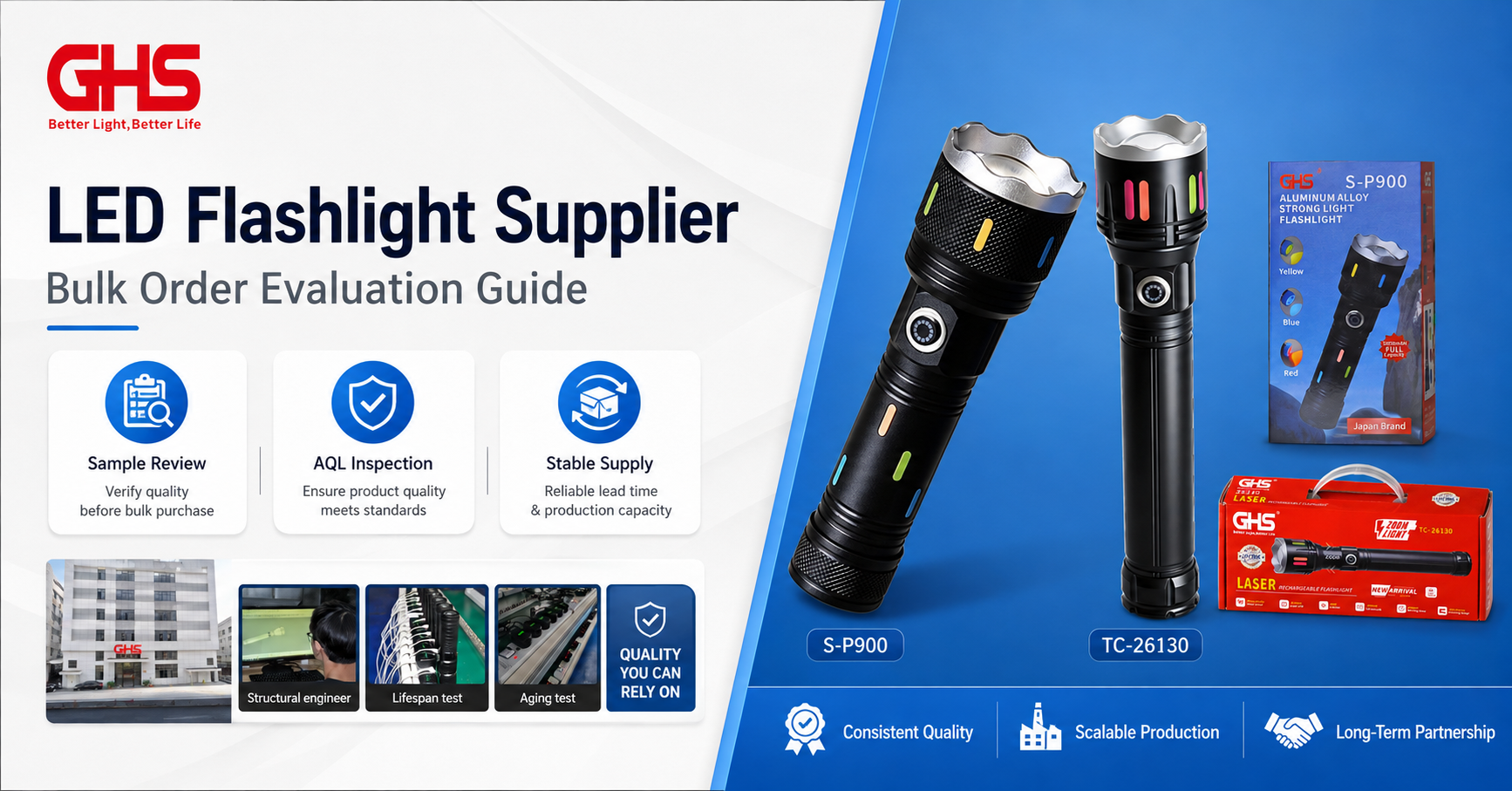
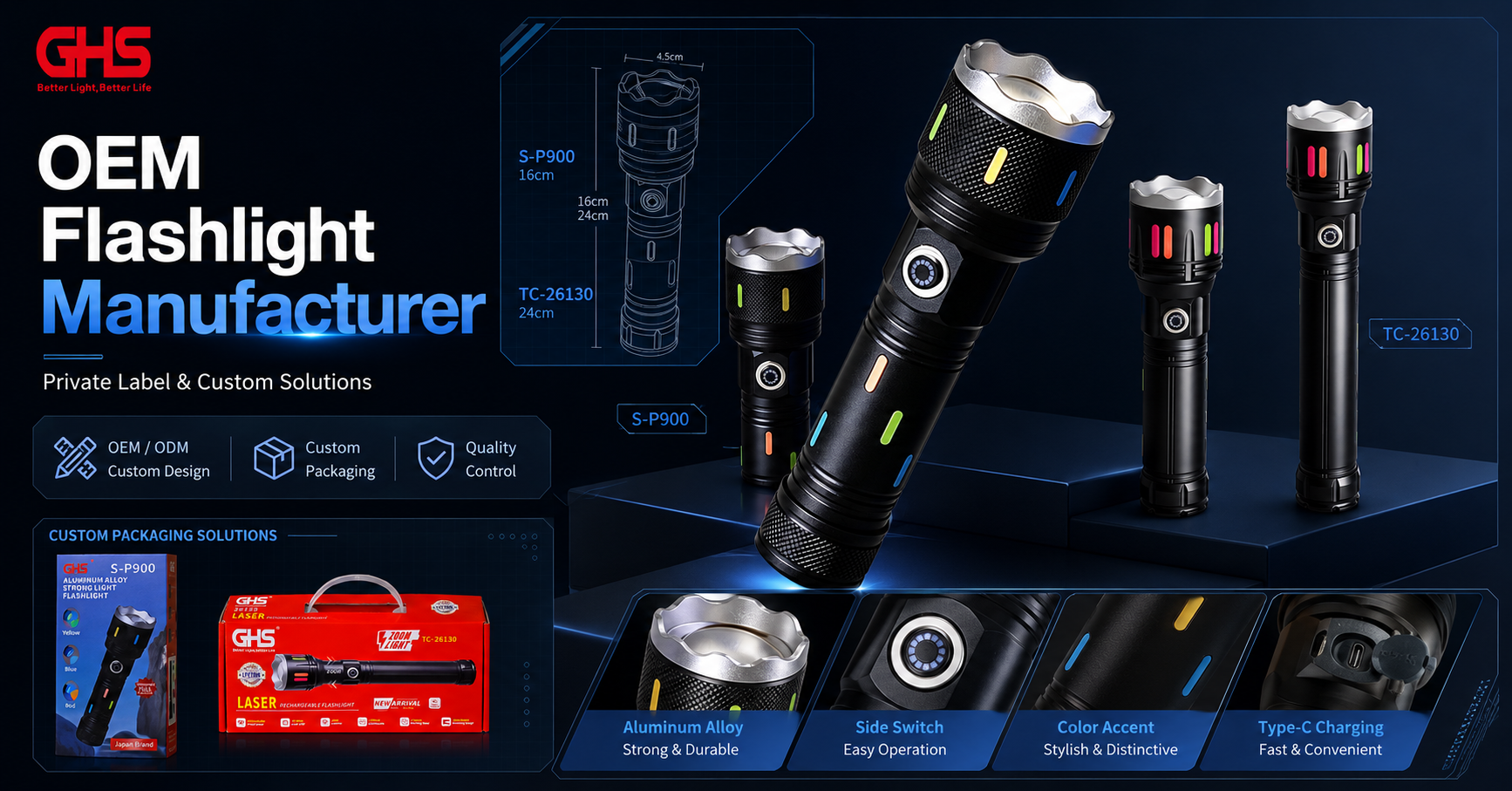
For example, current product pages include rechargeable adjustable-beam models such as TC-26130, which can help buyers understand the type of product platform available before discussing customization.
Thermal Management Separates Marketing Performance From Usable Performance
High-output LEDs generate heat.
The driver generates heat.
The battery generates heat.
If that heat is not managed effectively, the flashlight may experience:
- Rapid output reduction
- Reduced efficiency
- Uncomfortable surface temperatures
- Increased stress on components
- Reduced battery performance
- Shorter component life
That is why thermal design should be part of manufacturer evaluation.
Questions to Ask About Thermal Performance
Ask:
- How is heat transferred from the LED board to the housing?
- What housing material is used?
- Is the LED board mechanically secured to the heat-transfer surface?
- Does the driver reduce output at high temperature?
- Has sustained output been tested?
- Is temperature behavior different between prototypes and production units?
A large flashlight body does not automatically guarantee good thermal management.
Effective thermal performance depends on the complete heat path.
For high-intensity products, this becomes even more important. Buyers evaluating long-range or larger-head products can review models such as the S-P300W high-intensity flashlight as a starting point for discussing beam, battery, housing, and thermal requirements.
Housing Material Should Match the Target Market
Flashlight housing decisions influence:
- Product durability
- Weight
- Thermal behavior
- Cost
- Appearance
- Surface finishing
- Perceived value
Two broad material approaches are common.
Aluminum Alloy Housing
Aluminum-based flashlight bodies are often appropriate for:
- Outdoor products
- Professional applications
- Higher-output flashlights
- Security equipment
- Premium retail
- Products requiring a more substantial feel
Potential advantages include:
- Structural rigidity
- Efficient heat transfer
- Machined features
- Anodized finishes
- Premium appearance
However, aluminum construction may increase manufacturing cost and weight compared with simple plastic products.
Engineering Plastic or ABS Housing
Plastic housings can be appropriate for:
- Household lighting
- Cost-sensitive projects
- Promotional products
- Lightweight consumer applications
- Large-volume retail programs
Advantages may include:
- Lower weight
- Design flexibility
- Cost control
- Reduced external heat conductivity
The correct question is therefore not:
“Is aluminum better than plastic?”
It is:
“Which housing architecture best supports the application, target price, thermal requirement, durability requirement, and market positioning?”
That is the kind of discussion a capable rechargeable flashlight manufacturer should be prepared to have.
Waterproofing Requires Model-Level Verification
“Waterproof” is another term that should be handled carefully in B2B sourcing.
A buyer should never assume that every flashlight from a manufacturer has the same environmental protection level.
Protection depends on the exact product structure.
Key sealing areas include:
- Lens
- Bezel
- O-rings
- Thread interfaces
- Tailcap
- Switch
- Charging port
- Battery compartment
- USB cover
Even seemingly small OEM modifications may influence sealing performance.
For example:
- Moving a charging port
- Changing a switch
- Replacing a tailcap
- Modifying a lens
- Adding USB output
- Changing an O-ring groove
can affect the final result.
Therefore, if a project requires a specific IP rating, ask for evidence that applies to the exact model and configuration being purchased.
Do not rely on a general statement such as “our flashlights are waterproof.”
This principle is especially important for outdoor, agriculture, marine-adjacent, industrial, and emergency applications.
For additional internal technical context, buyers can read the GHS guide to IP ratings, sealing, and waterproof flashlight sourcing.
The LED Driver Is a Critical but Often Overlooked Component
Many buyers focus on the visible LED and battery while overlooking the driver.
The driver controls how power is delivered to the LED.
It can influence:
- Output stability
- Efficiency
- Lighting modes
- Low-battery behavior
- Thermal response
- Flicker
- Runtime
- Component stress
If two suppliers use the same LED but different drivers, real-world performance may differ substantially.
For OEM programs, buyers should clarify whether the driver design is fixed or may change between batches.
This is particularly important when:
- Output levels matter
- Runtime has been validated
- A customer has approved a specific light mode sequence
- A retailer has printed performance claims on packaging
- Certification testing has been completed on a particular configuration
If a critical driver component changes, previous performance data may no longer represent the production product.
This is why GOOD control matters.
Power Indicators and User Interface Should Be Tested as Functional Features
Rechargeable flashlights increasingly include battery indicators, digital displays, side switches, multiple lighting modes, or power-bank outputs.
These features can improve usability, but they also create more engineering and QC requirements.
A battery indicator should be assessed for:
- Accuracy
- Readability
- Low-battery behavior
- Charging indication
- Display consistency
- Power consumption
A multi-mode switch should be assessed for:
- Mode sequence
- Memory function, if applicable
- Long-press behavior
- Accidental activation risk
- Switch durability
- User simplicity
For mass retail or emergency products, more modes are not always better.
A complex UI can increase customer confusion and return rates.
The best manufacturer should help align the user interface with the actual buyer persona.
Quality Control Should Cover Components, Assembly, and Finished Products
A professional rechargeable flashlight manufacturing program needs more than a final visual inspection.
The QC process should control the product from incoming materials to shipment.
Incoming Quality Control
Typical incoming inspection items can include:
- LED components
- Battery cells or packs
- Driver PCB
- Charging PCB
- Switches
- Lenses
- Reflectors
- O-rings
- Aluminum or plastic housings
- Surface-finished components
- Cables
- Packaging materials
The most important principle is not simply “inspect everything.”
It is identifying which components create the greatest product risk.
For a rechargeable flashlight, batteries, charging electronics, LEDs, drivers, switches, and sealing components deserve particular attention.
In-Process Quality Control
During assembly, manufacturers should control:
- Soldering
- Wiring
- Battery connections
- PCB installation
- Optical alignment
- Thread fit
- Switch assembly
- Port cover assembly
- O-ring installation
- Housing fit
Many final-product failures originate from assembly variation rather than component failure.
Functional Testing
Functional inspection should verify relevant features such as:
- Power on/off
- Lighting modes
- Zoom or focus movement
- Charging
- Battery indication
- USB output
- Side switch
- Tail switch
- Beam alignment
Final Inspection
Before shipment, buyers should define acceptance requirements for:
- Appearance
- Function
- Logo position
- Product color
- Accessories
- Labeling
- Packaging
- Quantity
- Carton markings
If waterproofing, runtime, charging time, beam distance, or other measurable claims are commercially important, define how they will be verified.
Buyers interested in understanding the manufacturing environment can review the GHS factory videos before moving into sample or RFQ discussions.
Why a Golden Sample and Written Specification Matter
One of the strongest ways to reduce OEM production risk is to create a clear approval reference before mass production.
A good approval package contains more than one physical sample.
It should ideally include:
- Approved physical sample
- Written specification
- Product drawings where relevant
- Approved battery configuration
- LED and driver requirements
- Lighting mode sequence
- Charging specification
- Housing material
- Surface finish
- Logo position
- Packaging artwork
- Accessories
- Key test requirements
The approved physical unit becomes the golden sample.
The written documents explain what makes that sample acceptable.
Without both, disagreements become much harder to resolve.
A sample alone cannot tell the production team which internal components are critical.
A spreadsheet alone may not fully communicate appearance and tactile quality.
Together, they create a much stronger mass-production reference.
BOM Control Is Essential for Repeat Orders
For distributors and private-label brands, the second and third orders can be more important than the first.
Once a product is listed online, placed in retail stores, added to a distributor catalog, or incorporated into an emergency kit, silent component changes can create major problems.
Potential uncontrolled changes include:
- Battery supplier
- LED bees
- Driver components
- PCB
- Switch
- O-ring material
- Charging IC
- USB cable
- Surface finish
Some substitutions may be harmless.
Others can change runtime, brightness, color, charging behavior, waterproofing, or reliability.
Therefore, buyers should ask:
Which components are controlled in the BOM, and what happens if the supplier wants to change one?
A mature OEM process should establish an approval mechanism for significant component changes.
This is one of the differences between buying a generic flashlight and building a stable private-label product program.
Understand the Difference Between Private Label, OEM, and ODM
These terms are often used interchangeably, but the project depth can be very different.
Private Label
A private-label project usually starts with an existing product platform.
Typical changes may include:
- Logo
- Packaging
- Manual
- Barcode
- Label
- Color
- Accessories
This is usually the fastest route to market because the base product already exists.
OEM Customization
OEM flashlight projects may go further.
Possible changes can include:
- Battery configuration
- Charging interface
- Lighting modes
- Surface finish
- Accessories
- Optical configuration
- Switch
- Packaging
- Branding
The greater the customization, the more important sample validation becomes.
ODM or Deeper Product Development
ODM projects can involve:
- Housing development
- Mechanical structure
- PCB
- Driver
- Optical design
- Battery system
- User interface
- Prototyping
- Testing
This type of project requires more engineering coordination and usually more development time.
GHS's current product-video content highlights OEM/ODM capabilities, and buyers considering customized programs can view the product videos before discussing project scope.
For private-label purchasing strategy, the related GHS article on choosing an OEM flashlight manufacturer provides additional context.
How to Compare Rechargeable Flashlight Manufacturer Quotations
Comparing quotation totals without comparing specifications is one of the fastest ways to make a poor sourcing decision.
Two quotations may refer to visually similar products but completely different internal configurations.
Use a comparison table like this:
| Quote Item | What to Compare | Main Risk |
|---|---|---|
| Battery | Type, capacity, supplier, protection | Runtime and consistency |
| LED | Type, output target, consistency | Brightness and color variation |
| Driver | Regulation, modes, component control | Output instability |
| Charging | Connector, current, circuit | Long charging time or failure |
| Housing | Material, finish, dimensions | Durability and thermal issues |
| Optics | Reflector/lens, zoom design | Beam quality |
| Waterproofing | Structure and test requirement | Field failure |
| Accessories | Cable, strap, battery, case | Incomplete retail package |
| Packaging | Box, insert, manual, barcode | Rework before shipment |
| QC | Inspection and agreed tests | Quality disputes |
| Documentation | Specifications and reports | Compliance/sales risk |
The cheapest unit price may become expensive if it creates:
- Returns
- Rework
- Airfreight replacement
- Retail penalties
- Negative product reviews
- Distributor complaints
- Packaging changes
- Inventory write-offs
That is why professional buyers increasingly evaluate total sourcing risk, not only FOB unit price.
MOQ Should Be Evaluated Together With Customization Depth
There is no single correct MOQ for all rechargeable flashlight projects.
MOQ can change depending on:
- Existing model vs custom product
- Housing color
- Logo method
- Battery
- Packaging
- Custom PCB
- Special accessories
- Tooling
- Printed manuals
- Retail boxes
An existing flashlight with standard components and a simple logo may require a different quantity from a fully customized ODM program.
Therefore, the better RFQ question is not:
“What is your MOQ?”
It is:
“What is the MOQ for this exact configuration, and which customization choices are driving that MOQ?”
This makes quotation discussions more productive and may reveal ways to reduce the initial order quantity.
For example, using an existing product platform while customizing packaging and branding may be more practical for a new brand than redesigning the complete flashlight.
Lead Time Should Be Broken Into Stages
“Lead time” is another term that buyers should define carefully.
A complete project may include:
- Requirement confirmation
- Quotation
- Sample preparation
- Sample approval
- Packaging artwork
- Material purchasing
- Production
- QC
- Packing
- Shipment preparation
A manufacturer may quote production lead time beginning only after all materials and artwork are confirmed.
A buyer may interpret the same number as the complete calendar time from purchase order to shipment.
That misunderstanding can affect launch dates.
Ask the manufacturer to separate:
- Sample lead time
- Approval time
- Packaging preparation
- Material lead time
- Production time
- Final inspection
- Shipment preparation
This is particularly important for rechargeable products because batteries, customized electronics, and packaging can affect material scheduling.
Packaging Is Part of Product Engineering for B2B Buyers
Packaging should not be treated as the final decorative step.
For retail and e-commerce programs, packaging affects:
- Product protection
- Shipping volume
- Retail presentation
- User instructions
- Barcode compliance
- Accessory control
- Battery information
- Brand positioning
Before approval, confirm:
- Product quantity per box
- Battery included or not
- Cable included or not
- Wrist strap
- Spare accessories
- Manual
- Label
- Barcode
- Inner tray
- Master carton
For e-commerce buyers, packaging durability may be especially important because individual units experience parcel-distribution handling rather than pallet-only transportation.
Evaluate the Manufacturer's Ability to Communicate Technical Information
Communication quality is sometimes treated as a soft factor.
In custom manufacturing, it directly affects product quality.
A supplier should be able to explain:
- What can be customized
- What cannot be customized
- Which changes require tooling
- Which changes affect MOQ
- Which changes affect waterproofing
- Which changes affect charging
- Which specifications require testing
- Which components may change
- Which documents are available
Be cautious if every technical question receives only:
“No problem.”
Good manufacturers should also be able to say:
“This change is possible, but it will affect cost, tooling, lead time, thermal performance, or sealing.”
That type of answer often indicates more mature engineering communication.
Which Buyers Need a Rechargeable Flashlight Manufacturing Partner?
This sourcing model is especially relevant for:
Importers and Distributors
They need stable supply, practical price positioning, documentation, repeatability, and multiple product tiers.
Private-Label Brands
They need branding, packaging, feature differentiation, golden samples, and controlled repeat orders.
Outdoor and Camping Brands
They care about runtime, charging, grip, weight, environmental resistance, and practical beam design.
Hardware and Tool Distributors
They often need robust products that are easy to explain, stock, and reorder.
Security Equipment Suppliers
They may prioritize beam intensity, operating simplicity, battery status, housing strength, and reliable charging.
Industrial and MRO Suppliers
They need useful illumination rather than exaggerated marketing specifications.
Automotive Accessory Companies
Their applications can include roadside emergencies, engine inspection, tire changes, and emergency kits.
E-Commerce Brands
They need differentiated features, packaging, consistent batches, product imagery, and low complaint rates.
A single flashlight does not serve all of these customers equally well.
That is why the correct manufacturer should be able to match the product architecture to the channel.
How to Evaluate GHS as a Rechargeable Flashlight Manufacturer
Guangdong Guanghuishi Electrical Appliances Co., Ltd. positions GHS as a lighting manufacturer integrating product development, manufacturing, and sales.
The company states that it was established in 2009 and operates from Zhaoqing, Guangdong. Buyers who want to understand the company background can review the GHS About Us page.
The current website product portfolio includes rechargeable flashlights, adjustable-beam models, basic flashlight platforms, and higher-intensity products.
Rather than assuming that one product is suitable for every market, buyers should first browse the current product portfolio and identify a platform closest to the intended use case.
From there, the sourcing discussion should focus on:
- Battery
- Charging
- Output target
- Beam
- Housing
- Waterproof requirement
- Accessories
- Packaging
- OEM level
- Target market
- Order volume
This reduces development risk and makes quotation comparison more accurate.
A Practical Manufacturer Scorecard for Procurement Teams
The following is a practical internal purchasing model rather than an industry certification standard.
Procurement teams can adjust the weighting to match their project.
| Evaluation Area | Suggested Weight |
|---|---|
| Battery and charging engineering | 20% |
| Quality control and repeatability | 20% |
| Optical and thermal performance | 15% |
| OEM/ODM capability | 15% |
| Documentation and specification control | 10% |
| Supply stability and lead-time management | 10% |
| Communication and project support | 10% |
The key advantage of a scorecard is consistency.
Without a structured comparison method, purchasing decisions often become overly influenced by price, salesperson responsiveness, or the appearance of one sample.
A structured evaluation forces the team to consider long-term commercial risk.
Common Mistakes When Choosing a Rechargeable Flashlight Manufacturer
Mistake 1: Choosing by Peak Lumens
Peak output does not describe runtime, beam distance, thermal stability, or sustained performance.
Mistake 2: Choosing the Lowest Quotation
A lower quotation may reflect differences in batteries, electronics, housing, accessories, packaging, or QC.
Mistake 3: Assuming Every USB-C Product Charges Quickly
USB-C describes the interface, not the complete charging performance.
Mistake 4: Approving Appearance Before Internal Specifications
A visually correct sample can still have uncontrolled batteries, drivers, or PCB components.
Mistake 5: Ignoring Repeat-Order BOM Control
A successful first order does not guarantee identical future production unless critical components are controlled.
Mistake 6: Using “Waterproof” Without Defining the Requirement
Environmental protection should be linked to an exact model, structure, and test requirement.
Mistake 7: Customizing Too Much on the First Order
New brands often reduce risk by starting from an established product platform and customizing the areas that create real market value.
Mistake 8: Treating Packaging as an Afterthought
Packaging influences product protection, retail compliance, shipping volume, branding, and customer experience.
Mistake 9: Asking Only for Certificates, Not Their Scope
A certificate or test report is useful only when buyers understand which company, model, configuration, and standard it applies to.
Mistake 10: Sending an Incomplete RFQ
Poor RFQs create poor quotations.
The more clearly the application and requirements are defined, the easier it becomes to compare manufacturers fairly.
What Information Should You Send With an RFQ?
A professional RFQ for a rechargeable flashlight project should ideally contain:
- Target market
- Buyer type
- Application
- Expected annual or order quantity
- Target price range
- Preferred flashlight size
- Housing preference
- Battery preference
- Runtime requirement
- Charging interface
- Beam type
- Output requirement
- Waterproof requirement
- Lighting modes
- Battery indicator requirement
- Power-bank requirement
- Logo
- Product color
- Packaging format
- Accessories
- Required documentation
- Target launch date
If you do not yet know all of these specifications, send the application first.
A capable manufacturer should help translate the application into technical requirements.
For buyers currently planning an OEM, wholesale, or private-label rechargeable flashlight project, the next step is to contact GHS with your target market, application, quantity, and customization requirements.
FAQ
What should I ask a rechargeable flashlight manufacturer before requesting a quotation?
Start with the battery type, charging configuration, LED/driver system, beam type, housing material, waterproof requirement, accessories, QC process, OEM options, MOQ, packaging, and lead time. Also ask which internal components are controlled between repeat orders.
Is an 18650 or 21700 battery better for a rechargeable flashlight?
Neither format is automatically better. The correct choice depends on runtime, required current, flashlight size, weight, cost, and target application. Higher-capacity architectures may suit longer-runtime or higher-output products, while more compact designs may prioritize size and portability.
Does USB-C mean the flashlight supports fast charging?
No. USB-C identifies the connector type. Actual charging performance depends on the charging circuit, input voltage, charging current, battery capacity, thermal design, and supported protocol.
How should buyers verify flashlight runtime?
Define the lighting mode, starting battery condition, cutoff point, and test conditions. A runtime number without a clearly defined test method can be difficult to compare between suppliers.
What is a reasonable MOQ for an OEM rechargeable flashlight?
MOQ varies by product platform and customization depth. Logo-only projects, custom packaging, special housing colors, custom electronics, and full ODM products can have very different minimum quantities. Ask for the MOQ of the exact configuration rather than a generic factory MOQ.
Can a rechargeable flashlight manufacturer customize logo and packaging?
Many OEM programs can include logo, product color, box design, manual, barcode, accessories, and other branding elements. Deeper customization may also involve batteries, charging systems, electronics, optics, housing, or controls. GHS provides OEM/ODM-oriented product and manufacturing content through its website.
How can buyers verify a waterproof flashlight claim?
Ask for the exact IP requirement, applicable model, product configuration, test method, and available report or test evidence. Do not assume a waterproof claim applies to every flashlight made by the same supplier.
How can I prevent quality changes in repeat orders?
Use a golden sample, written specifications, approved packaging files, and controlled BOM. Establish a rule requiring approval before critical batteries, drivers, LEDs, PCB components, switches, seals, or other important parts are changed.
What should be included in a flashlight approval sample?
The approval should cover appearance, function, battery, charging, lighting modes, beam, switch behavior, housing, surface finish, logo, accessories, packaging, and any measurable performance or environmental requirement important to the project.
Should I choose a standard product or develop a custom flashlight?
Choose an existing platform when speed, lower development risk, and simpler MOQ are priorities. Choose deeper OEM or ODM development when your market requires meaningful differentiation in structure, function, electronics, optics, battery architecture, or user experience.
Conclusion
Choosing the right rechargeable flashlight manufacturer is primarily a risk-management and product-engineering decision, not a search for the highest lumen claim or lowest unit price. Battery consistency, charging architecture, driver stability, optical performance, thermal management, sealing, QC, BOM control, packaging, and repeat-order reliability all influence the real commercial value of the finished flashlight.
For importers, distributors, private-label brands, outdoor suppliers, hardware companies, security equipment buyers, and industrial purchasers, the most effective approach is to define the application first and then compare manufacturers against measurable requirements. You can review the GHS rechargeable and high-intensity flashlight product range, explore its manufacturing background, or send your RFQ directly to GHS with your target market, quantity, battery, charging, performance, packaging, and OEM requirements.