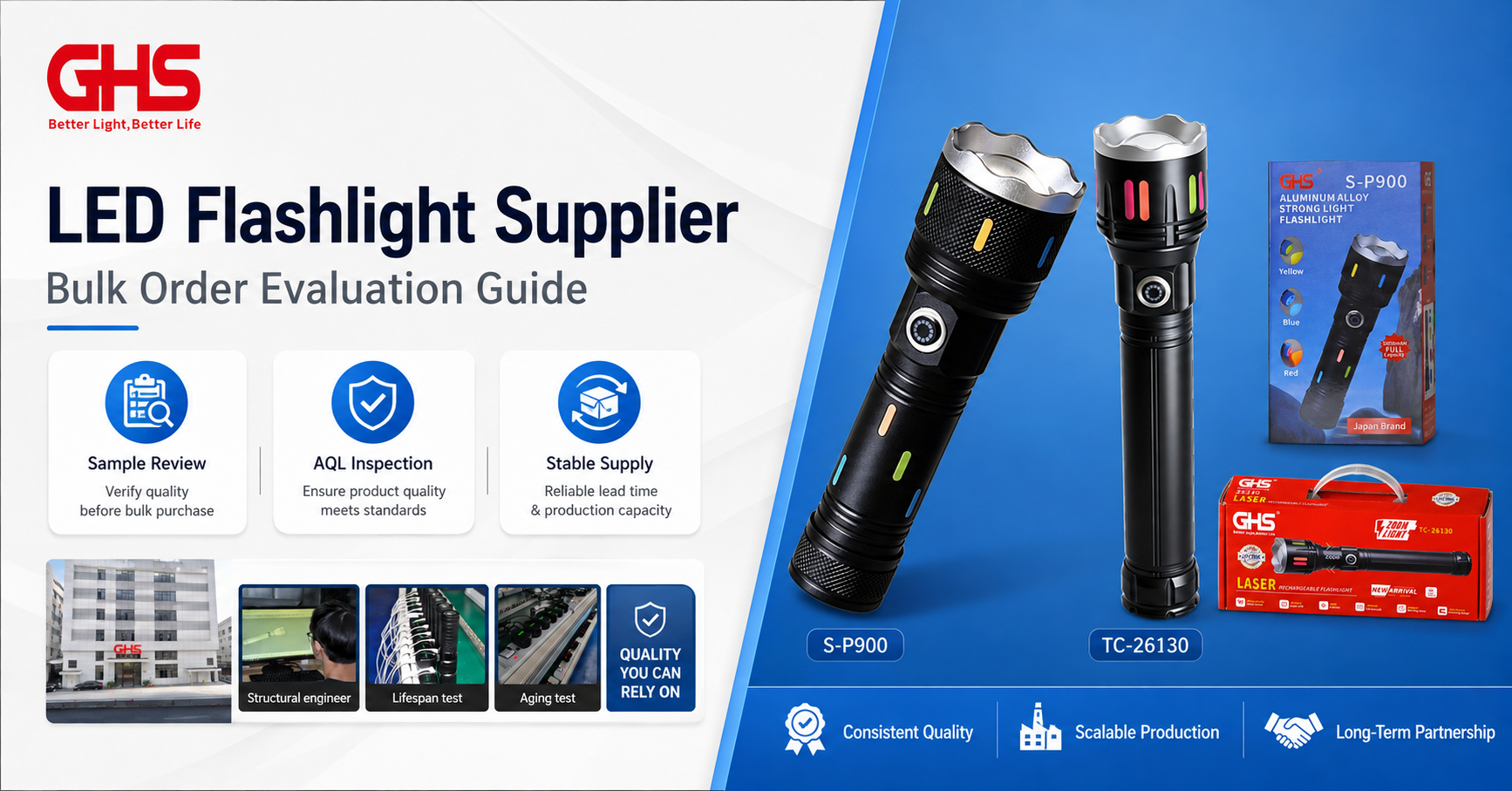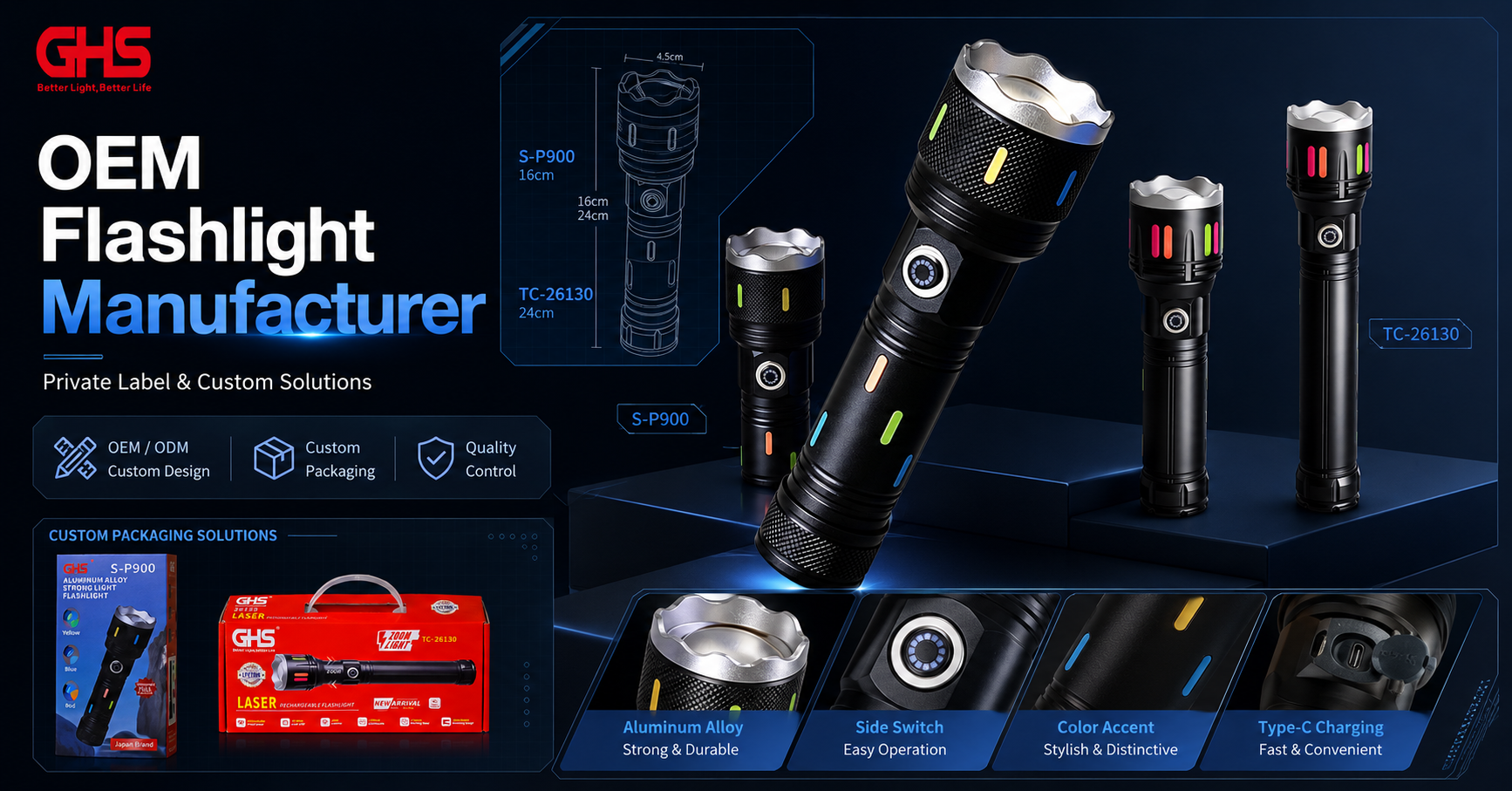

What Should You Look for in an LED Flashlight Manufacturer?
A reliable LED flashlight manufacturer should be evaluated by more than price, appearance or a single lumen figure. B2B buyers should consider product performance, component consistency, quality control, production reliability, customization capability, communication and the supplier's ability to maintain approved specifications across repeat orders.
For importers, distributors, wholesalers and private-label brands, the goal is not simply to find a factory that can produce a flashlight.
The real goal is to find a manufacturing partner that can repeatedly deliver the required product specification at an acceptable total cost and within the expected schedule.
Before choosing a supplier, buyers should ask five basic questions:
- Does the product meet the actual application requirements?
- Can the manufacturer explain the key components and performance clearly?
- Is there a defined quality-control process?
- Can approved specifications be maintained during mass production?
- Can the supplier support the required branding, packaging and commercial terms?
These questions provide a better foundation for B2B sourcing than comparing quotations alone.
LED Flashlight Manufacturer Buyer Checklist
A structured supplier comparison helps purchasing teams avoid decisions based only on product photos or price.
| Evaluation Area | What B2B Buyers Should Check | Why It Matters |
|---|---|---|
| Light output | Lumens, beam pattern, beam distance | Determines application suitability |
| Runtime | Runtime at different operating modes | Affects real-world usability |
| LED system | LED source, driver and output stability | Influences performance consistency |
| Battery | Type, capacity and configuration | Affects runtime, safety and logistics |
| Charging | USB-C or other charging system | Influences convenience and product positioning |
| Housing | Aluminum, ABS or other material | Affects durability, weight and cost |
| Waterproofing | Required IP protection level | Important for outdoor and industrial use |
| QC | Incoming, in-process and final inspection | Reduces batch inconsistency |
| OEM | Logo, color, packaging and specifications | Important for private-label programs |
| MOQ | Minimum quantity for each configuration | Influences inventory investment |
| Lead time | Sampling and production schedule | Affects launches and replenishment |
| Documentation | Applicable test and compliance documents | Reduces import and market risk |
Buyers should use the same checklist for every shortlisted supplier so that quotations can be compared on an equivalent basis.
Manufacturer vs Supplier: Which Is Better for B2B Buyers?
A search for an LED flashlight supplier may return manufacturers, trading companies, wholesalers and sourcing companies.
These business models are different.
A manufacturer normally participates directly in production or product development, while a trading supplier may source products from one or several factories.
For B2B flashlight projects, direct manufacturing capability can become particularly important when the buyer requires:
- Stable repeat orders
- Product customization
- Private-label packaging
- Logo application
- Specification control
- Technical changes
- Long-term component consistency
A trading supplier may still be useful when a buyer needs many unrelated product categories or wants to consolidate products from multiple factories.
The correct choice depends on the sourcing objective.
For buyers developing a long-term flashlight product line, it is important to understand who actually controls the manufacturing process and critical components.
Do Not Select a Flashlight by Lumens Alone
Lumens are one of the most visible flashlight specifications, but they should not be treated as the only performance indicator.
Two flashlights with similar maximum lumen claims can perform differently because of differences in:
- Runtime
- Beam intensity
- Beam distance
- Beam pattern
- Thermal management
- Battery capacity
- Driver efficiency
- Output regulation
- Housing design
For this reason, professional buyers should ask how performance data is measured.
The ANSI/PLATO FL 1 framework is widely referenced in the portable-lighting industry for standardized performance measurements such as light output, runtime and beam distance.
When evaluating an LED flashlight manufacturer, buyers can ask:
- How is lumen output measured?
- Is the stated output continuous or temporary?
- How is runtime defined?
- Which operating mode is used for runtime testing?
- How is beam distance measured?
- Are test conditions consistent between models?
Clear test definitions make supplier comparisons more meaningful.
Check the LED, Driver and Electronics Together
The LED itself is only one part of a flashlight system.
Performance also depends on:
- LED driver
- PCB
- Wiring
- Switch
- Battery
- Charging circuit
- Optical system
- Thermal design
A high-output LED does not automatically create a high-quality flashlight.
If the driver cannot regulate current effectively or the housing cannot dissipate heat properly, the flashlight may reduce output quickly or deliver inconsistent performance.
For B2B sourcing, an RFQ should therefore describe the required result, not simply request the most powerful LED available.
Useful requirements may include:
- Target lumen range
- Beam type
- Beam distance
- Desired runtime
- Operating modes
- Battery preference
- Charging interface
- Housing material
- Product size
- Waterproof requirement
- Target market
- Target price level
This information helps the manufacturer recommend a more appropriate configuration.
Aluminum vs Plastic Flashlight Housing
Housing material affects durability, weight, appearance, heat management and price.
Aluminum Flashlights
Aluminum alloy housings are commonly used for products requiring:
- Higher durability
- Professional appearance
- Better heat transfer
- Outdoor applications
- High-output configurations
- Anodized surface finishes
They are commonly found in professional, outdoor and higher-performance flashlight categories.
ABS and Plastic Flashlights
Engineering-plastic housings can be suitable when buyers prioritize:
- Lower weight
- Cost efficiency
- Electrical insulation
- Promotional applications
- Household applications
- High-volume production
Neither material is automatically superior.
The correct choice depends on how the flashlight will be used and how the buyer wants to position the product.
What Should Buyers Know About Waterproof Flashlights?
“Waterproof” should not be treated as a vague marketing term.
IEC 60529 defines the IP classification system used to describe protection against solid objects and water ingress.
For flashlight sourcing, buyers should define the required protection level according to the intended application.
Important structural areas can include:
- Lens sealing
- O-rings
- Housing joints
- Thread tolerances
- Switch sealing
- Charging-port covers
- Battery-compartment seals
Instead of asking:
“Is this flashlight waterproof?”
A more useful B2B question is:
“What IP protection level can this model meet, and how is the requirement tested?”
This gives both buyer and manufacturer a measurable target.
Rechargeable Flashlights Need Additional Battery Evaluation
When sourcing rechargeable products, the battery becomes a critical component.
Buyers should clarify:
- Battery chemistry
- Cell format
- Rated capacity
- Battery supplier
- Protection circuit
- Charging voltage
- Charging current
- Charging time
- Runtime
- Replaceable or built-in design
Common lithium-ion cell formats used in portable lighting include 18650 and 21700, although the correct choice depends on product size, power demand and runtime requirements.
B2B buyers should also consider transportation requirements.
Lithium cells and batteries may need documentation related to UN 38.3 transport testing, depending on the product and shipping configuration.
Battery documentation should therefore be confirmed before mass production rather than after the shipment is ready.
How Should an LED Flashlight Factory Control Quality?
Quality control should not begin only when the finished products are packed.
A more complete manufacturing system normally controls quality at several stages.
Incoming Component Inspection
Important components may include:
- LEDs
- Batteries
- PCBs
- Drivers
- Switches
- Housing components
- Optics
- Charging ports
- Packaging materials
Incoming inspection helps prevent defective or incorrect materials from entering mass production.
In-Process Inspection
During assembly, manufacturers may check:
- Wiring
- Soldering
- Switch installation
- Charging function
- Housing fit
- Thread fit
- Product appearance
In-process inspection makes it easier to identify problems before an entire production batch is completed.
Functional Testing
Depending on the flashlight specification, functional testing may cover:
- Light modes
- Switch operation
- Charging
- Current
- Output
- Runtime sampling
- Battery connection
Final Inspection
Finished-product inspection may include:
- Function
- Appearance
- Logo
- Accessories
- User manual
- Packaging
- Barcode
- Carton marks
- Quantity
For bulk purchasing, buyers should agree on inspection criteria before production begins.
Why Is Production Consistency Important?
A good sample does not guarantee a good mass-production order.
One of the most important criteria when evaluating an LED flashlight manufacturer is the ability to reproduce the approved sample consistently.
Buyers should ask how the supplier controls:
- Approved samples
- Bill of materials
- Component substitutions
- Engineering changes
- Housing color
- Surface finish
- Logo location
- Packaging revisions
- Repeat-order specifications
This is especially important for private-label brands.
If the battery, LED, driver, housing or packaging changes between orders without approval, the product may deliver an inconsistent customer experience.
For long-term sourcing programs, buyers should maintain an approved specification sheet covering the components and performance requirements that cannot be changed without authorization.
What OEM Flashlight Customization Is Available?
An OEM flashlight manufacturer may support different levels of customization.
Branding Customization
Typical private-label options can include:
- Printed logo
- Laser-engraved logo
- Customized product color
- Gift box
- Blister packaging
- Instruction manual
- Barcode labels
- Shipping carton marks
Configuration Customization
Depending on the model, buyers may also discuss:
- Battery configuration
- Charging interface
- Lighting modes
- Accessories
- Surface finishing
- Packaging sets
Deeper Product Development
More complex projects may involve:
- Housing modifications
- Electronic changes
- Optical changes
- Tooling
- Structural redesign
The deeper the customization, the more important it becomes to clarify MOQ, tooling cost, sample approval, development time and ownership of custom designs.
What Determines Flashlight MOQ?
There is no universal MOQ that applies to every flashlight.
Minimum order quantities may depend on:
- Existing product or new design
- Logo process
- Product color
- Packaging
- Battery configuration
- Component purchasing requirements
- Tooling
- Production setup
- Order value
A standard flashlight with a simple logo may have very different production requirements from a fully customized model.
For a more accurate quotation, buyers should provide:
- Expected quantity
- Target product
- Logo requirement
- Packaging
- Battery
- Color
- Target market
The manufacturer can then determine the most practical production route.
What Determines LED Flashlight Pricing?
Unit price should always be evaluated against the product specification.
Cost can be affected by:
- LED
- Driver
- Battery
- Housing material
- Machining
- Surface finish
- Optical components
- Charging system
- Waterproof structure
- Accessories
- Packaging
- Testing
- Order quantity
- Customization level
For B2B buyers, the lowest quoted unit price is not necessarily the lowest total sourcing cost.
A cheaper product may create additional expenses through:
- Higher defect rates
- Customer complaints
- Returns
- Rework
- Delayed shipments
- Packaging errors
- Inconsistent repeat orders
The correct comparison is therefore:
Specification + Quality + Service + Risk + Price
rather than price alone.
How to Reduce Risk When Sourcing Flashlights from China
Buyers searching for a flashlight manufacturer in China can reduce sourcing risk by following a structured purchasing process.
Step 1: Define the Application
Clarify whether the flashlight is designed for:
- Outdoor use
- Household use
- Emergency use
- Industrial inspection
- Hardware distribution
- Promotional programs
- Professional applications
Step 2: Prepare a Detailed RFQ
Include:
- Product type
- Lumen requirement
- Beam requirement
- Battery
- Runtime
- Charging
- Material
- Waterproof level
- Quantity
- Logo
- Packaging
- Target market
Step 3: Compare Manufacturers Using the Same Criteria
Do not compare one supplier's premium model with another supplier's entry-level model.
Use equivalent specifications.
Step 4: Test Samples
Evaluate:
- Output
- Runtime
- Charging
- Switch
- Housing
- Finish
- Accessories
- Packaging
Step 5: Freeze Critical Specifications
Confirm which components and specifications require buyer approval before changes can be made.
Step 6: Confirm Inspection Requirements
Define inspection standards before production.
Step 7: Confirm Commercial Terms
Clarify:
- MOQ
- Production schedule
- Packaging
- Payment terms
- Shipping terms
- Required documentation
A structured sourcing process reduces misunderstandings on both sides.
How to Compare Two LED Flashlight Manufacturers
Use a weighted comparison instead of choosing suppliers based on quotation alone.
| Factor | Manufacturer A | Manufacturer B | Suggested Importance |
| Product performance | Evaluate | Evaluate | High |
| Component transparency | Evaluate | Evaluate | High |
| QC process | Evaluate | Evaluate | High |
| Sample consistency | Evaluate | Evaluate | High |
| OEM capability | Evaluate | Evaluate | Medium–High |
| MOQ flexibility | Evaluate | Evaluate | Medium |
| Lead time | Evaluate | Evaluate | Medium |
| Documentation | Evaluate | Evaluate | High |
| Communication | Evaluate | Evaluate | Medium–High |
| Price | Evaluate | Evaluate | High |
The importance of each factor should change according to the project.
For example, waterproof performance may be critical for outdoor products but less important for a basic household flashlight.
Questions to Ask Before Placing a Bulk Order
Before choosing an LED flashlight manufacturer, ask:
- Are you the direct manufacturer of this flashlight?
- Which major components are used?
- Which components can be customized?
- How are lumen output and runtime measured?
- What battery options are available?
- How is waterproof performance tested?
- What inspections are performed during production?
- Can we approve a pre-production sample?
- How are component substitutions controlled?
- What OEM logo options are available?
- What packaging can be customized?
- What determines MOQ?
- What is the sample lead time?
- What is the bulk-production lead time?
- Which test reports or documents are available?
- How are quality issues handled after delivery?
Clear answers to these questions make supplier comparison more objective.
Why Include GHS in Your LED Flashlight Supplier Evaluation?
For buyers sourcing portable lighting products, supplier evaluation should begin with the actual project requirements.
When discussing a potential project with GHS, provide as much information as possible about:
- Application
- Quantity
- Target market
- Lumen requirement
- Battery
- Runtime
- Housing
- Waterproof requirement
- Logo
- Packaging
This allows the supplier to determine whether an existing product or another production solution is appropriate.
Buyers should also confirm model-specific specifications, testing, MOQ, lead time and customization details during the RFQ and sampling stages rather than assuming the same conditions apply to every flashlight.
FAQ About LED Flashlight Manufacturers
What is an LED flashlight manufacturer?
An LED flashlight manufacturer produces portable lighting products that combine LEDs, drivers, batteries, optical components, switches and housings. Some manufacturers may also support branding, packaging and product customization.
How do I find a reliable LED flashlight manufacturer in China?
Evaluate manufacturing capability, product performance, component control, quality inspection, technical communication, samples, documentation and repeat-order consistency. Do not rely only on price or product photos.
What should I include in an LED flashlight RFQ?
Include product application, quantity, lumen range, runtime, battery, charging method, housing material, waterproof requirement, logo, packaging and target market.
How important are lumens when buying flashlights wholesale?
Lumens are important, but buyers should also compare runtime, beam distance, beam pattern, thermal performance, battery configuration and output stability.
What is the difference between a flashlight manufacturer and a flashlight supplier?
A manufacturer normally participates directly in production. A supplier may be a manufacturer, trading company, wholesaler or sourcing intermediary. Buyers should understand who controls the production process.
Can LED flashlights be customized?
Depending on the model and supplier capability, customization may include logo, product color, packaging, battery configuration, accessories and other specifications.
What affects OEM flashlight MOQ?
MOQ can be affected by product design, logo process, packaging, color, battery, component purchasing quantities, tooling and production setup.
What should I check when sourcing a waterproof flashlight?
Define the required IP protection level and confirm how the product's seals, housing joints, switches and charging interfaces support that requirement.
What should I check when sourcing rechargeable flashlights?
Check battery type, rated capacity, protection circuit, charging system, runtime, applicable transport documentation and target-market requirements.
Is the cheapest LED flashlight supplier usually the best option?
Not necessarily. Buyers should compare specification, component quality, QC, production consistency, documentation, service and total sourcing risk together with price.