
What Should B2B Buyers Check in a Rechargeable Flashlight Manufacturer?
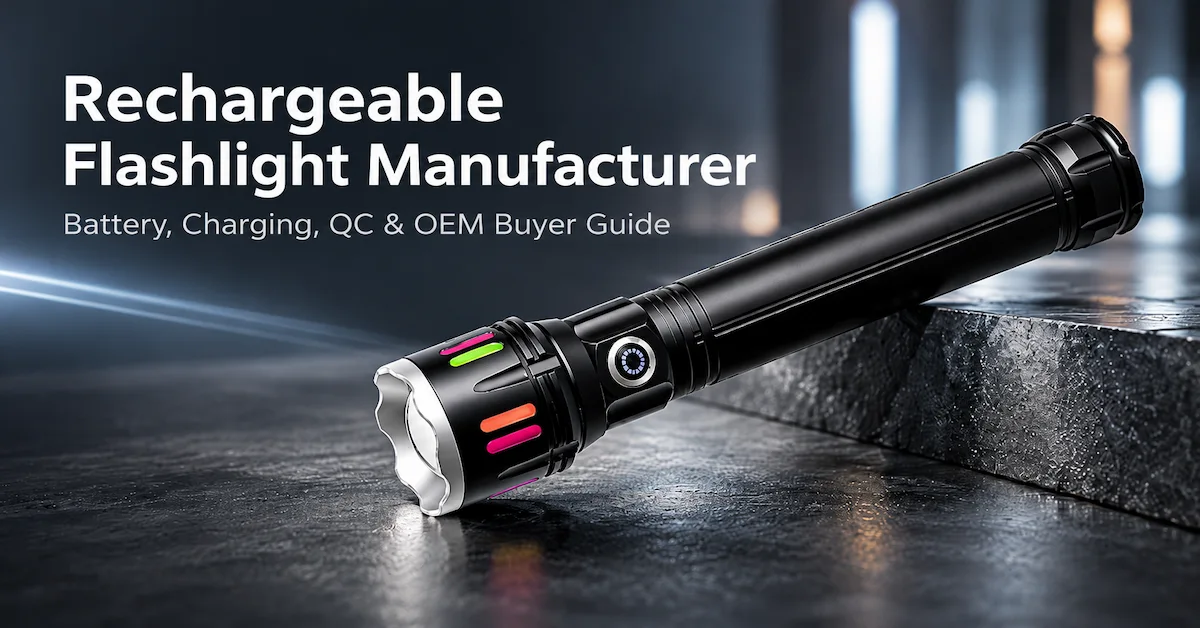
A reliable rechargeable flashlight manufacturer should be able to explain how the battery, LED, driver, charging circuit, housing and thermal system work together.
For B2B buyers, rechargeable flashlights are more complex than basic disposable-battery models because product performance depends on an integrated electrical system.
A flashlight may advertise high brightness or large battery capacity, but those figures alone do not tell buyers:
- How long useful output can be maintained
- How quickly the product charges
- How heat affects performance
- Whether battery protection is properly designed
- Whether performance remains consistent between production batches
- Whether the battery documentation matches export requirements
For importers, wholesalers and private-label brands, the best supplier is therefore not automatically the one offering the largest lumen or battery number.
The better question is:
Can the manufacturer consistently deliver the required brightness, runtime, charging performance and battery configuration for the intended application?
Rechargeable Flashlight Buyer Checklist
Before comparing quotations, buyers should define the key purchasing requirements.
| Evaluation Area | What Buyers Should Confirm | B2B Importance |
|---|---|---|
| Battery system | Chemistry, format, capacity and configuration | High |
| Runtime | Runtime at specified operating modes | High |
| Charging | Interface, charging time and charging circuit | High |
| Light output | Initial and usable output | High |
| Driver | Output regulation and operating modes | High |
| Thermal design | Heat dissipation and output management | High |
| Battery protection | Overcharge, over-discharge and short-circuit protection where applicable | High |
| Housing | Material, structure and heat transfer | Medium–High |
| QC | Battery, charging and functional inspection | High |
| OEM options | Logo, packaging and product configuration | Medium–High |
| Documentation | Battery and market-specific documents | High |
| MOQ / lead time | Commercial feasibility | Medium–High |
Using the same checklist for every supplier makes quotation comparisons more objective.
Why Battery Capacity Alone Does Not Determine Runtime
Battery capacity is important, but it is only one part of flashlight runtime.
Actual operating time can also be affected by:
- LED power consumption
- Driver efficiency
- Output mode
- Thermal regulation
- Battery voltage
- Cell quality
- Environmental temperature
- Product electronics
A flashlight with a larger-capacity battery does not automatically provide proportionally longer usable runtime if it also operates at significantly higher output.
For B2B purchasing, battery capacity should therefore be evaluated together with measured runtime at defined operating modes.
This is especially important when comparing products from different manufacturers.
If one supplier measures runtime in low mode while another uses high mode, the numbers cannot be compared directly.
18650 vs 21700: What Should Buyers Consider?
18650 and 21700 are common cylindrical lithium-ion cell formats found in rechargeable portable electronics and lighting products.
Their names relate to their physical dimensions rather than directly specifying capacity or quality.
When choosing between battery formats, buyers should evaluate the complete product requirement.
| Factor | 18650 | 21700 |
| Physical size | Smaller | Larger |
| Product design | Suitable for compact designs | Often suited to larger power systems |
| Potential capacity | Depends on specific cell | Depends on specific cell |
| Weight | Generally lower | Generally higher |
| Runtime potential | Configuration dependent | Configuration dependent |
| High-output applications | Possible | Often considered for higher-energy designs |
The correct choice cannot be determined from cell format alone.
Buyers should ask the rechargeable flashlight manufacturer about:
- Actual cell specification
- Rated capacity
- Supplier or cell source
- Protection configuration
- Product current requirements
- Runtime target
- Charging system
- Product dimensions
A well-designed 18650 flashlight can be more appropriate than a poorly designed 21700 flashlight, depending on the target application.
Built-In Battery vs Replaceable Battery
Battery architecture also influences product positioning.
Built-In Rechargeable Battery
A built-in battery can support:
- Simple consumer operation
- Integrated product design
- Reduced battery handling
- Compact charging systems
However, buyers should consider battery serviceability and the expected product lifecycle.
Replaceable Rechargeable Battery
A replaceable battery can be useful for:
- Professional users
- Outdoor applications
- Long operating periods
- Users carrying spare batteries
- Products requiring easier battery replacement
The correct design depends on the target market.
An outdoor distributor may have different requirements from a promotional product importer.
Why Charging Design Matters
Rechargeable flashlight buyers should evaluate charging as part of the product specification rather than treating it as an accessory feature.
Important questions include:
- What charging interface is used?
- What input voltage is required?
- How long does charging take?
- Is charging status indicated?
- Is the charging port protected?
- Is the charging circuit integrated into the flashlight?
- What battery protection is used?
- Can the supplied cable meet the intended market requirements?
USB charging has become common in portable lighting, while USB-C is increasingly preferred in many newer electronic products because of connector convenience.
However, simply using a USB-C connector does not automatically indicate charging speed or electrical capability.
B2B buyers should confirm the actual charging specification rather than relying on the connector type alone.
Runtime Claims Need a Defined Test Method
Runtime is one of the most important specifications for rechargeable flashlights.
It is also one of the easiest figures to misunderstand.
A supplier may state:
Runtime: 8 hours
But a professional buyer should ask:
Eight hours at which output level?
The revised ANSI/PLATO FL 1 2025 Standard, announced by PLATO in February 2026, provides standardized guidance for portable-lighting performance claims and includes updates addressing short-duration elevated brightness or “turbo/boost” modes.
For procurement purposes, buyers should clarify:
- Starting output
- Selected operating mode
- Runtime definition
- Test environment
- Battery condition
- Whether output gradually decreases
- Whether temporary boost output is included
This helps buyers compare rechargeable flashlight models more fairly.
Maximum Lumens vs Sustained Output
Maximum lumen output can be valuable for marketing, but professional buyers should also consider sustained performance.
High-power LEDs generate heat.
As temperature rises, flashlight electronics may reduce current to protect the LED, battery or circuit.
Therefore, a flashlight advertised at a high maximum output may not maintain that output continuously.
B2B buyers evaluating a high power flashlight manufacturer should ask:
- How long can the maximum mode operate?
- Does output step down automatically?
- How is temperature managed?
- What is the sustained output after step-down?
- How does battery voltage affect brightness?
For many professional applications, stable usable output can be more valuable than a very high short-duration peak.
Thermal Management Is Part of Flashlight Performance
Heat management connects several components:
LED → PCB → housing → surrounding air
If heat cannot move efficiently away from the LED and driver, product performance and component life may be affected.
Common design considerations can include:
- LED mounting
- PCB construction
- Contact between PCB and housing
- Aluminum housing
- Body thickness
- Heat-dissipation surface area
- Electronic temperature management
For this reason, buyers should not evaluate the LED brand or nominal wattage in isolation.
A rechargeable flashlight is a complete thermal and electrical system.
What Should Rechargeable Flashlight QC Include?
Rechargeable products require additional inspection compared with simple battery-powered flashlights.
Incoming Battery Inspection
Depending on the manufacturer's process and product requirements, checks may involve:
- Battery identification
- Voltage
- Physical appearance
- Capacity-related sampling
- Protection components
- Supplier consistency
Charging Function Inspection
Manufacturers should verify that the product:
- Accepts charging
- Shows the correct charging indication
- Connects reliably
- Completes the intended charging cycle
Lighting Function Inspection
Inspection may include:
- Power-on function
- Operating modes
- Switch response
- Output
- Beam consistency
Runtime Sampling
Runtime testing does not necessarily need to be performed on every finished flashlight, but representative testing can help verify whether production remains consistent with approved specifications.
Appearance and Assembly Inspection
Checks may also cover:
- Housing
- Threads
- Switches
- Charging-port covers
- Lens
- Logo
- Accessories
- Packaging
The exact QC plan should be defined according to the model and order requirements.
Why Lithium Battery Documentation Matters for Export Orders
Rechargeable flashlights containing lithium-ion batteries can require additional transportation consideration compared with non-rechargeable products.
Section 38.3 of the United Nations Manual of Tests and Criteria addresses testing of lithium cells and batteries. UNECE's current Revision 8 materials and Amendment 1 continue to include requirements and updates relating to subsection 38.3.
For B2B buyers, this means battery transport requirements should be discussed before shipment planning.
Depending on the product, battery and logistics method, buyers may need to confirm relevant documentation with the manufacturer, freight forwarder and applicable carrier.
Do not wait until mass production is finished to ask whether the battery documentation supports the intended shipping route.
How to Compare Rechargeable Flashlight Samples
A sample evaluation should go beyond appearance.
Use a structured comparison.
1. Check Physical Quality
Evaluate:
- Housing finish
- Threads
- Switch feel
- Lens
- Charging port
- Seals
- Product weight
- Assembly quality
2. Test Every Operating Mode
Confirm:
- Mode sequence
- Brightness differences
- Switch behavior
- Memory function if specified
- Warning indicators if applicable
3. Evaluate Charging
Record:
- Charging interface
- Charging indication
- Approximate charging time
- Cable fit
- Connector stability
4. Evaluate Runtime
Test the operating modes relevant to your customers.
Do not evaluate runtime only in the lowest-output mode if your customers primarily use medium or high output.
5. Evaluate Heat
Operate the flashlight at the expected high-output setting and observe:
- Surface temperature
- Automatic step-down
- Stability
- Unexpected shutdown
6. Compare the Sample With the Written Specification
The approved sample and written specification should agree.
If they do not, clarify the discrepancy before mass production.
How Can B2B Buyers Control Repeat-Order Consistency?
The biggest purchasing risk is not always the first order.
It is often maintaining the same product over several repeat orders.
Critical rechargeable flashlight components can include:
- LED
- Battery
- Driver
- PCB
- Switch
- Charging circuit
- Housing
- Optics
If one component changes, performance may also change.
Buyers should therefore establish a controlled specification covering the components that cannot be substituted without approval.
A useful supplier question is:
If a battery, LED or driver becomes unavailable, how do you manage component substitutions?
The correct process should involve communication, evaluation and approval rather than silent replacement.
OEM Rechargeable Flashlight Options
Private-label buyers often need customization beyond a standard product.
An OEM flashlight manufacturer may support several levels of customization depending on the specific model.
Branding
Possible requirements can include:
- Logo printing
- Laser marking
- Product color
- Packaging
- Barcode
- User manual
- Carton marks
Product Configuration
Depending on project feasibility:
- Battery configuration
- Lighting modes
- Charging interface
- Accessories
- Surface finish
Advanced Customization
More complex projects may involve:
- Electronic modifications
- Housing development
- Optical changes
- Tooling
- New structural design
The deeper the customization, the earlier buyers should discuss MOQ, development cost, sampling and lead time.
What Determines Rechargeable Flashlight MOQ?
MOQ is affected by the production configuration rather than by the product name alone.
Important factors can include:
- Existing model vs new model
- Battery configuration
- Housing color
- Logo method
- Packaging
- Accessories
- Electronic changes
- Component purchasing quantities
- Tooling
A simple private-label project generally has different manufacturing requirements from a fully customized rechargeable flashlight.
For an accurate quotation, provide the manufacturer with:
- Estimated order quantity
- Target model
- Target market
- Logo
- Packaging
- Battery requirements
- Charging requirements
- Performance target
What Determines Rechargeable Flashlight Cost?
Important cost drivers can include:
- LED
- Battery
- Driver
- PCB
- Charging electronics
- Housing material
- Machining
- Surface treatment
- Optics
- Switch
- Waterproof structure
- Accessories
- Packaging
- Testing
- Customization
- Order volume
A quotation with a lower battery specification or simpler driver should not be compared directly with a higher-specification product.
B2B buyers should first create an equivalent specification and then compare prices.
Common Rechargeable Flashlight Sourcing Mistakes
Choosing the Largest Lumen Number
Peak output alone does not describe sustained performance.
Choosing the Largest Battery Capacity
Capacity needs to be evaluated with runtime, output and battery quality.
Ignoring Charging Performance
Charging is part of the product experience and should be included in sample testing.
Not Confirming Battery Documentation
This can cause problems during international logistics.
Approving Appearance Only
A visually good sample may still have unacceptable runtime or charging performance.
Failing to Control Components
Unapproved battery or driver substitutions can change the finished product.
Selecting Only by Price
Price differences may reflect meaningful differences in components, testing and manufacturing controls.
GHS Rechargeable Flashlight Product Context
GHS currently lists several rechargeable flashlight products within its flashlight range, including the TC-26130 Rechargeable Multicolor LED Flashlight, TC-18130 Rechargeable Multicolor LED Flashlight, TC-12130 Rechargeable Multicolor LED Flashlight, and S-P900 Rechargeable Zoom LED Flashlight.
These products show that rechargeable portable lighting is an established part of the current GHS product portfolio.
For B2B projects, buyers should confirm the exact specification of the selected model directly during inquiry, including:
- Battery configuration
- Light output
- Runtime
- Charging system
- Available customization
- MOQ
- Packaging
- Lead time
- Applicable documentation
This is preferable to assuming that every rechargeable model uses the same configuration.
Questions to Ask a Rechargeable Flashlight Manufacturer
Before placing a bulk order, ask:
- What battery type does this model use?
- What is the rated battery capacity?
- Is the battery built in or replaceable?
- Which charging interface is used?
- How is charging time measured?
- How is runtime tested?
- What is the runtime at each important mode?
- Does high output automatically step down?
- How is heat managed?
- Which battery protection functions are included?
- What incoming battery inspections are performed?
- What charging tests are performed during production?
- Can we approve a pre-production sample?
- How are battery or driver substitutions controlled?
- Which OEM options are available?
- What determines MOQ?
- What is the estimated production lead time?
- Which battery transport documents are available for the selected configuration?
FAQ About Rechargeable Flashlight Manufacturers
What is a rechargeable flashlight manufacturer?
A rechargeable flashlight manufacturer produces portable lighting products that integrate an LED lighting system with a rechargeable battery, driver, charging circuit and housing. Depending on its capabilities, the manufacturer may also support OEM branding, packaging and specification customization.
How do I choose a rechargeable flashlight manufacturer?
Compare battery configuration, runtime, charging, output stability, thermal design, QC, component control, OEM capabilities, documentation and production consistency rather than selecting a supplier by price alone.
Is a higher battery capacity always better?
No. Capacity should be evaluated together with flashlight output, driver efficiency, physical size, battery quality and runtime requirements.
Which is better for flashlights, 18650 or 21700?
Neither is universally better. The correct cell format depends on product size, power demand, desired runtime and overall flashlight design.
What determines rechargeable flashlight runtime?
Runtime can be influenced by battery capacity, output level, LED efficiency, driver efficiency, temperature and electronic output regulation.
Why does a high-lumen flashlight reduce brightness after use?
High output generates heat. Some flashlight designs reduce current after a period of high-output operation to manage temperature and protect components.
What should buyers test in a rechargeable flashlight sample?
Test the housing, operating modes, charging, runtime, heat behavior, switch, battery system, accessories and packaging against the written specification.
Can rechargeable flashlights be customized?
Depending on the manufacturer and model, buyers may request logo, color, packaging, battery configurations, lighting modes, accessories or more extensive product development.
What battery documents should buyers request?
Requirements depend on the battery, shipment and destination. Lithium-battery projects should discuss applicable UN 38.3-related documentation and transport requirements with the supplier and logistics provider.
How can buyers reduce rechargeable flashlight sourcing risk?
Use a detailed RFQ, test samples under realistic conditions, freeze critical specifications, define QC requirements and confirm battery documentation before mass production.