
How Should You Choose a Flashlight Manufacturer in China?
Choosing a flashlight manufacturer in China should begin with the product and purchasing requirements, not with the lowest quotation.
For B2B buyers, the real challenge is finding a supplier that can consistently deliver the required flashlight specification across samples, mass production and repeat orders.
A professional sourcing evaluation should consider:
- Product category
- Lighting performance
- Battery system
- Housing and materials
- Manufacturing capability
- Quality control
- Component management
- OEM capabilities
- MOQ
- Lead time
- Documentation
- Communication
- After-sales problem handling
The cheapest supplier is not necessarily the lowest-cost supplier once defects, delays, returns and specification changes are considered.
For importers and distributors, supplier selection should therefore focus on total sourcing risk and long-term consistency.
China Flashlight Manufacturer Buyer Checklist
Use the same criteria when comparing shortlisted suppliers.
| Evaluation Area | What Buyers Should Check | Importance |
|---|---|---|
| Product match | Does the factory make the flashlight type you need? | High |
| Manufacturing capability | Assembly, testing and production control | High |
| Component control | LED, driver, battery and housing consistency | High |
| Samples | Does the sample meet written requirements? | High |
| Quality control | Incoming, process and final inspection | High |
| OEM capability | Logo, packaging and product customization | Medium–High |
| MOQ | Minimum quantity for the required configuration | Medium |
| Lead time | Sample, production and shipment schedule | High |
| Documentation | Applicable product and battery documents | High |
| Pricing | Price based on equivalent specifications | High |
| Communication | Technical and commercial response quality | Medium–High |
| Repeat orders | Ability to reproduce approved specifications | High |
A supplier should not be selected until buyers understand what is actually included in the quotation.
Manufacturer, Trading Company or Wholesaler?
When searching for a flashlight supplier in China, buyers may encounter different business models.
Direct Flashlight Manufacturer
A manufacturer usually participates directly in:
- Component sourcing
- Assembly
- Testing
- Production management
- Quality inspection
Depending on its capabilities, it may also provide engineering and OEM support.
Direct factories can be attractive for buyers requiring stable repeat production or deeper product customization.
Trading Company
A trading company may source products from one or multiple factories.
This can be useful when buyers need:
- Multiple product categories
- Mixed sourcing
- Smaller consolidated orders
- One contact for several factories
However, buyers should understand which company controls production and quality.
Wholesale Supplier
A wholesaler may focus on existing products that can be supplied quickly from stock or standard production.
This model can suit buyers prioritizing availability rather than customization.
There is no universally superior model.
The correct supplier structure depends on the purchasing strategy.
Define the Product Before Searching for a Factory
A common sourcing mistake is sending the same vague request to dozens of suppliers:
“Please quote your best rechargeable flashlight.”
This produces quotations that are difficult to compare because every supplier may quote a different configuration.
A better RFQ should define:
- Flashlight type
- Target application
- Estimated quantity
- Brightness requirement
- Runtime expectation
- Battery type
- Charging requirement
- Housing material
- Waterproof requirement
- Operating modes
- Logo requirements
- Packaging
- Target market
- Required documentation
The clearer the RFQ, the easier it is to determine whether two Chinese flashlight factories are quoting comparable products.
Evaluate Product Specialization
Not every flashlight factory specializes in the same products.
A manufacturer may focus on:
- Basic flashlights
- Rechargeable flashlights
- High-output flashlights
- Outdoor flashlights
- Promotional lighting
- Work lights
- Tactical-style products
- Specialty portable lighting
A factory that is suitable for a low-cost household flashlight may not be the best supplier for a technically demanding rechargeable model.
Before discussing price, ask:
- Which flashlight categories do you manufacture most frequently?
- Which models are standard products?
- Which products have stable repeat production?
- Which components can be customized?
- Which products are recommended for my target application?
The goal is to match the buyer's requirement with the manufacturer's established capability.
Check the Actual Product Platform
Product catalogs can contain dozens or hundreds of items.
But B2B buyers should determine which products are:
- Regular production models
- Newly developed models
- Customer-specific projects
- Products sourced externally
- Products that are no longer actively produced
A large catalog does not automatically mean stronger manufacturing capability.
Instead of asking:
“How many flashlight models do you have?”
Ask:
“Which models are currently in regular mass production and most suitable for repeat B2B orders?”
This is more relevant to supply stability.
How Should Buyers Evaluate a China Flashlight Factory?
A factory evaluation should focus on how requirements move through the production system.
The basic process may include:
Incoming Materials → Assembly → Functional Testing → Inspection → Packaging → Shipment
Buyers should understand how each stage is controlled.
Incoming Components
Important flashlight components can include:
- LEDs
- Drivers
- PCBs
- Batteries
- Switches
- Charging circuits
- Housing parts
- Lenses
- Reflectors
- Seals
Ask whether critical components are inspected before assembly.
Production
During production, buyers can evaluate how the factory manages:
- Work instructions
- Assembly
- Soldering
- Wiring
- Housing fit
- Switch installation
- Charging components
Testing
Depending on the model, flashlight testing may include:
- Power-on testing
- Light modes
- Charging
- Current
- Switch function
- Beam
- Runtime sampling
Final Inspection
Final checks may cover:
- Function
- Appearance
- Logo
- Accessories
- Packaging
- Labels
- Cartons
- Quantity
A good sourcing decision depends more on whether these processes are controlled than on how impressive the showroom looks.
How Important Is a Quality Management System?
B2B buyers should examine whether the manufacturer uses repeatable and documented quality processes.
ISO describes ISO 9001 as an internationally recognized quality-management standard designed to help organizations consistently meet customer requirements and continually improve their processes.
However, buyers should distinguish between:
- Using quality-management principles
- Claiming compliance
- Holding a valid third-party certification
Do not state that a supplier is ISO certified unless it can provide valid certification covering the relevant organization and scope.
Even when certification is available, buyers should still evaluate the actual factory process.
A certificate does not replace sample testing or order-specific inspection.
Why Samples Matter Before Bulk Orders
A sample is one of the most valuable tools for evaluating a China flashlight manufacturer.
It allows buyers to test the actual product rather than relying on a listing page.
Check:
- Housing quality
- Product dimensions
- Weight
- Switch
- Beam pattern
- Lighting modes
- Charging
- Battery
- Runtime
- Surface finish
- Logo
- Packaging
The sample should be compared against a written specification.
Do not rely on memory or verbal descriptions.
If a sample is approved, record the critical characteristics so they can be checked again during mass production.
Golden Samples and Written Specifications
For private-label or recurring B2B orders, buyers should consider using an approved reference sample.
A golden sample can provide a physical reference for:
- Color
- Appearance
- Logo
- Product feel
- Assembly
- Accessories
- Packaging
However, a golden sample should be supported by written specifications.
Internal components such as the battery, LED or driver may not be identifiable from appearance alone.
The strongest control is:
Approved Sample + Written Specification + Critical Component List
Why Component Consistency Matters
Component substitution is an important sourcing risk.
Two visually identical flashlights can perform differently if they use different:
- LEDs
- Drivers
- Batteries
- PCBs
- Switches
A supplier may need to change components because of availability or cost.
This is not automatically unacceptable.
The key question is whether substitutions are controlled.
Buyers should define which components require approval before changes are made.
For long-term distribution programs, uncontrolled component substitutions can affect:
- Light output
- Runtime
- Charging
- Product life
- Customer satisfaction
- Repeat-order consistency
How to Compare Flashlight Quotations from China
A common mistake is comparing only the final unit price.
Before comparing quotations, confirm that the suppliers quoted the same requirements.
| Specification | Supplier A | Supplier B |
| LED | Confirm | Confirm |
| Battery | Confirm | Confirm |
| Runtime | Confirm | Confirm |
| Housing | Confirm | Confirm |
| Charging | Confirm | Confirm |
| Waterproof requirement | Confirm | Confirm |
| Logo | Confirm | Confirm |
| Packaging | Confirm | Confirm |
| Accessories | Confirm | Confirm |
| Testing | Confirm | Confirm |
| Order quantity | Confirm | Confirm |
If the specifications differ, the prices are not directly comparable.
A lower quotation can result from:
- Lower battery capacity
- Different LED
- Different driver
- Lighter housing
- Simpler packaging
- Fewer accessories
- Less testing
The correct purchasing comparison is specification first, price second.
What Determines Flashlight Pricing in China?
Pricing can be influenced by:
- LED
- Battery
- Driver
- Electronics
- Housing material
- Machining
- Surface finishing
- Charging system
- Optics
- Waterproof structure
- Accessories
- Packaging
- Testing
- Customization
- Quantity
Larger order quantities can sometimes improve cost efficiency, but buyers should avoid assuming that volume automatically produces a fixed percentage discount.
Actual pricing depends on the product configuration and production economics.
What Determines MOQ?
MOQ may be affected by:
- Standard vs customized product
- Housing color
- Logo process
- Battery
- Packaging
- Electronic changes
- Component purchasing quantity
- Production setup
An existing model with standard packaging may have different MOQ requirements from a private-label product with custom boxes and color.
When requesting a quotation, ask the supplier to explain:
Which requirement is driving the MOQ?
This provides more useful information than simply asking for the absolute minimum.
How Should Buyers Evaluate Lead Time?
Lead time should not be treated as one number.
It can include:
Sampling
- Product selection
- Customization
- Sample production
- Buyer approval
Material Preparation
- Components
- Batteries
- Packaging
- Customized parts
Production
- Assembly
- Functional testing
- Inspection
- Packing
Shipment Preparation
- Final checks
- Documents
- Logistics coordination
Buyers with fixed launch schedules should ask for a stage-by-stage timeline.
Rechargeable Flashlights Need Extra Export Planning
Rechargeable flashlight orders require additional consideration because lithium batteries can affect international transport.
The UN Manual of Tests and Criteria, subsection 38.3, sets out testing requirements applicable to lithium metal and lithium-ion cells and batteries before transport under relevant conditions.
For rechargeable flashlight orders, buyers should confirm relevant battery information and transportation documentation before shipment.
Questions can include:
- What battery model is used?
- Is a relevant UN 38.3 test summary available?
- Does the shipped battery configuration match the tested type?
- What documents does the freight forwarder require?
Transport requirements can vary according to battery configuration and shipping method, so buyers should confirm them with both the supplier and logistics provider.
Waterproof Claims Should Be Verifiable
If the flashlight is marketed as water-resistant or waterproof, define the target requirement clearly.
IEC 60529 establishes the IP Code classification used to describe protection provided by electrical enclosures against solid objects and water ingress.
Instead of accepting:
“This flashlight is waterproof.”
ask:
“What IP protection level applies to this model and what test supports the claim?”
This is especially important if customization changes:
- Charging-port covers
- Switches
- Housing joints
- Lens assemblies
A customized structure can change sealing performance.
How to Audit a Flashlight Supplier Remotely
Not every buyer can visit a China factory before the first order.
A remote supplier evaluation can still gather useful evidence.
Request:
- Business information
- Factory photos or video
- Production-line video
- Quality-control process
- Product testing process
- Sample
- Packaging examples
- Relevant certificates where applicable
During a live video call, buyers can ask to see:
- Assembly
- Testing
- Warehouse
- Packaging
- Sample room
Remote audits cannot replace every form of on-site verification, but they can help buyers filter suppliers before investing in travel or third-party inspection.
When Should You Use Third-Party Inspection?
Third-party inspection can be valuable when:
- The order value is significant
- The supplier is new
- Product specifications are complex
- Private-label packaging is critical
- Previous orders had quality problems
- The buyer cannot inspect the goods personally
Inspection requirements should be defined before production.
An inspector needs clear criteria.
“Check quality” is not a useful inspection standard.
Instead, define:
- Quantity
- Product function
- Appearance
- Packaging
- Logo
- Accessories
- Critical dimensions
- Performance checks where practical
Common Mistakes When Sourcing Flashlights from China
Choosing by Price First
Price should be compared only after confirming equivalent specifications.
Sending an Incomplete RFQ
Vague requirements create inconsistent quotations.
Not Testing Samples
Product photos cannot confirm runtime, charging or build quality.
Ignoring Internal Components
Visually identical products can contain different batteries and electronics.
Approving Samples Without Written Specifications
A physical sample alone may not identify critical internal parts.
Waiting Until Shipment to Check Battery Documents
Rechargeable products require earlier logistics planning.
Assuming Every Supplier Is a Direct Factory
Understand the actual supplier business model.
Not Planning for Repeat Orders
Consistency matters more when a product becomes successful.
GHS Product Range for China Flashlight Sourcing
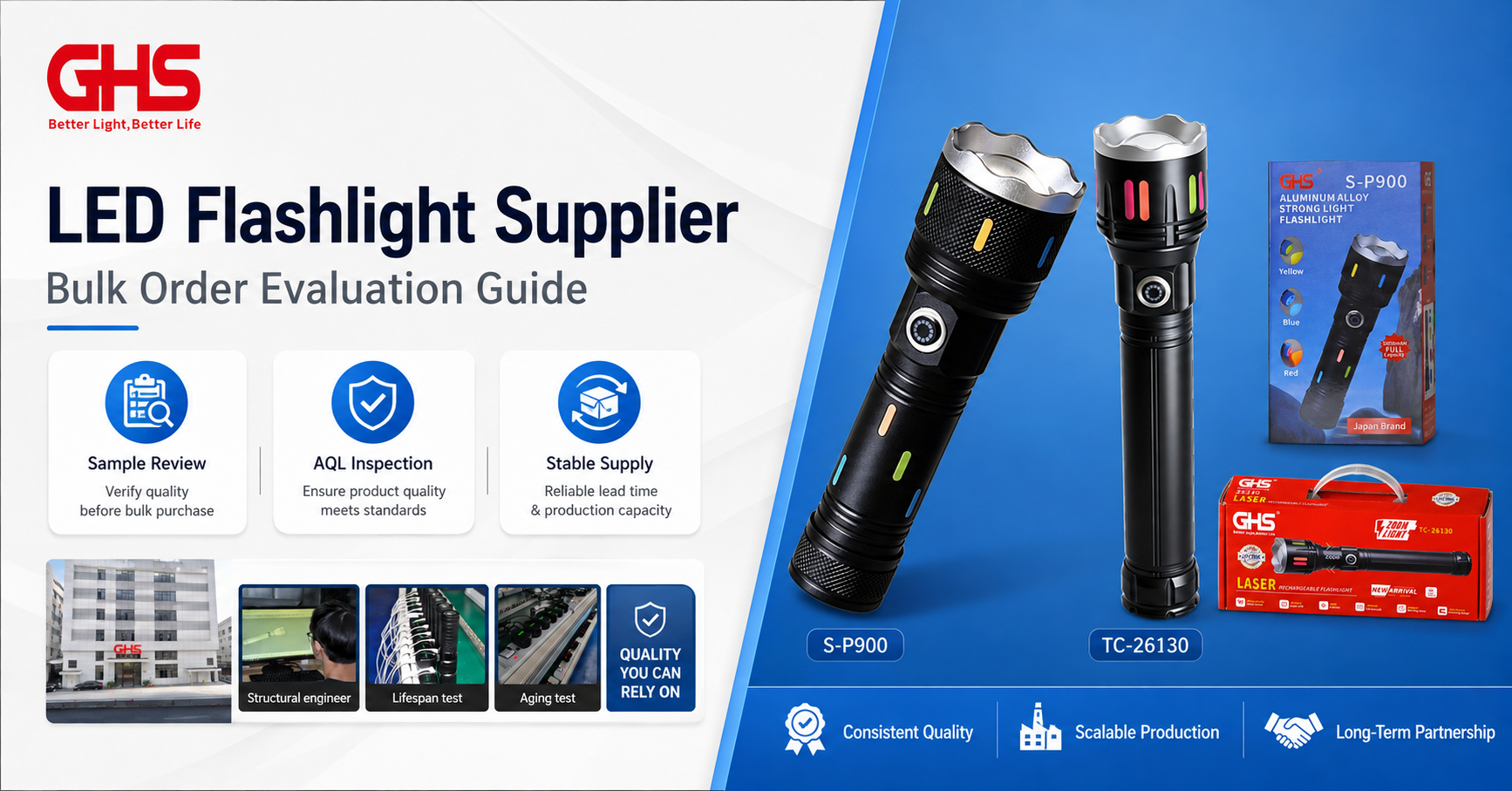
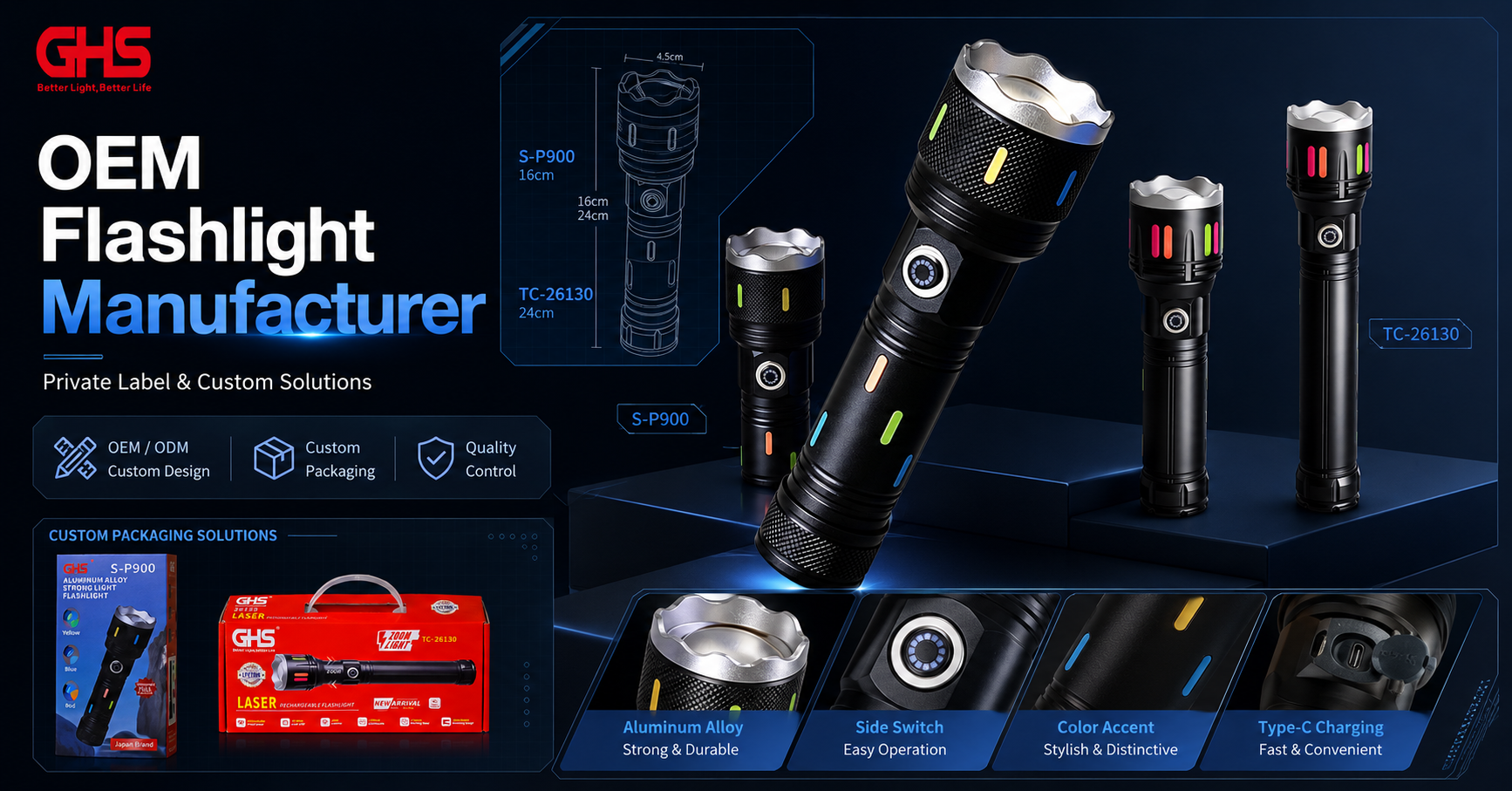
GHS currently lists multiple flashlight products on its website, including the TC-26130, TC-18130, TC-12130 and S-P900 rechargeable flashlight models.
The current product structure also includes flashlight categories such as Basic flashlight, High-intensity flashlight and New flashlight.
For buyers evaluating GHS as a potential flashlight manufacturer in China, the website product range can be used as an initial product-selection reference.
Before ordering, confirm the exact requirements for the selected model, including:
- Product specification
- Battery
- Charging
- Runtime
- Available customization
- MOQ
- Packaging
- Lead time
- Testing
- Documentation
This keeps the commercial discussion based on a confirmed project rather than assumptions.
Questions to Ask a China Flashlight Manufacturer
Before placing an order, ask:
- Are you the direct manufacturer of this model?
- Is this model currently in regular production?
- Which components are critical to the specification?
- Which battery is used?
- How is lumen output measured?
- How is runtime tested?
- What incoming inspections are performed?
- What functional tests are performed?
- Can we approve a final sample?
- How are component substitutions handled?
- Which OEM options are available?
- What determines MOQ?
- What determines the quoted price?
- How long does sampling take?
- How long does production take?
- Which documents are available?
- Can a third-party inspection be arranged?
- How are quality problems handled?
- How are repeat-order specifications controlled?
- Who will be responsible for technical and commercial communication?
FAQ About Flashlight Manufacturers in China
Why do B2B buyers source flashlights from China?
China has a broad manufacturing supply chain for electronic and portable-lighting products. However, buyers should evaluate individual manufacturers based on actual product fit, quality control, components and commercial requirements rather than relying on country of origin alone.
How do I find a reliable flashlight manufacturer in China?
Start with a detailed RFQ, shortlist suppliers with relevant product experience, evaluate their manufacturing and QC processes, test samples and compare quotations using equivalent specifications.
How can I tell if a supplier is a factory or trading company?
Ask about production processes, factory location, assembly, testing and component control. Factory visits, video audits and third-party verification can provide additional evidence.
What should I include in a flashlight RFQ?
Include product type, application, quantity, lumen requirement, runtime, battery, charging, housing, waterproof requirement, logo, packaging, target market and required documentation.
Should I always choose the lowest-priced China flashlight factory?
No. Compare components, specifications, QC, consistency, documentation and service together with price. A lower unit cost can create a higher total cost if defects or delays increase.
How should I compare samples from different flashlight manufacturers?
Use the same test criteria for every sample, including appearance, light modes, charging, runtime, battery, switches, packaging and relevant application-specific requirements.
What is a good MOQ for flashlight sourcing?
There is no universal MOQ. It depends on the model, customization, battery, packaging, components and production setup.
Do rechargeable flashlights need UN 38.3 documentation?
Lithium cells and batteries used in transport are subject to applicable UN transport-testing requirements. Buyers should confirm the exact battery configuration and relevant documentation with the supplier and logistics provider.
How important is flashlight factory quality control?
Quality control is critical because flashlight performance depends on multiple components and assembly steps. Buyers should examine incoming, in-process, functional and final inspection rather than relying only on final visual inspection.
How can I maintain quality on repeat flashlight orders?
Use an approved sample, written specifications and controlled critical components. Require communication and approval before important components are substituted.