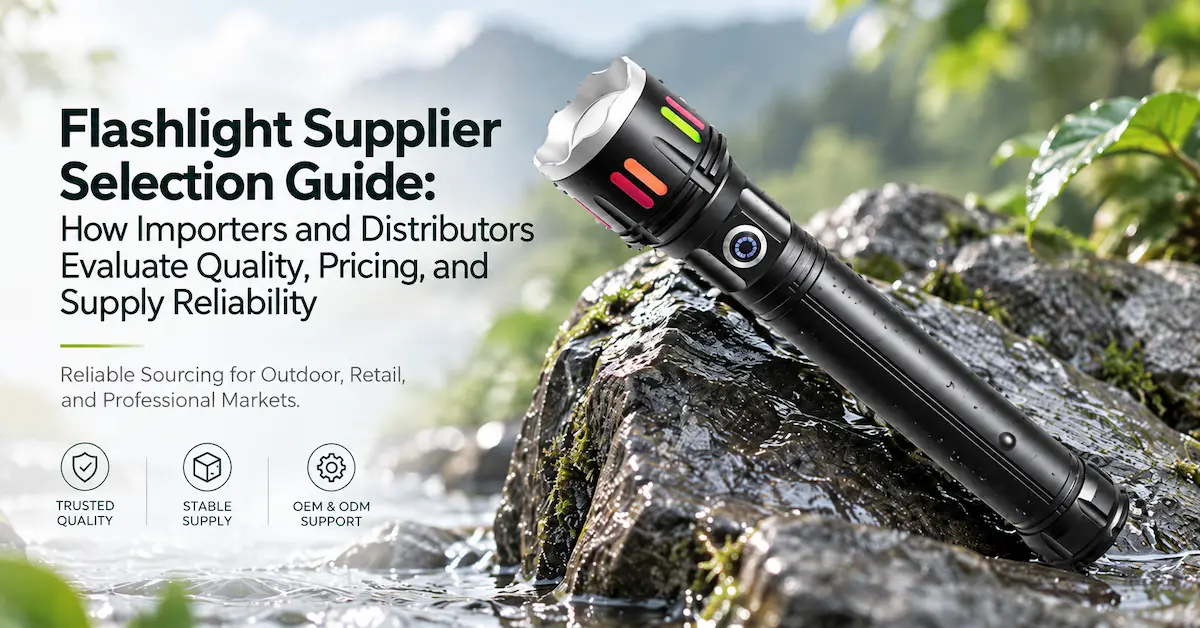

What Should B2B Buyers Expect From a Flashlight Manufacturer?
A professional flashlight manufacturer should provide more than an attractive catalog and a competitive quotation. For distributors, importers, wholesalers, outdoor brands, hardware channels and private-label programs, the real requirement is a supplier that can convert an approved product specification into consistent mass production and then reproduce that specification during repeat orders. Product design, LED and driver selection, battery configuration, housing construction, optics, charging, assembly, testing, packaging, quality control and change management all contribute to the final commercial result. GHS describes Guangdong Guanghuishi Electrical Appliances Co., Ltd. as a lighting enterprise integrating R&D, manufacturing and sales, established in 2009, with its headquarters and production base in Zhaoqing. Buyers can first review the company's manufacturing and R&D background and then compare it with the current flashlight product range.
For B2B sourcing, the key question is not simply whether a supplier can produce a flashlight. The more useful question is whether the supplier can repeatedly deliver the exact product the buyer approved: the same agreed battery configuration, lighting functions, housing, finish, logo, accessories, packaging and inspection requirements. That distinction becomes especially important when a flashlight moves from an initial trial order to a long-term retail or distribution program.
Who Should Work Directly With a Flashlight Factory—and Who May Not Need To?
Direct factory sourcing is most useful for importers that need repeat production, distributors building stable product lines, private-label brands requiring logo and packaging control, outdoor-equipment companies looking for differentiated products, industrial suppliers that need defined performance requirements, and buyers whose annual volume justifies closer control over specification and production. Companies developing their own brand should also review the site's OEM flashlight manufacturing guide, while volume buyers can compare the commercial issues discussed in the wholesale flashlight supplier guide.
Direct factory cooperation is not automatically the best purchasing model for every buyer. A company that requires very small quantities of many unrelated product categories, immediate stock from multiple brands, or one-time consumer purchases may benefit more from a wholesaler or sourcing company. The correct supplier structure depends on whether the buyer's priority is customization, specification control, inventory flexibility, mixed sourcing or repeat manufacturing. This is why supplier qualification should begin with the buyer's sales model rather than with the assumption that one sourcing model is always superior.
Start With the Application Before Selecting a Flashlight Product
One of the most common mistakes in flashlight sourcing is asking suppliers for “the brightest rechargeable model” without defining where the product will be used. A flashlight intended for outdoor retail may need a different balance of runtime, charging convenience, beam behavior and weather resistance from one positioned for security, inspection, emergency response or general hardware channels. Buyers should therefore define the application, user group, target price segment, distribution channel, expected runtime, lighting modes, charging method, battery requirements, housing expectations, environmental conditions and packaging before shortlisting products.
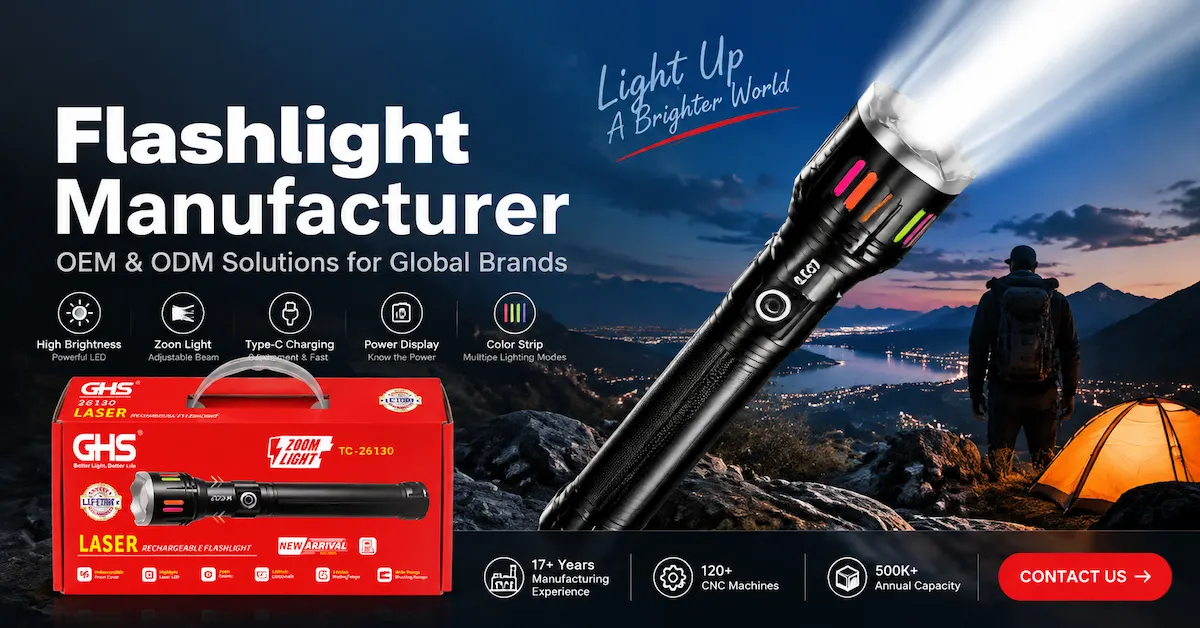
The existing GHS range gives buyers several starting points. The TC-26130 rechargeable multi-color LED flashlight, TC-18130 rechargeable multi-color LED flashlight, TC-12130 rechargeable multi-color LED flashlight and S-P900 rechargeable zoom LED flashlight are current product platforms that buyers can review before deciding whether a standard model, OEM configuration or deeper product-development project is required.
Build a Controlled RFQ Before Comparing Suppliers
A quotation has little value when different suppliers are quoting different specifications. Before comparing any flashlight manufacturer, create one RFQ that defines the same requirements for every candidate. This allows purchasing teams to compare equivalent products instead of comparing only headline prices. The RFQ should also separate confirmed requirements from optional preferences so the supplier understands which items are mandatory and which can be optimized during product selection.
| RFQ Area | What the Buyer Should Define | Why It Matters |
|---|---|---|
| Final application | Outdoor, retail, industrial, security, emergency or general use | Determines product priorities |
| Target market | Country, region and sales channel | Influences product positioning and documents |
| Product type | Basic, rechargeable, high-output, zoom or specialty | Narrows platform selection |
| Light requirement | Output target, beam preference and modes | Prevents misleading brightness comparisons |
| Runtime | Required operating time and test condition | Connects battery capacity with usable output |
| Battery | Type, configuration and replacement requirement | Affects performance and logistics |
| Charging | Type-C or other required system | Affects electronics and user experience |
| Housing | Material, dimensions, finish and weight expectations | Influences durability and cost |
| Environment | Water, dust, impact and operating conditions | Determines structural requirements |
| Branding | Logo, color, labels and manuals | Defines OEM scope |
| Packaging | Standard or private-label packaging | Affects MOQ, cost and launch readiness |
| Quantity | Sample, trial order and annual forecast | Supports production planning |
| Documentation | Product, battery and market requirements | Reduces export risk |
| Inspection | Functional, appearance and packaging checks | Defines acceptance criteria |
A clear RFQ also reduces development revisions later. When the approved configuration changes, the buyer and supplier can identify whether the modification affects price, sample approval, packaging, tooling, battery documentation or production time.
Evaluate the Complete Lighting System, Not Just the Lumen Number
For B2B buyers, lumen output should be treated as one part of the lighting system rather than the sole measure of quality. Actual performance depends on the interaction of the LED, driver, battery, optical system, reflector or lens, housing and thermal path. A product can produce a strong initial output but still behave differently after extended operation because temperature and battery voltage affect the system. Buyers sourcing performance-oriented models can study GHS's high power flashlight buying guide for a deeper discussion of output, beam and thermal performance.
Before sample approval, buyers should define what they actually need to verify: beam shape, useful throw, flood coverage, lighting-mode sequence, sustained performance, runtime, charging behavior and heat management. A reliable sourcing decision should be based on the intended application rather than on the largest number printed on packaging. For rechargeable projects, the rechargeable flashlight manufacturer guide provides a more focused framework for evaluating battery, charging and runtime.
Which Components Should Buyers Control?
Two flashlights that look almost identical externally can perform differently because their internal components are different. Critical items can include the LED, driver, PCB, battery, charging circuit, switch, lens or reflector, seals, housing parts and thermal interfaces. Buyers do not necessarily need to dictate every component brand, but they should understand which components influence the performance characteristics that matter to the project.
The most important issue for repeat orders is controlled substitution. Component changes may occasionally be necessary because of supply availability, but buyers should define which changes require notification or approval. For example, an uncontrolled battery change can affect runtime or charging behavior, while a change in LED or driver can influence output, color, regulation or thermal behavior. The strongest repeat-order control is therefore not simply “same appearance”; it is an approved product definition that connects the sample to written specifications and critical components.
How Manufacturing Capability Affects Repeat-Order Consistency
Factory equipment is useful only when it supports repeatable production. The GHS homepage currently publishes a factory floor area of 1,300 m², annual capacity of 500K units, 120+ CNC machines and 17+ years of manufacturing experience. Its About Us page also describes standardized manufacturing processes, modern factory management and integrated product-development capabilities. These figures describe company-level capability and should not be treated as an automatic capacity commitment for a specific order, so buyers should still confirm order-specific production schedules and available capacity.
When evaluating production capability, ask how requirements move through the factory: how incoming components are checked, how assembly instructions are controlled, how product functions are tested, how cosmetic requirements are inspected and how packaging is verified. A strong flashlight manufacturer should be able to explain how the approved sample becomes the production reference and how deviations are detected before shipment. Buyers that want a broader factory-sourcing checklist can also review the existing China flashlight manufacturer B2B sourcing guide.
Quality Control Should Use Measurable Acceptance Criteria
“Good quality” and “strict QC” are not sufficient purchasing requirements. A buyer should define what will actually be checked and what constitutes an acceptable result. Depending on the model, inspection may cover power-on function, lighting modes, charging, switches, beam behavior, product appearance, surface finish, logo position, accessories, labels, packaging, carton quantity and selected performance checks. The GHS homepage states ISO 9001:2015 quality-management positioning and 100% pre-shipment inspection, while the site also presents multiple standards and certification references under its global-standards section. Buyers should confirm which documents apply to the exact company, model, configuration and target market before relying on any certification claim.
For private-label projects, approval should include the complete retail configuration rather than only the flashlight itself. A product can pass functional inspection and still create commercial problems if the logo, manual, box artwork, barcode, accessory set or carton marking is wrong. Quality control should therefore connect product function with retail readiness.
Why the Approved Sample Needs a Written Specification
A sample is one of the most useful tools in supplier qualification because it allows the buyer to evaluate the actual product. However, a physical sample alone cannot show every internal characteristic. Battery type, driver configuration, LED specification and internal electronics may not be identifiable from appearance. For repeat programs, buyers should therefore create an approval record that links the sample to a written specification, packaging version and critical-component requirements.
A practical approval record can include model number, revision, product dimensions, housing finish, light modes, battery configuration, charging system, accessories, logo, packaging, sample date and approval status. If an updated sample is produced, assign a new revision rather than referring to both versions as “the approved sample.” This simple discipline helps prevent misunderstandings when the first bulk order is produced several weeks later or when a repeat order is placed months after the original project.
Compare Existing Product Platforms Before Starting a New ODM Project
Full ODM development is not necessary for every project. An existing product platform can often provide the housing, electronics and basic functional architecture, while the buyer customizes branding, packaging or selected features. Deeper ODM work becomes more relevant when the project requires structural changes, new functions, new electronics or a differentiated product concept. GHS states that its OEM/ODM capability extends from concept development toward branded finished products, while its published R&D positioning covers optics, thermal management and user experience.
| GHS Product Platform | Published Product Positioning | Useful Evaluation Direction | Confirm Before Ordering |
|---|---|---|---|
| TC-26130 | Rechargeable multi-color LED flashlight | Multifunction rechargeable product evaluation | Battery, runtime, exact modes, charging, accessories, OEM scope |
| TC-18130 | Rechargeable multi-color LED flashlight | Alternative rechargeable platform | Complete specification, packaging, MOQ and customization |
| TC-12130 | Rechargeable multi-color LED flashlight | Product-line comparison and private-label evaluation | Battery, output, functions, documents and lead time |
| S-P900 | Rechargeable zoom LED flashlight | Adjustable-beam product evaluation | Zoom behavior, runtime, charging, housing and customization |
The correct approach is to decide how much customization creates real commercial value. A distributor launching a new regional range may only need logo and packaging changes, while a brand seeking differentiation may require engineering support.Buyers planning deeper development can review the site's custom flashlight manufacturer guide before preparing the project brief.
How Should Buyers Evaluate MOQ and Lead Time?
MOQ is not simply a number decided by the factory. It may be influenced by the standard product quantity, custom housing color, logo process, battery purchasing requirements, printed packaging, accessories, electronic modifications and production setup. Buyers should therefore ask what specifically drives the MOQ for each customized element. A standard flashlight with factory packaging may have very different commercial requirements from the same model with a custom color, branded box and revised accessory set.
Lead time should also be separated into stages: requirement confirmation, sample preparation, buyer approval, component preparation, packaging preparation, production, testing, inspection and shipment preparation. This allows the purchasing team to understand whether a delay comes from engineering, artwork approval, components or mass production. Distributors with seasonal programs should plan replenishment before inventory becomes critical rather than treating every order as a new project.
Compare Total Sourcing Cost, Not Just Unit Price
Price comparisons become meaningful only after the specifications match. A lower quotation may reflect a different battery, LED, driver, housing weight, packaging configuration, accessories or inspection scope. For this reason, the purchasing sequence should be specification first, commercial terms second and price comparison third. Buyers sourcing larger volumes can use the LED flashlight supplier bulk-order guide to compare product specification, MOQ, packaging, inspection and repeat-order requirements.
The total commercial risk also includes defective goods, rework, delayed launches, inconsistent repeat orders, obsolete packaging, freight, inspection and inventory. A slightly lower unit price does not necessarily create a lower cost per sellable unit. This is particularly important for distributors that need a product to remain stable across several shipments.
How OEM and ODM Support Should Be Evaluated
OEM normally begins from an established product platform and can include agreed changes such as branding, packaging, manuals, accessories, product color or selected configuration adjustments. ODM requires deeper engineering participation when the buyer needs product development or structural changes. Before choosing an OEM flashlight manufacturer, clarify exactly which elements are standard, customizable or subject to new development. The site's private-label OEM guide provides a detailed checklist for brand owners.
Customization should always be connected to the commercial objective. A private-label distributor may gain more from reliable packaging, consistent branding and predictable replenishment than from unnecessary structural changes. A differentiated professional product may justify deeper engineering work. In both cases, agree on sample approval, specification control, cost responsibility, tooling where applicable, documentation, MOQ and mass-production release before placing the bulk order.
What Should You Send for a Project Evaluation?
A serious inquiry should include the target application, market, sales channel, required product type, expected output or beam requirement, runtime expectations, battery and charging preference, dimensions if restricted, environmental conditions, logo requirement, packaging, accessories, estimated initial quantity, annual forecast and required documentation. If the buyer already has an existing product, photos, drawings or performance targets can provide additional context.
Sending this information allows the sales and technical teams to recommend an appropriate existing platform or determine whether further customization is needed. Buyers can first review the full GHS product catalog and then submit project requirements through Contact Us for model selection, OEM discussion or quotation.
Frequently Asked Questions
1. How do I choose a flashlight manufacturer for bulk orders?
Begin by defining the product and commercial requirements, then compare suppliers using the same RFQ. Evaluate product specialization, sample quality, critical components, production control, QC, OEM capability, MOQ, lead time, documents and repeat-order management. Do not select a supplier from unit price alone because different quotations may represent different product configurations.
2. What should I test before approving a flashlight sample?
Check the product against a written requirement, including housing, dimensions, finish, switch operation, lighting modes, beam behavior, charging, battery configuration, runtime where required, accessories, logo and packaging. The final approved sample should be clearly identified so production is not based on an earlier revision.
3. What is the difference between OEM and ODM flashlight manufacturing?
OEM usually starts from an existing platform and applies agreed branding or configuration changes. ODM involves greater product-development responsibility, which can include new functions, electronics, structural changes or product concepts. The exact boundary should be defined in the project rather than assumed from the terms alone.
4. What determines flashlight MOQ?
MOQ can be influenced by the flashlight model, custom housing color, logo method, battery, printed packaging, accessories, electronic changes and manufacturing setup. Ask the supplier to separate the MOQ for the standard product, logo, color and packaging so you understand which element is driving the minimum quantity.
5. How should I compare two flashlight quotations?
Confirm that both quotations use equivalent LEDs, batteries, drivers, housing construction, charging systems, accessories, packaging, inspection scope and trade terms. If the specifications are different, the unit prices are not directly comparable. Request clarification before choosing the lower quotation.
6. Why is battery control important for rechargeable flashlights?
The battery affects runtime, charging behavior, product performance and transport planning. Buyers should confirm the approved battery configuration and relevant shipping documentation before production. Battery substitution should be controlled because a visually identical finished flashlight can perform differently with another cell or battery configuration.
7. Should I use a golden sample for repeat orders?
Yes, a physical reference sample is useful for appearance, finish, logo, assembly, accessories and packaging. However, it should be supported by written specifications and critical-component information because internal electronics and battery differences may not be visible externally.
8. How can I reduce quality risk before shipment?
Define acceptance criteria before production, approve the final product and packaging, agree on inspection requirements and make sure the supplier understands how nonconforming goods will be handled. For larger or higher-risk orders, buyers can also arrange third-party inspection using clearly defined criteria.
9. Can an existing GHS flashlight be used for a private-label project?
Existing GHS products such as TC-26130, TC-18130, TC-12130 and S-P900 can provide starting platforms for project evaluation. The available branding, packaging or technical modifications should be confirmed for the selected model rather than assuming every customization is available across the entire range.
10. What information should I provide when requesting a quotation?
Provide the intended application, destination market, target channel, product type, required performance, battery and charging preferences, environmental requirement, branding, packaging, accessories, quantity forecast and required documentation. A complete inquiry allows the supplier to recommend and price a more relevant configuration.
Conclusion
Selecting a flashlight manufacturer is ultimately a product-control and supply-chain decision, not simply a search for the brightest model or lowest quotation. B2B buyers should begin with the application, define a controlled RFQ, evaluate the complete lighting and battery system, review components and manufacturing processes, approve samples against written specifications, establish measurable quality criteria, compare MOQ and lead-time drivers, and create a repeat-order control process before committing to volume production. GHS currently combines a range of rechargeable and portable flashlight platforms with published R&D, manufacturing, OEM/ODM and quality-management capabilities; buyers can review the company's About Us, compare the current product catalog, explore further sourcing topics in the GHS Blog, and submit a defined sourcing or private-label requirement through Contact Us. A successful supplier relationship is built not only on an acceptable first sample, but on the ability to reproduce the approved product, packaging and commercial requirements consistently across mass production and future orders.