
How Should B2B Buyers Choose a Reliable Flashlight Supplier?
Selecting the right flashlight supplier is an important decision for importers, distributors, retailers, outdoor brands, and professional equipment companies. Unlike consumer purchases, B2B flashlight sourcing requires buyers to consider not only product appearance and price, but also manufacturing capability, quality consistency, supply stability, customization options, and long-term cooperation potential.
A qualified supplier should help buyers reduce sourcing risks by providing stable products, clear specifications, reliable production processes, and effective communication throughout the purchasing cycle. Whether the buyer is developing a private-label flashlight line, expanding an outdoor product portfolio, or sourcing professional lighting equipment, supplier evaluation directly affects market performance and customer satisfaction.
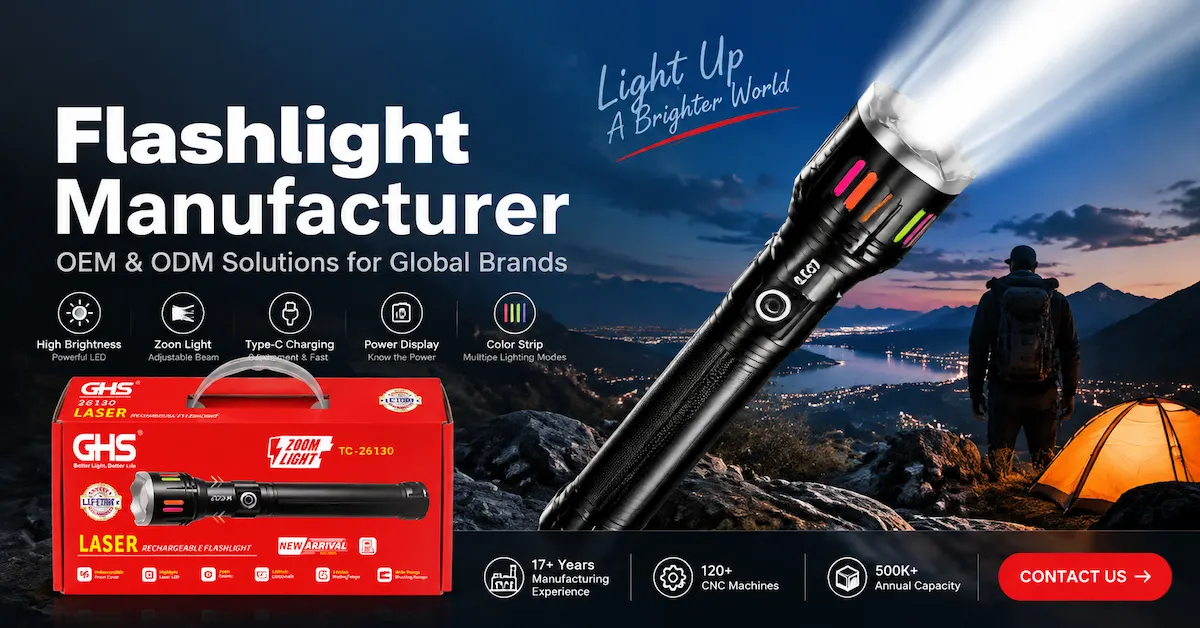
GHS focuses on flashlight product development, manufacturing, and supply solutions for global customers. Buyers can review the company's About Us page to understand its manufacturing background, R&D capability, and production experience.
For professional buyers, the best flashlight supplier is not always the one offering the lowest quotation. A reliable supplier should be able to explain product specifications, manufacturing processes, quality control methods, and how the approved product will remain consistent during future orders.
Who Should Work With a Professional Flashlight Supplier?
Different buyers have different sourcing requirements. Understanding the purchasing purpose helps companies choose the right supplier type and cooperation model.
Importers and Distributors
Importers and distributors usually need:
- Stable product availability
- Competitive wholesale pricing
- Consistent product quality
- Reliable delivery schedules
- Multiple product options
For these buyers, supplier reliability is closely connected with inventory management and customer satisfaction. A supplier that can support repeated orders with consistent specifications helps distributors maintain stable product lines.
GHS provides different flashlight product platforms through its product catalog, allowing distributors to compare different models according to market positioning and application requirements.
Outdoor Equipment Brands
Outdoor brands often require flashlights that match specific market positioning.
Typical requirements include:
- Rechargeable flashlight solutions
- Durable housing
- Waterproof performance
- Outdoor-friendly design
- Custom packaging
- Brand customization
These companies often look beyond standard products and require cooperation with suppliers that understand product development and private-label requirements.
Industrial and Professional Equipment Suppliers
Industrial customers usually focus on reliability rather than only appearance.
Common requirements include:
- Long operating time
- Strong durability
- Stable output
- Easy maintenance
- Professional-grade construction
Applications may include:
- Equipment inspection
- Factory maintenance
- Emergency response
- Workshop operations
Security and Tactical Equipment Buyers
Security-related buyers often evaluate:
- High output capability
- Impact resistance
- Waterproof structure
- Reliable switching systems
- Tactical usability
Companies interested in professional applications can also review the tactical flashlight supplier guide.
Flashlight Supplier vs Trading Company: What Should Buyers Understand?
When sourcing from overseas markets, buyers often compare direct suppliers with trading companies. Both models can work depending on purchasing goals, but their advantages are different.
| Evaluation Factor | Flashlight Supplier / Manufacturer | Trading Company |
|---|---|---|
| Product knowledge | Direct technical understanding | Depends on factory communication |
| Customization ability | Usually stronger OEM/ODM support | Depends on supplier resources |
| Production communication | Direct connection | Indirect communication |
| Specification control | Easier for long-term projects | May require additional coordination |
| Product development | Suitable for customized products | Usually focused on existing products |
| Repeat order management | More direct control | Depends on supplier network |
For companies building long-term product lines, cooperation with a direct flashlight supplier can improve communication efficiency and product consistency.
However, buyers should evaluate suppliers based on actual capability rather than assuming every factory automatically provides better service. The important factors are technical communication, quality management, production control, and the ability to support the buyer's business model.
Define Application Requirements Before Selecting a Flashlight Supplier
One common sourcing mistake is selecting a flashlight only based on brightness or price. A suitable product depends on the final application environment, user requirements, and market positioning.
Before contacting suppliers, buyers should define:
Target Application
Examples include:
- Outdoor camping
- Hiking
- Emergency response
- Security
- Industrial inspection
- Retail sales
- Professional equipment
Product Performance Requirements
Important factors include:
- Light output
- Beam distance
- Runtime
- Charging method
- Battery type
- Waterproof requirement
- Product size
- Weight
- Operating environment
A professional flashlight supplier should recommend products based on the actual application instead of simply offering the highest-output model.
GHS provides different product categories including rechargeable flashlights, high-performance flashlights, and multifunction flashlight platforms. Buyers can review available products through the flashlight product page.
What Information Should Buyers Prepare Before Requesting a Quote?
A detailed request allows suppliers to provide more accurate recommendations and pricing.
| Information | Buyer Should Provide |
|---|---|
| Application | Outdoor, industrial, security, retail |
| Target market | Country and sales channel |
| Product type | Rechargeable, tactical, high-power |
| Quantity | Sample quantity and bulk order forecast |
| Branding | Logo, packaging, private label |
| Battery | Required battery configuration |
| Charging | Type-C or other charging requirements |
| Environment | Waterproof, dustproof, impact requirements |
| Certification | Required market standards |
| Delivery | Target schedule |
A clear RFQ helps suppliers understand whether the buyer needs a standard product, OEM customization, or a deeper ODM development project.
How to Evaluate Flashlight Supplier Manufacturing Capability?
Manufacturing capability is one of the most important evaluation factors for B2B buyers because it directly affects product consistency and delivery reliability.
A professional supplier should have capabilities covering:
- Product design
- Component sourcing
- Machining
- Assembly
- Testing
- Quality inspection
- Packaging
- Production management
GHS states that its manufacturing operation includes:
- 1,300㎡ factory area
- 120+ CNC machines
- 500K annual production capacity
- 17+ years manufacturing experience
These figures represent company-level capability. Buyers should still confirm the available production schedule and capacity allocation for specific models and order quantities.
A capable flashlight supplier should be able to explain not only factory size but also how production quality is controlled from incoming materials to finished products.
What Technical Factors Should Buyers Compare Between Flashlight Suppliers?
A flashlight is not simply a combination of an LED and a battery. The final performance depends on how multiple components work together, including the light source, driver system, battery, optical structure, housing design, thermal management, and charging system.
When evaluating a flashlight supplier, buyers should compare the technical details that directly influence product reliability and user experience.
| Technical Factor | Why It Matters |
|---|---|
| LED source | Determines brightness, efficiency, and lighting performance |
| Driver system | Controls output stability and power management |
| Battery system | Influences runtime, charging safety, and product life |
| Optical design | Affects beam distance, focus, and coverage |
| Housing material | Determines durability and heat dissipation |
| Charging system | Influences user convenience and product positioning |
| Waterproof structure | Supports outdoor and professional applications |
| Switch design | Affects operation reliability |
A professional supplier should understand how these elements affect the final product rather than only focusing on visible appearance.
For example, a high-output flashlight designed for outdoor exploration requires different priorities compared with a compact retail flashlight. A professional buyer should evaluate the complete product system instead of selecting products based only on one specification.
How Materials and Manufacturing Processes Affect Flashlight Quality
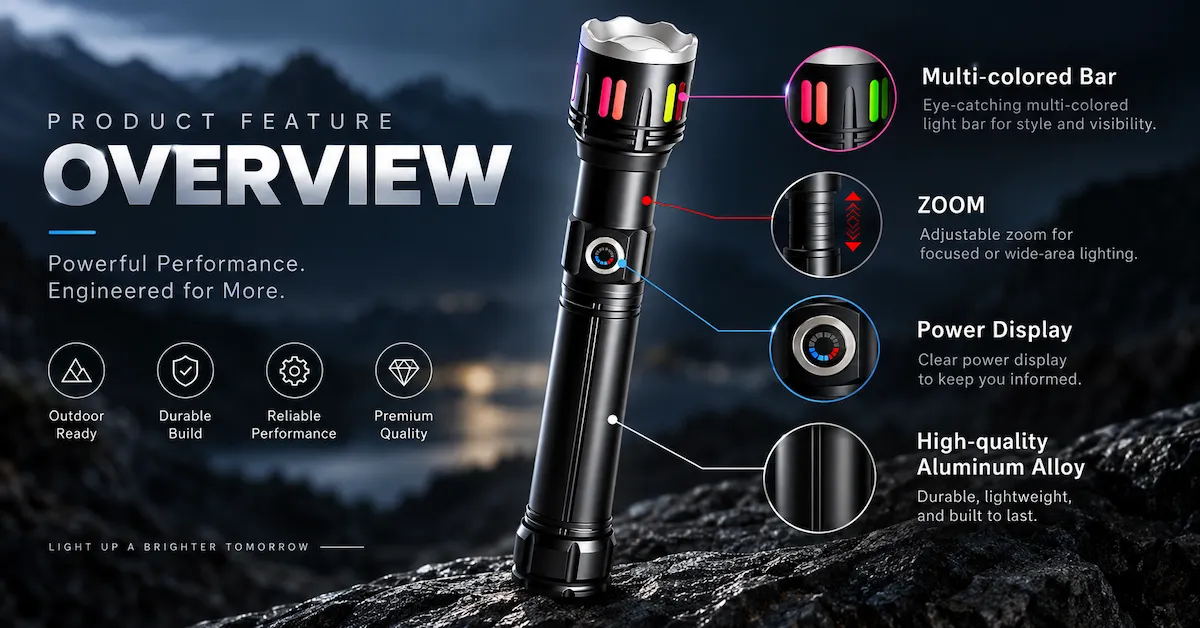
The materials and manufacturing processes used by a flashlight supplier directly influence durability, appearance, and production consistency.
Aluminum Alloy Housing
Many professional flashlights use aluminum alloy housings because they provide:
- Lightweight structure
- Strong mechanical durability
- Better heat dissipation
- Premium product appearance
For outdoor and professional applications, housing quality affects impact resistance and long-term reliability.
Precision Machining and Surface Treatment
Manufacturing processes influence:
- Product dimensions
- Assembly accuracy
- Surface finish
- Appearance consistency
GHS highlights CNC machining capability as part of its manufacturing strength, supporting the production of precision flashlight components and customized product requirements.
Optical Components
Optical design affects how users experience the flashlight.
Important elements include:
- Lens structure
- Reflector design
- Beam pattern
- Light distribution
Different applications require different beam characteristics. Outdoor users may need long-distance illumination, while industrial users may require wider working-area coverage.
Electronic Components
Rechargeable flashlights also depend on:
- LED driver
- Battery management system
- Charging circuit
- Power indicator
- Protection functions
A reliable flashlight supplier should be able to explain how these components are controlled during production.
How Should Buyers Evaluate Flashlight Quality Control?
Quality control is one of the most important factors when selecting a supplier for bulk purchasing.
A professional quality system should include multiple inspection stages.
Incoming Material Inspection
Before production starts, suppliers should verify:
- Components
- Housing materials
- Electronic parts
- Batteries
- Accessories
This helps prevent defective materials from entering production.
Production Process Inspection
During assembly, suppliers should control:
- Component installation
- Electrical connections
- Charging functions
- Mechanical assembly
- Appearance quality
Final Product Inspection
Before shipment, products should be checked for:
- Lighting function
- Switch operation
- Charging performance
- Appearance defects
- Packaging accuracy
GHS presents quality management and pre-shipment inspection capabilities on its company information pages. Buyers should still confirm the inspection standards and acceptance criteria for their specific product and order.
Companies evaluating waterproof products can also review the waterproof flashlight supplier guide.
Why Certification and Compliance Matter for Flashlight Buyers
Certification requirements depend on the target market, product category, and application environment.
For B2B buyers, compliance evaluation helps reduce risks related to:
- Market entry
- Customer requirements
- Product liability
- Import procedures
When reviewing supplier certifications, buyers should confirm:
- Applicable product model
- Certification scope
- Testing documents
- Destination market requirements
A supplier's general certification capability is useful, but buyers should always verify whether specific documents apply to the exact flashlight configuration they are purchasing.
How to Compare Different Flashlight Product Platforms
Before developing a completely new product, buyers should evaluate whether an existing flashlight platform already meets their requirements.
Starting from an existing platform can reduce:
- Development time
- Sample costs
- Engineering risk
- Production uncertainty
GHS provides several flashlight platforms that can serve different market requirements.
| Product Platform | Features | Suitable Buyers |
|---|---|---|
| TC-26130 Rechargeable Flashlight | Multifunction design, rechargeable platform | Outdoor brands, premium retailers |
| TC-18130 Rechargeable Flashlight | Rechargeable multi-function design | Distributors and general lighting buyers |
| TC-12130 Rechargeable Flashlight | Portable rechargeable solution | Private-label projects |
| S-P900 Rechargeable Zoom Flashlight | Zoom function and adjustable beam | Outdoor and professional users |
| Waterproof Flashlight | Outdoor protection-focused design | Emergency and outdoor applications |
Buyers can review these platforms through the GHS flashlight products page before deciding between standard purchasing, OEM customization, or ODM development.
How OEM and Private Label Support Create Business Value
Many distributors and brands do not only need standard flashlights. They need products that match their own market positioning.
A capable flashlight supplier may support:
OEM Services
Including:
- Logo customization
- Packaging design
- Product color options
- Accessories
- Branding materials
OEM is suitable for buyers who already have a clear product direction but need manufacturing support.
ODM Services
ODM projects may involve:
- Product concept development
- Structural optimization
- Feature modification
- Prototype development
- Engineering support
ODM is more suitable for brands that want differentiated products instead of simply adding a logo.
GHS provides OEM/ODM cooperation for customers requiring customized flashlight solutions. Buyers planning private-label projects can review the OEM flashlight manufacturer guide.
How Should Buyers Evaluate Flashlight Supplier Pricing?
Price is important, but it should not be the only decision factor.
Different quotations may vary because of:
- LED quality
- Battery configuration
- Housing material
- Packaging requirements
- Accessories
- Testing standards
- Customization level
A professional comparison should evaluate total sourcing value.
| Cost Factor | Buyer Consideration |
|---|---|
| Unit price | Basic purchasing cost |
| MOQ | Inventory commitment |
| Packaging | Retail presentation requirements |
| Customization | Branding and market differentiation |
| Quality control | Risk reduction |
| Lead time | Inventory planning |
| Repeat order stability | Long-term business value |
The lowest quotation does not always represent the lowest total cost. Product inconsistency, delayed shipments, and quality issues can create additional expenses after purchase.
How MOQ and Lead Time Affect Flashlight Sourcing Decisions
MOQ and lead time are important factors for importers and distributors.
MOQ may depend on:
- Standard product availability
- Product customization
- Packaging requirements
- Logo printing
- Accessories
- Product modifications
Lead time usually includes:
- Product confirmation
- Sample preparation
- Sample approval
- Material preparation
- Production
- Quality inspection
- Shipment preparation
A reliable flashlight supplier should clearly explain each stage and identify possible factors that may affect delivery.
For buyers managing seasonal inventory, early communication and demand forecasting are essential for maintaining stable supply.
How to Build Long-Term Cooperation With a Flashlight Supplier
Successful supplier relationships require more than completing the first order.
Long-term cooperation depends on:
Clear Product Specifications
Both parties should confirm:
- Product model
- Technical requirements
- Packaging details
- Quality standards
Approved Sample Management
The approved sample should become the production reference.
Continuous Communication
Regular communication helps manage:
- New product requirements
- Market feedback
- Production changes
- Future improvements
Supply Planning
Forecast information allows suppliers to prepare:
- Materials
- Production schedules
- Inventory plans
A reliable supplier becomes a long-term manufacturing partner rather than only a product source.
Frequently Asked Questions
1. How do I choose a reliable flashlight supplier?
Evaluate product experience, manufacturing capability, quality control, customization support, communication efficiency, and repeat-order reliability. A supplier should demonstrate how it controls product quality from development to shipment.
2. What is the difference between a flashlight supplier and a flashlight manufacturer?
A supplier may provide products through different sourcing channels, while a manufacturer directly controls production. For OEM, customization, and long-term programs, direct manufacturing cooperation may provide better technical communication.
3. Can a flashlight supplier provide private-label products?
Many professional suppliers support private-label projects including logo, packaging, accessories, and selected product customization. Buyers should confirm available customization options for each model.
4. What information should I provide when requesting a flashlight quotation?
Provide application, market, quantity, product type, battery requirements, charging method, customization needs, packaging requirements, and required certifications.
5. How can I compare flashlight suppliers from China?
Compare factory capability, product consistency, technical support, quality systems, customization ability, pricing structure, and communication efficiency.
6. What affects flashlight wholesale pricing?
Pricing depends on product configuration, materials, components, order quantity, customization requirements, packaging, and testing requirements.
7. How long does flashlight production take?
Production time depends on whether the order is standard, customized, or a new development project. Buyers should confirm each production stage with the supplier.
8. Should I choose OEM or ODM flashlight services?
OEM is suitable when buyers need branding and manufacturing support based on an existing product. ODM is suitable when buyers require deeper product development or customized solutions.
9. How can I reduce flashlight sourcing risks?
Use clear specifications, approve samples, define quality requirements, confirm production processes, and maintain communication throughout the project.
10. What makes a flashlight supplier suitable for long-term cooperation?
Stable quality, reliable delivery, technical capability, customization support, and consistent repeat production are key factors for long-term cooperation.
Conclusion
Choosing the right flashlight supplier requires a complete evaluation of product capability, manufacturing strength, quality control, customization support, pricing structure, and supply reliability. For importers, distributors, outdoor brands, and professional buyers, the best supplier is one that can provide consistent products, clear communication, and reliable support throughout the entire sourcing process.
GHS provides flashlight product solutions supported by manufacturing experience, product development capability, OEM/ODM services, and professional sourcing support. Buyers can explore the available flashlight product range, learn more about the company's manufacturing capabilities through About Us, and submit sourcing requirements through Contact Us for product evaluation and cooperation discussion.