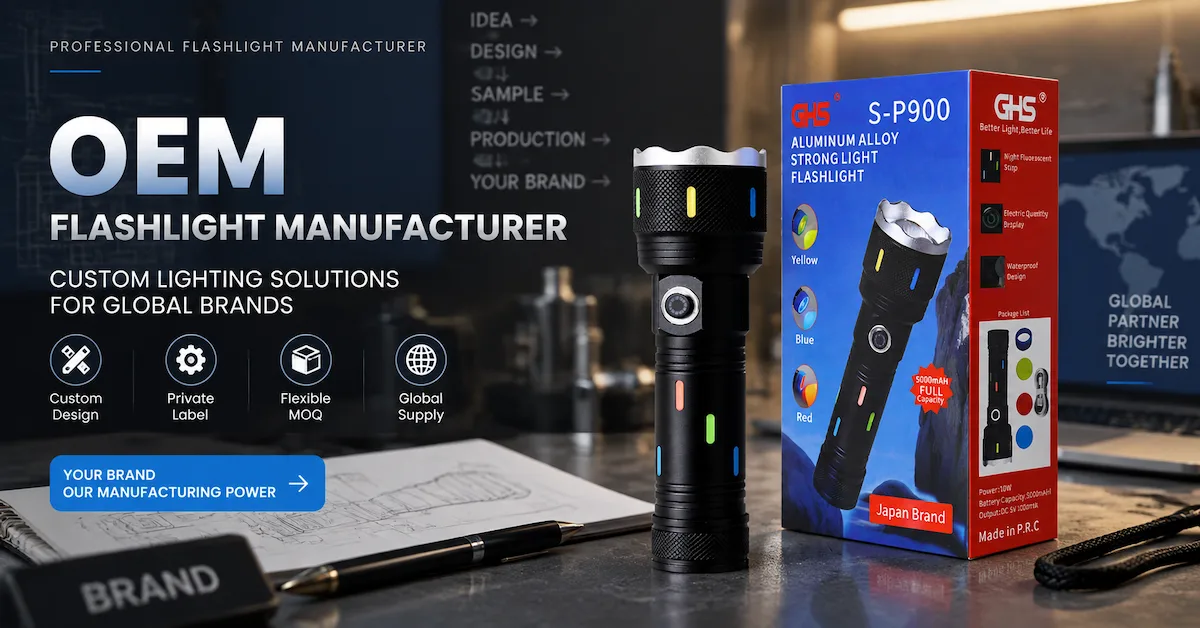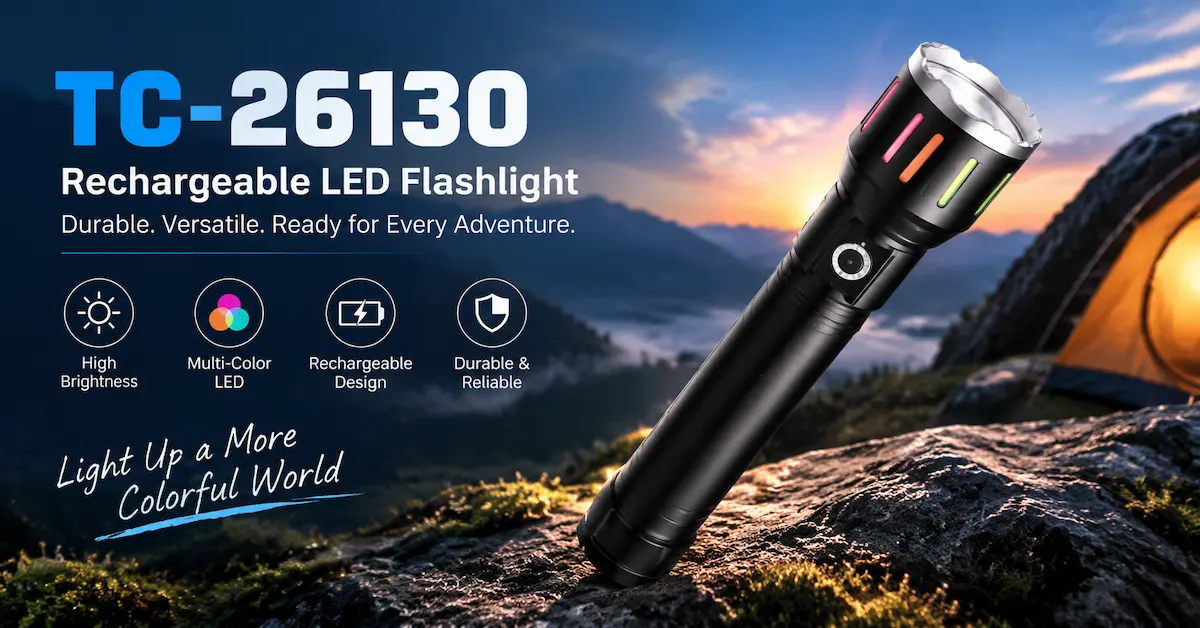

What Is an ODM Flashlight Manufacturer and Why Do Brands Need One?
An ODM flashlight manufacturer is a manufacturing partner that helps brands develop customized flashlight products from concepts, requirements, or market opportunities into finished products. Unlike traditional suppliers that only provide existing catalog models, an ODM partner participates more deeply in product definition, engineering development, prototype creation, testing, and production preparation.
For brands entering the flashlight market, ODM manufacturing provides a way to create differentiated products without establishing their own factory, engineering team, production line, and quality-control system.
A professional ODM project may involve:
- Market requirement analysis
- Product concept evaluation
- Industrial design improvement
- Structural development
- Optical system selection
- Battery and charging solution design
- Prototype manufacturing
- Performance testing
- Production preparation
- Mass production management
The value of ODM is not simply customization. The real value is the ability to transform an idea into a manufacturable product.
For example, a brand may have a market idea:
“Create a rechargeable outdoor flashlight for premium camping customers.”
An experienced ODM flashlight manufacturer can help answer:
- What structure is practical for production?
- Which LED and optical system fit the application?
- Which battery solution provides the right balance between runtime and size?
- Which materials provide durability without unnecessary cost?
- How can the product maintain consistent quality during mass production?
GHS provides flashlight product development and manufacturing capabilities for global buyers. Companies evaluating ODM cooperation can review the company's About Us page to understand its manufacturing background and production capability.
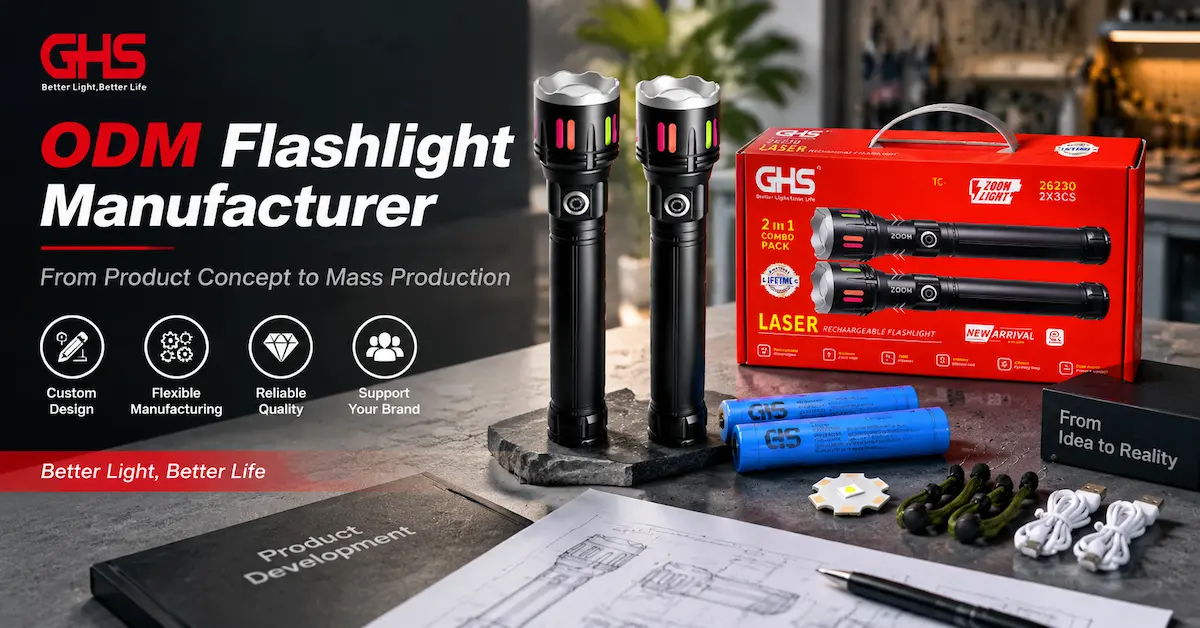
Who Should Work With an ODM Flashlight Manufacturer?
ODM flashlight manufacturing is mainly suitable for companies that want to build unique products rather than simply purchase standard flashlights.
Different buyer groups have different development goals.
Outdoor Brands Developing New Lighting Products
Outdoor brands often need products that match their own customer groups.
Typical applications include:
- Camping equipment
- Hiking products
- Adventure gear
- Emergency tools
- Survival equipment
These brands may require:
- Unique product appearance
- Rechargeable systems
- Waterproof structures
- Multiple lighting functions
- Lightweight designs
- Brand-specific packaging
A standard flashlight from the market may not provide enough differentiation.
ODM allows brands to create products that match:
- Their customer expectations
- Their price positioning
- Their product portfolio
- Their brand identity
Professional Equipment Companies
Professional users often require flashlights designed around specific working environments.
Applications include:
- Security equipment
- Industrial inspection
- Emergency response
- Professional tools
These buyers may need:
- Specific operating functions
- Reliable performance
- Long service life
- Special mounting solutions
- Customized accessories
An ODM partner can help translate these practical requirements into a production-ready product.
Retail and Private Label Brands
Retail brands often use ODM development to create products that compete through differentiation.
Possible ODM requirements include:
- New housing design
- Customized functions
- Brand-specific packaging
- Special accessories
- Unique product positioning
For these companies, the goal is not only selling a flashlight but building a recognizable product category.
Buyers interested in brand customization can also review the OEM flashlight manufacturer guide to understand how OEM and ODM cooperation differ.
ODM Flashlight Manufacturer vs OEM Flashlight Manufacturer: What Is the Difference?
OEM and ODM are often mentioned together, but they represent different cooperation models.
| Category | OEM Flashlight Manufacturer | ODM Flashlight Manufacturer |
|---|---|---|
| Starting point | Existing product platform | Product idea or market requirement |
| Design involvement | Limited | Higher engineering involvement |
| Customization level | Medium | High |
| Development responsibility | Mainly production | Product development + production |
| Suitable buyers | Brands needing customization | Brands creating new products |
| Development cycle | Usually shorter | Usually longer |
OEM Model
OEM usually means:
- The buyer has a product direction
- Manufacturer produces based on requirements
- Branding and packaging may be customized
Examples:
- Adding company logo
- Changing packaging
- Selecting accessories
- Adjusting product configuration
ODM Model
ODM involves deeper cooperation:
- Product concept
- Engineering design
- Structure optimization
- Functional development
- Prototype testing
ODM is suitable when a brand wants a product that is different from existing market options.
The right choice depends on the buyer's goals.
A company launching a simple branded flashlight may only need OEM.
A company creating a new professional lighting product may need ODM.
What Information Should Brands Prepare Before Starting an ODM Flashlight Project?
A successful ODM project starts with a clear product brief.
The buyer should define:
| Requirement | Examples |
|---|---|
| Target market | Outdoor, security, industrial, retail |
| Customer group | Professionals, consumers, distributors |
| Product positioning | Premium, professional, affordable |
| Application | Camping, inspection, emergency |
| Lighting requirements | Beam, brightness, modes |
| Battery | Rechargeable or replaceable |
| Charging | Type-C or other system |
| Size | Compact or high-performance |
| Materials | Aluminum alloy or other structures |
| Quantity | Prototype and production forecast |
The clearer the requirement, the easier it is for an ODM flashlight manufacturer to evaluate:
- Development difficulty
- Production feasibility
- Estimated investment
- Manufacturing approach
Why Product Strategy Should Come Before Engineering Development
Many unsuccessful product projects focus on technical specifications before understanding market needs.
A flashlight should first answer:
Who Is the Product Designed For?
Examples:
- Outdoor enthusiasts
- Security professionals
- Industrial workers
- Retail consumers
What Problem Does It Solve?
Examples:
- Need longer runtime
- Need better portability
- Need stronger durability
- Need easier charging
Why Will Customers Choose It?
Possible advantages:
- Better design
- Better user experience
- More suitable functions
- Stronger brand identity
An experienced ODM flashlight manufacturer can provide better technical suggestions when the commercial purpose is clear.
ODM Flashlight Product Development Begins With Platform Evaluation
Not every ODM project requires a completely new flashlight design.
A practical development strategy is often:
Existing platform → Engineering optimization → Brand customization → Mass production
This approach can reduce:
- Development time
- Engineering risks
- Prototype cycles
- Production uncertainty
GHS provides multiple flashlight product platforms that brands can evaluate before deciding the required level of customization. Buyers can review the GHS flashlight product range to understand available product directions.
For some projects, a proven platform with customized branding may be the most efficient solution.
For others, deeper ODM development may create stronger market differentiation.
How Does an ODM Flashlight Manufacturer Develop a Product From Concept to Production?
A professional ODM flashlight manufacturer should have a complete product development system that connects market ideas with engineering execution. The purpose of ODM is not only to create a customized flashlight but also to ensure that the final product can be manufactured consistently, tested properly, and supplied reliably.
A typical ODM flashlight development process includes:
- Market requirement analysis
- Product concept evaluation
- Technical feasibility review
- Design optimization
- Prototype development
- Performance validation
- Sample approval
- Production preparation
- Mass production
- Quality control and delivery
Each stage influences the final product quality, development cost, and launch schedule.
For brands, the biggest advantage of working with an experienced ODM partner is reducing the gap between an idea and a production-ready product.
Step 1: Product Concept and Requirement Analysis
Before engineering starts, the ODM flashlight manufacturer needs to understand the product purpose.
A complete requirement analysis should include:
Market Positioning
The manufacturer needs to understand:
- Target customers
- Price positioning
- Sales channels
- Competitive environment
For example:
A premium outdoor brand may require:
- Premium materials
- Better packaging
- Stronger brand identity
A professional equipment supplier may focus on:
- Reliability
- Long runtime
- Practical operation
Application Environment
The application determines many technical decisions.
Important factors include:
- Indoor or outdoor use
- Weather exposure
- Working temperature
- Operating duration
- Storage environment
- User handling conditions
A flashlight designed for camping does not necessarily require the same structure as a flashlight designed for industrial inspection.
Functional Requirements
Brands should define:
- Lighting modes
- Beam requirements
- Charging method
- Battery preference
- Size requirements
- Accessories
The clearer the requirement, the more accurately the manufacturer can develop the product.
Step 2: ODM Flashlight Design and Engineering Evaluation
After requirements are confirmed, the manufacturer evaluates whether the concept can become a practical product.
Engineering evaluation usually considers:
- Structure feasibility
- Material selection
- Component availability
- Manufacturing difficulty
- Expected production cost
- Testing requirements
A professional ODM flashlight manufacturer should provide suggestions when a design creates unnecessary production difficulties.
For example:
A thinner housing may improve appearance but reduce heat dissipation.
A larger battery may improve runtime but increase product weight.
More functions may increase market appeal but also increase production complexity.
ODM development requires balancing customer expectations with manufacturing reality.
LED and Optical System Development for ODM Flashlights
Lighting performance is one of the most important parts of flashlight development.
An ODM project may evaluate:
- LED selection
- Beam structure
- Reflector design
- Lens configuration
- Light distribution
- Output stability
Different applications require different optical solutions.
Outdoor Product Development
Outdoor brands may require:
- Long-distance illumination
- Adjustable beam
- Multiple modes
- Portable structure
Professional Equipment Development
Professional users may need:
- Stable output
- Reliable operation
- Practical beam coverage
Retail Product Development
Retail products may focus on:
- User-friendly operation
- Attractive appearance
- Easy charging
- Market differentiation
The best optical design is not always the brightest solution. It should match the intended user scenario.
Battery and Charging System Development
For rechargeable flashlight products, battery design is a major ODM consideration.
The battery system affects:
- Runtime
- Product size
- Weight
- Charging experience
- Product cost
ODM development may include:
- Battery capacity selection
- Battery placement
- Charging interface
- Power indicator
- Charging protection
Buyers should define:
- Expected runtime
- Charging frequency
- Operating environment
- Transportation requirements
An uncontrolled battery change during production may influence:
- Performance
- Safety
- Documentation
- Customer experience
Brands developing rechargeable flashlight products can also review the rechargeable flashlight manufacturer guide.
Material Selection for ODM Flashlight Manufacturing
Material selection affects:
- Durability
- Appearance
- Heat management
- Production cost
Aluminum Alloy Housing
Aluminum alloy is commonly used for professional flashlights because it provides:
- Lightweight construction
- Mechanical strength
- Heat dissipation
- Premium appearance
Surface Treatment
Surface finishing affects:
- Product appearance
- Scratch resistance
- Brand perception
Structural Components
ODM projects may customize:
- Body shape
- Grip structure
- Switch position
- Charging port location
- Mounting accessories
A manufacturer must consider whether the design can be produced efficiently at scale.
CNC Machining Capability in ODM Flashlight Production
Precision manufacturing is important when developing customized flashlight structures.
CNC machining helps control:
- Dimension accuracy
- Thread quality
- Component fitting
- Surface consistency
This is especially important for products requiring:
- Custom housing
- Professional durability
- Precise assembly
A manufacturer with machining capability can better support customized structures while maintaining production consistency.
GHS states that its manufacturing capability includes CNC machining resources and flashlight production experience. Buyers can review the company's About Us page for additional manufacturing information.
Prototype Development and Testing Process
Prototype development is a critical stage in ODM projects.
The purpose of prototypes is to verify whether:
- The design works
- The product meets requirements
- Manufacturing is practical
- Performance matches expectations
Prototype Evaluation Areas
Functional Testing
Includes:
- Lighting modes
- Charging function
- Battery performance
- Switch operation
Structural Testing
Includes:
- Assembly quality
- Housing strength
- Product dimensions
- Component fitting
User Experience Testing
Includes:
- Grip comfort
- Operation convenience
- Product handling
A professional ODM flashlight manufacturer should use prototype feedback to improve the product before mass production.
ODM Flashlight Manufacturing Process
After sample approval, the product moves into production preparation.
A controlled manufacturing process includes:
Material Preparation
Including:
- Housing materials
- LEDs
- Electronic components
- Batteries
- Accessories
Component Processing
Including:
- CNC machining
- Surface treatment
- Component preparation
Assembly
Including:
- Electronic installation
- LED installation
- Battery integration
- Housing assembly
Testing
Including:
- Functional inspection
- Charging inspection
- Lighting performance
- Appearance inspection
Packaging
Including:
- Product labels
- Manuals
- Accessories
- Retail packaging
The production process should follow the approved sample and specification.
Quality Control in ODM Flashlight Manufacturing
Quality control is one of the most important factors when selecting an ODM flashlight manufacturer.
A strong QC system should cover the complete production cycle.
| QC Stage | Inspection Focus |
|---|---|
| Material inspection | Verify incoming components |
| Assembly inspection | Confirm production accuracy |
| Functional testing | Check flashlight operation |
| Performance testing | Verify lighting requirements |
| Appearance inspection | Check product finish |
| Final inspection | Confirm shipment quality |
| Packaging inspection | Verify labels and accessories |
For ODM products, quality control should also verify:
- Approved design version
- Product specifications
- Component consistency
- Packaging requirements
- Customer requirements
Why Sample Approval Is Critical in ODM Projects
The approved sample becomes the reference point for mass production.
Before approval, buyers should confirm:
- Product appearance
- Functions
- Materials
- Accessories
- Packaging
- Performance requirements
The approved version should include:
- Product revision number
- Specification details
- Testing records
- Customer approval status
This prevents problems where:
- Prototype differs from production
- Repeat orders use different components
- Packaging changes without approval
A professional ODM process connects:
Concept → Prototype → Approved Sample → Mass Production
How ODM Flashlight Manufacturers Support Product Improvement
ODM cooperation does not end after the first production order.
Long-term product improvement may involve:
- Customer feedback analysis
- Function updates
- Material optimization
- Cost improvement
- New product extensions
Brands can continue developing their product portfolio through cooperation with the same manufacturing partner.
For example:
A brand may start with one rechargeable flashlight model and later develop:
- Different sizes
- Different battery versions
- Different applications
- Different market versions
This creates a scalable product strategy.
How Should Buyers Evaluate an ODM Flashlight Manufacturer’s Factory Capability?
Selecting an ODM flashlight manufacturer requires evaluating whether the supplier can support the entire product lifecycle, from early concept development to stable mass production.
A capable ODM partner should not only manufacture products but also provide support in:
- Product engineering
- Manufacturing feasibility analysis
- Prototype development
- Production preparation
- Quality management
- Supply coordination
For brands, the most important question is:
Can this manufacturer transform my product concept into a stable commercial product?
A professional ODM factory should have the ability to manage:
| Capability Area | Buyer Evaluation Focus |
|---|---|
| Product development | Can the supplier provide engineering suggestions? |
| Manufacturing | Can the product be produced consistently? |
| Customization | Can requirements be implemented efficiently? |
| Testing | Are product functions properly validated? |
| Quality control | Are standards clearly defined? |
| Supply management | Can future orders be supported? |
GHS provides flashlight manufacturing and product development capabilities for global customers. Buyers can review the company's manufacturing background when evaluating ODM cooperation.
Why Production Capacity Matters in ODM Flashlight Projects
A product idea may be successful during prototype development but fail commercially if the manufacturer cannot support stable production.
Production capability affects:
- Delivery reliability
- Product consistency
- Inventory planning
- Market launch schedules
When evaluating an ODM flashlight manufacturer, buyers should ask:
- What production resources are available?
- How are production schedules managed?
- How are repeat orders controlled?
- How are quality issues handled?
GHS publishes manufacturing information including:
- Factory capabilities
- CNC machining resources
- Product development experience
However, buyers should always confirm the production availability and timeline for their specific project because capacity depends on product type, order quantity, and production schedule.
How MOQ Influences ODM Flashlight Development
Minimum order quantity is an important consideration for brands developing customized products.
ODM MOQ can be affected by:
| Factor | Impact |
|---|---|
| Product complexity | New designs may require higher commitment |
| Materials | Special materials may require purchasing quantities |
| Components | Customized parts affect supply planning |
| Packaging | Printed packaging usually requires minimum quantities |
| Production setup | New processes may require additional preparation |
Brands should understand that MOQ is not only a factory requirement.
It is often connected with:
- Material purchasing
- Production efficiency
- Customization level
- Supply chain management
A practical ODM strategy is to start with the level of customization that creates real market value while maintaining reasonable production requirements.
ODM Flashlight Manufacturing Cost Analysis
The cost of ODM development depends on the complexity of the project.
A complete cost evaluation may include:
Product Development Cost
Includes:
- Engineering evaluation
- Design adjustments
- Prototype development
Component Cost
Includes:
- LED system
- Battery
- Driver
- Charging components
- Housing materials
Manufacturing Cost
Includes:
- Machining
- Assembly
- Testing
- Packaging
Customization Cost
Includes:
- Branding
- Special appearance
- Accessories
- Packaging
Testing and Compliance Cost
Includes:
- Product validation
- Market requirements
- Documentation
A professional ODM flashlight manufacturer should explain cost structure clearly so brands understand which features increase investment and which features create commercial value.
How Can Brands Reduce ODM Development Risks?
ODM development involves investment, so risk management is important.
1. Define Requirements Before Development
Clear requirements reduce:
- Miscommunication
- Repeated revisions
- Unnecessary costs
Brands should define:
- Product purpose
- Target users
- Required functions
- Expected quantity
- Market positioning
2. Use Existing Technology Where Appropriate
Not every product requires completely new technology.
Using proven:
- LED solutions
- Battery systems
- Housing structures
- Production methods
can reduce development risks.
3. Validate Samples Carefully
Before mass production, buyers should verify:
- Performance
- Appearance
- Functions
- Packaging
- User experience
4. Control Product Changes
After approval, changes should be managed carefully.
Any change involving:
- Components
- Structure
- Battery
- Electronics
- Packaging
should be reviewed before implementation.
ODM Flashlight Manufacturer Selection Checklist
Before choosing an ODM partner, buyers can evaluate:
| Category | Questions |
|---|---|
| Experience | Does the company understand flashlight development? |
| Product capability | Can it support the required application? |
| Engineering | Can it provide technical solutions? |
| Manufacturing | Can it support stable production? |
| Quality | Are inspection standards defined? |
| Communication | Can issues be solved quickly? |
| Customization | Can requirements be implemented? |
| Supply | Can future orders be supported? |
A suitable ODM partner should match both technical requirements and business goals.
ODM Flashlight Product Platform Comparison
Before developing a completely new flashlight, brands can evaluate existing platforms as development references.
| Product Platform | Features | Suitable ODM Direction |
|---|---|---|
| TC-26130 Rechargeable Flashlight | Rechargeable multifunction design | Private label and branded flashlight projects |
| S-P900 Rechargeable Zoom Flashlight | Zoom beam and professional lighting design | Outdoor and professional applications |
| TC-18130 Rechargeable Flashlight | Rechargeable product platform | Distributor product development |
| TC-12130 Rechargeable Flashlight | Portable multifunction solution | Retail and brand customization |
Brands can review the complete GHS flashlight product range to identify suitable starting platforms.
An experienced ODM flashlight manufacturer can help determine whether the project requires:
- Existing platform customization
- Product modification
- Full product development
How AI Search and GEO Content Help Buyers Find ODM Flashlight Manufacturers
Modern buyers increasingly use AI tools to research suppliers before contacting companies.
They may ask:
- Which ODM flashlight manufacturer supports private label?
- How do I develop a custom flashlight product?
- What should I check before selecting a flashlight factory?
- What is the difference between OEM and ODM flashlight manufacturing?
For AI systems to understand a manufacturer correctly, content should clearly explain:
- Company capability
- Product expertise
- Customer types
- Development process
- Technical knowledge
- Manufacturing experience
A strong GEO-friendly supplier page should answer buyer questions directly rather than only presenting product images.
This type of structured information helps search systems understand the relationship between:
ODM flashlight manufacturer → product development → customization → manufacturing → buyer requirements
Frequently Asked Questions
1. What does an ODM flashlight manufacturer do?
An ODM flashlight manufacturer helps brands develop customized flashlight products from concepts or requirements. Services may include product design support, engineering evaluation, prototype development, testing, and mass production.
2. What is the difference between OEM and ODM flashlight manufacturing?
OEM usually focuses on customizing existing products, while ODM involves deeper product development where the manufacturer participates in design, engineering, and solution development.
3. Why should brands choose ODM instead of buying standard flashlights?
ODM allows brands to create differentiated products with customized functions, appearance, packaging, and market positioning instead of competing only with standard products.
4. How long does ODM flashlight development take?
The timeline depends on product complexity, customization requirements, prototype revisions, testing needs, and production preparation.
5. What information should brands provide for an ODM flashlight project?
Brands should provide application, target customers, required functions, product positioning, battery requirements, lighting requirements, quantity forecast, packaging needs, and launch schedule.
6. Can ODM manufacturers customize flashlight appearance?
Yes. Depending on project requirements, customization may include housing design, colors, branding, packaging, accessories, and selected product features.
7. How can brands control ODM flashlight quality?
Brands should approve samples, define specifications, establish inspection requirements, and control changes after production approval.
8. Does ODM always require a completely new flashlight design?
No. Many ODM projects begin from existing platforms and improve or customize selected features to reduce development risk.
9. What affects ODM flashlight project cost?
Cost depends on engineering work, materials, components, customization level, testing requirements, packaging, and production quantity.
10. How do I choose a reliable ODM flashlight manufacturer?
Evaluate manufacturing experience, engineering capability, product knowledge, quality systems, communication ability, customization support, and long-term supply capability.
How to Start an ODM Flashlight Manufacturing Project
Brands can begin an ODM project through the following steps:
Step 1: Define the Product Concept
Clarify:
- Target market
- Customer needs
- Application
- Product positioning
Step 2: Discuss Technical Requirements
Confirm:
- Product functions
- Materials
- Battery system
- Lighting requirements
- Structure
Step 3: Evaluate Development Options
Decide whether to use:
- Existing platform
- Customized platform
- New product development
Step 4: Develop and Approve Prototype
Evaluate:
- Product performance
- Design
- Manufacturing quality
Step 5: Start Mass Production
After approval:
- Production begins
- Quality control is applied
- Products are prepared for market launch
Brands interested in ODM flashlight development can review the GHS product portfolio and submit project requirements through Contact Us.
Conclusion
Choosing the right ODM flashlight manufacturer is a strategic decision for brands that want to create differentiated lighting products and build long-term market value.
A successful ODM project requires more than a product idea. It requires a manufacturing partner that understands customer requirements, provides engineering support, controls production quality, manages technical details, and maintains consistency from prototype to mass production.
Brands should evaluate:
- Product development capability
- Manufacturing resources
- Technical expertise
- Quality management
- Customization flexibility
- Long-term supply reliability
GHS provides flashlight manufacturing solutions for global buyers, supporting product platforms, customization projects, and ODM cooperation. Companies developing new flashlight products can explore the GHS flashlight products, learn more about manufacturing capability through About Us, and contact the team through Contact Us with product concepts, technical requirements, and customization goals.
A professional ODM flashlight manufacturer is not only a production supplier but also a development partner that helps brands transform ideas into reliable commercial products.